Also known as: Desert bighorn sheep, California bighorn sheep, Nelson's bighorn sheep
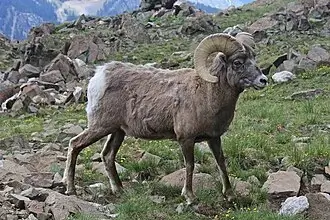
The bighorn sheep or bighorn is a species of sheep native to North America. It is named for its large horns. A pair of horns may weigh up to 14 kg (30 lb); the sheep typically weigh up to 143 kg (315 lb). Recent genetic testing indicates three distinct subspecies of Ovis canadensis, one of which is endangered: O. c. sierrae.
Life History
O. cervinaDesmarestO. montanaCuvier[5] Thebighorn sheep(Ovis canadensis)[6]orbighornis a species ofsheepnative to North America.[7]It is named for its largehorns. A pair of horns may weigh up to 14 kg (30 lb);[8]the sheep typically weigh up to 143 kg (315 lb).[9]Recent genetic testing indicates three distinct subspecies ofOvis canadensis, one of which is endangered:O. c. sierrae. Sheep originally crossed to North America over theBering Land Bridgefrom Siberia; the population in North America peaked in the millions, and the bighorn sheep entered into the mythology ofNative Americans. By 1900, the population had crashed to several thousand due to diseases introduced through Europeanlivestockand overhunting.[10] Bighorn sheep are named for the large, curvedhornsborne by the rams (males). Ewes (females) also have horns, but they are shorter and straighter.[21]They range in color from light brown to grayish or dark, chocolate brown, with a white rump and lining on the backs of all four legs. Males typically weigh 58–143 kg (128–315 lb), are 90–105 cm (35–41 in) tall at the shoulder, and 1.6–1.85 m (63–73 in) long from the nose to the tail. Females are typically 34–91 kg (75–201 lb), 75–90 cm (30–35 in) tall, and 1.28–1.58 m (50–62 in) long.[9]Male bighorn sheep have large horn cores, enlarged cornual and frontal sinuses, and internal bonysepta. These adaptations serve to protect the brain by absorbing the impact of clashes.[22]Bighorn sheep havepreorbital glandson the anterior corner of each eye, inguinal glands in the groin, and pedal glands on each foot. Secretions from these glands may support dominance behaviors.[22] Bighorns from theRocky Mountainsare relatively large, with males that occasionally exceed 230 kg (500 lb) and females that exceed 90 kg (200 lb). In contrast, Sierra Nevada bighorn males weigh up to only 90 kg (198 lb) and females to 60 kg (132 lb). Males' horns can weigh up to 14 kg (30 lb), as much as all the bones in the male's body.[8] The Rocky Mountain and Sierra Nevada bighorn sheep occupy the cooler mountainous regions of Canada and the United States. In contrast, the desert bighorn sheep subspecies are indigenous to the hotdesertecosystemsof the Southwestern United States and Mexico. Bighorn sheep inhabit alpine meadows, grassy mountain slopes, and foothill country near rugged, rocky cliffs and bluffs.[8]Since bighorn sheep cannot move through deep snow, they prefer drier slopes, where the annual snowfall is less than about 150 cm (60 in) per year.[8]A bighorn's winter range usually has lower elevations than its summer range.[23] Bighorn sheep are highly susceptible to certain diseases carried by domestic sheep, such aspsoroptic scabies[24]andpneumonia; additional mortality occurs as a result of accidents involving rock falls or falling off cliffs (a hazard of living in steep, rugged terrain). Bighorns are well adapted to climbing steep terrain, where they seek cover frompredators. Lambs are the most susceptible to predation, with potential predators includingcoyotes,bobcats,gray foxes,wolverines,jaguars,ocelots,lynxes, andgolden eagles.[25] Bighorn sheep of all ages are threatened byblack bears,grizzly bears,wolves, and especiallymountain lions, which are perhaps best equipped with the agility to prey on them in uneven, rocky habitats.[21][26][27]Fire suppressiontechniques may limit visibility through shrublands, and therefore increase cover and predation rates by mountain lions.[28]Bighorn sheep are considered good indicators of land health because the species is sensitive to many human-induced environmental problems. In addition to their aesthetic value, bighorn sheep are considered desirablegameanimals byhunters. Bighorn sheepgrazeongrassesand browseshrubs, particularly in fall and winter, and seekmineralsat naturalsalt licks.[26]Females tend to forage and walk, possibly to avoid predators and protect lambs,[29]while males tend to eat and then rest and ruminate, which lends to more effective digestion and greater increase in body size.[29]
Status, Trends & Threats
Bighorn sheep were widespread throughout the western United States, Canada, and northern Mexico two hundred years ago. The population was estimated to be 150,000 to 200,000.[46][47]Unregulated hunting, habitat destruction, overgrazing of rangelands, and diseases contracted from domestic livestock all contributed to the decline, the most drastic occurring from about 1870 through 1950.[48] In 1936, theArizona Boy Scoutsmounted a statewide campaign to save the bighorn sheep. The scouts first became interested in the sheep through the efforts of MajorFrederick Russell Burnham.[49]Burnham observed that fewer than 150 of these sheep still lived in the Arizona mountains. TheNational Wildlife Federation, theIzaak Walton League, and theNational Audubon Societyalso joined the effort.[50]On January 18, 1939, over 600,000 hectares (1,500,000 acres) of land were set aside to create theKofa National Wildlife Refugeand theCabeza Prieta National Wildlife Refuge.[50] Many state and federal agencies have actively pursued the restoration of bighorn sheep since the 1940s. However, these efforts have met with limited success, and most of the historical range of bighorns remains unoccupied.[48]Hunting for male bighorn sheep is allowed, but heavily regulated, in Canada and the United States.[1]
Hunting Season
Limited draw only. Desert zones (1-6, 8-13): Dec 5 - Feb 7. White Mountains (Zone 7): Aug 15 - Sep 27 (Period 1), Jan 2 - Feb 7 (Period 2). Specific dates vary by zone.
Frequently Asked Questions
Regulations for hunting Bighorn Sheep in California
Bighorn sheep hunting in California is extremely limited, with tags awarded through a preference point and random drawing system. A total of 13 hunt zones are available. The 2025 hunter success rate was 100%. A valid California hunting license and bighorn sheep tag are required. Tags are split between preference point holders and random draw. Nonlead ammunition is required. Desert bighorn sheep are found in the Mojave and Colorado deserts, with smaller populations in the White Mountains. Rugged terrain and limited road access characterize most hunt zones.
How many bighorn sheep tags are available in California?
Bighorn sheep tags are extremely limited, with approximately 27 tags across 13 hunt zones. Tags are allocated through a preference point and random drawing system. The 2025 hunter success rate was 100%.
What is the difference between desert and mountain bighorn sheep?
California manages desert bighorn sheep (Ovis canadensis nelsoni) in the Mojave and Colorado deserts (Zones 1-6, 8-13) and California bighorn sheep (Ovis canadensis californiana) in the White Mountains (Zone 7). Desert hunts occur Dec-Feb, while White Mountains has both summer and winter seasons.
When is Bighorn Sheep hunting season in California?
Limited draw only. Desert zones (1-6, 8-13): Dec 5 - Feb 7. White Mountains (Zone 7): Aug 15 - Sep 27 (Period 1), Jan 2 - Feb 7 (Period 2). Specific dates vary by zone.
What is the bag limit for Bighorn Sheep in California?
1 ram per tag.
What is another name for Bighorn Sheep?
Bighorn Sheep is also known as Desert bighorn sheep, California bighorn sheep, Nelson's bighorn sheep in California.
References
| State | Category | Directory | Subcategory | Content | Source |
|---|---|---|---|---|---|
| California | Hunting | Regulations | Season Dates | Limited draw only. Desert zones (1-6, 8-13): Dec 5 - Feb 7. White Mountains (Zone 7): Aug 15 - Sep 27 (Period 1), Jan 2 | Link |
| California | Hunting | Regulations | Regulations | Bighorn sheep hunting in California is extremely limited, with tags awarded through a preference point and random drawin | Link |