Also known as: Chukar partridge, Red-legged partridge
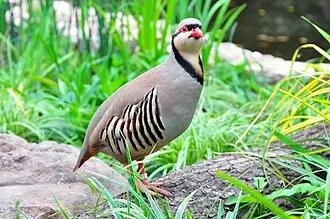
The chukar partridge, or simply chukar, is a Palearctic upland gamebird in the pheasant family Phasianidae. It has been considered to form a superspecies complex along with the rock partridge, Philby's partridge and Przevalski's partridge and treated in the past as conspecific particularly with the first. This partridge has well-marked black and white bars on the flanks and a black band running from the forehead across the eye down the head to form a necklace that encloses a white throat. Native to Asia, the species has been introduced into many other places and feral populations have established themselves in parts of North America, Malta and New Zealand. This bird can be found in parts of Middle East and temperate Asia.
Habitat & Range
Thispartridgehas its native range in Asia, includingIsrael,Jordan,Palestine,Lebanon,Syria,United Arab Emirates,Saudi Arabia,Oman,Turkey,Kurdistan,Iran,Afghanistan,Tajikistan,PakistanandIndia, along the inner ranges of the westernHimalayastoNepal, as well as southeasternmost Europe inBulgariaandGreece.[1]Further west in southeastern Europe it is replaced by therock partridge,Alectoris graeca. It barely ranges into Africa on theSinai Peninsula. The habitat in the native range is rocky open hillsides with grass or scattered scrub or cultivation. In Israel andJordanit is found at low altitudes, starting at 400 m (1,300 ft) below sea level in theDead Seaarea, whereas in the more eastern areas it is mainly found at an altitude of 2,000 to 4,000 m (6,600 to 13,100 ft) except in Pakistan, where it occurs at 600 m (2,000 ft).[2][7]They are not found in areas of high humidity or rainfall.[8] It has beenintroducedwidely as a game bird, and feral populations have become established in the United States (Rocky Mountains,Great Basin,high desert areas of California),Canada,Chile,Argentina,New ZealandandHawaii.[9]Initial introductions into the US were from the nominate populations collected from Afghanistan and Nepal.[10]The birds are hunted across the dry, rockyColumbia Basin, especially in the vicinity of theSnake Riverin Washington and Oregon.[11][12]It has also been introduced toNew South Walesin Australia but breeding populations have not persisted and are probably extinct.[13]A small population exists onRobben Islandin South Africa since it was introduced there in 1964.[14] The chukar readily interbreeds with thered-legged partridge(Alectoris rufa), and the practice of breeding and releasing captive-bred hybrids has been banned in various countries including theUnited Kingdom, as it is a threat to wild populations.[15]
Life History
A. c. chukarA. c. cypriotesA. c. dzungaricaA. c. falkiA. c. kleiniA. c. koroviakoviA. c. kurdestanicaA. c. pallescensA. c. pallidaA. c. potaniniA. c. pubescensA. c. sinaicaA. c. subpallidaA. c. werae; A. c. chukar; A. c. cypriotes; A. c. dzungarica; A. c. falki; A. c. kleini; A. c. koroviakovi; A. c. kurdestanica; A. c. pallescens; A. c. pallida; A. c. potanini; A. c. pubescens; A. c. sinaica; A. c. subpallida; A. c. werae A. c. chukar; A. c. cypriotes; A. c. dzungarica; A. c. falki; A. c. kleini; A. c. koroviakovi; A. c. kurdestanica; A. c. pallescens; A. c. pallida; A. c. potanini; A. c. pubescens; A. c. sinaica; A. c. subpallida; A. c. werae Caccabis kakelik Thechukar partridge(Alectoris chukar), or simplychukar, is aPalearcticuplandgamebirdin thepheasantfamilyPhasianidae. It has been considered to form asuperspecies complexalong with therock partridge,Philby's partridgeandPrzevalski's partridgeand treated in the past as conspecific particularly with the first. Thispartridgehas well-marked black and white bars on the flanks and a black band running from the forehead across the eye down the head to form a necklace that encloses a white throat. Native to Asia, the species has been introduced into many other places and feral populations have established themselves in parts of North America, Malta and New Zealand. This bird can be found in parts of Middle East and temperate Asia. The chukar is a rotund 32–35 cm (13–14 in) long partridge, with a light brown back, grey breast, and buff belly. The shades vary across the various populations. The face is white with a blackgorget. It hasrufous-streaked flanks, red legs and coral red bill. Sexes are similar, the female slightly smaller in size and lacking the spur.[2]The tail has 14 feathers, the third primary is the longest while the first is level with the fifth and sixth primaries.[3] It is very similar to therock partridge(Alectoris graeca) with which it has been lumped in the past[4]but is browner on the back and has a yellowish tinge to the foreneck. The sharply defined gorget distinguishes this species from thered-legged partridgewhich has the black collar breaking into dark streaks near the breast. Their song is a noisychuck-chuck-chukar-chukarfrom which the name is derived.[5]TheBarbary partridge(Alectoris barbara) has a reddish-brown rather than black collar with a grey throat and face with a chestnut crown.[6] Other common names of this bird includechukker(chukerorchukor),Indian chukarandkeklik.
Hunting Season
General: Oct 17 - Jan 31. Archery Only: Aug 15 - Sep 4. Falconry: Aug 15 - Feb 28.
Frequently Asked Questions
Regulations for hunting Chukar in California
Chukar hunting in California is popular in the Great Basin and Mojave Desert regions. Hunting is physically demanding as chukar inhabit steep, rocky terrain. Upland game bird validation is required. Nonlead ammunition is required. Chukar are not native to California but have established self-sustaining populations in arid, rocky habitats.
When is Chukar hunting season in California?
General: Oct 17 - Jan 31. Archery Only: Aug 15 - Sep 4. Falconry: Aug 15 - Feb 28.
What is the bag limit for Chukar in California?
6 per day.
What is another name for Chukar?
Chukar is also known as Chukar partridge, Red-legged partridge in California.
References
| State | Category | Directory | Subcategory | Content | Source |
|---|---|---|---|---|---|
| California | Hunting | Regulations | Season Dates | General: Oct 17 - Jan 31. Archery Only: Aug 15 - Sep 4. Falconry: Aug 15 - Feb 28. | Link |
| California | Hunting | Regulations | Regulations | Chukar hunting in California is popular in the Great Basin and Mojave Desert regions. Hunting is physically demanding as | Link |