Also known as: Wapiti, Tule elk, Roosevelt elk, Rocky Mountain elk
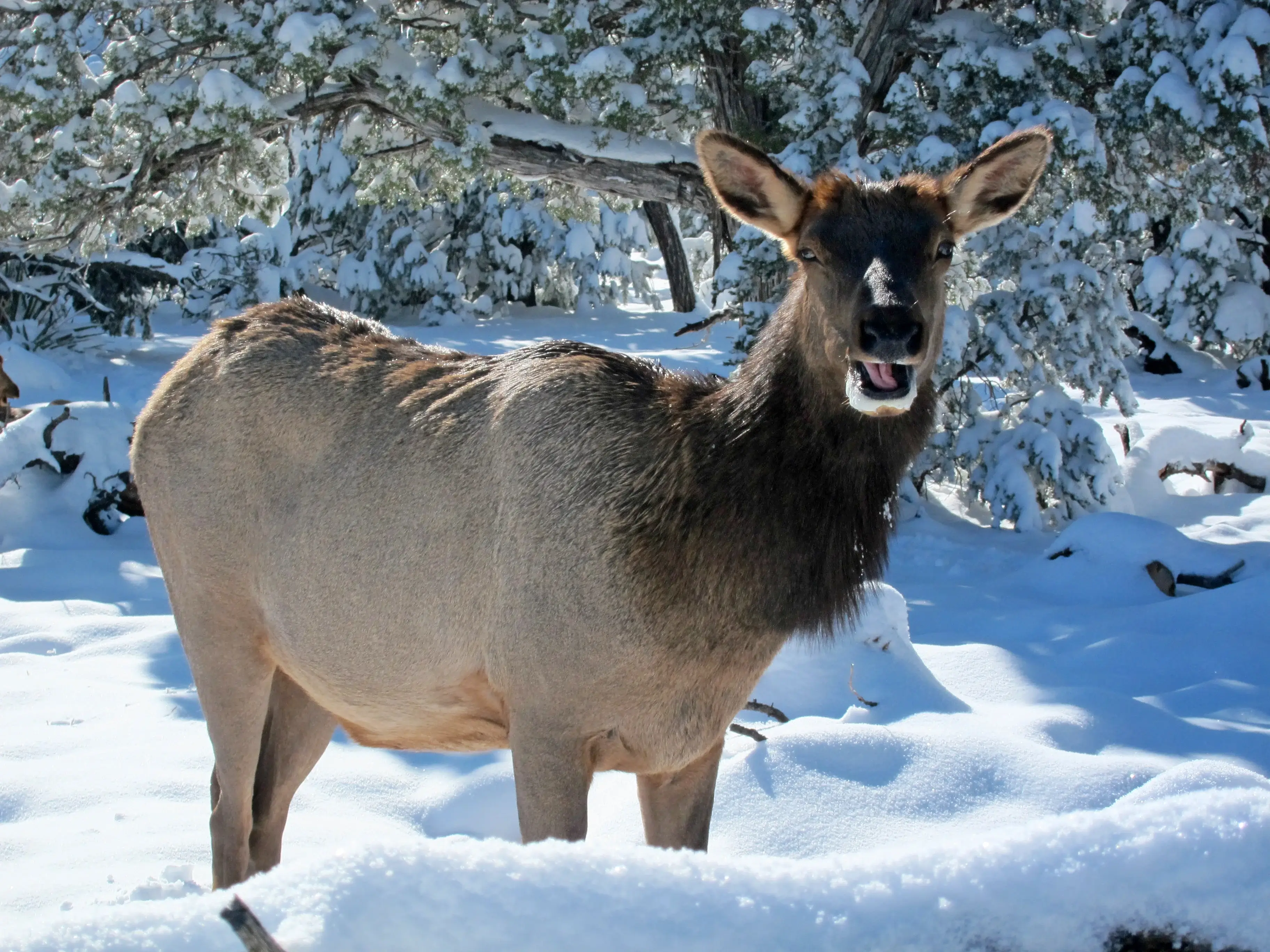
The elk or wapiti is the second largest species within the deer family, Cervidae, and one of the largest terrestrial mammals in its native range of North America and Central and East Asia. The word "elk" originally referred to the European variety of the moose, Alces alces, but was transferred to Cervus canadensis by North American colonists.
Life History
C. c. alashanicus; †C. c. canadensis; †C. c. combrayicus; C. c. kansuensis; C. c. macneilli; C. c. manitobensis; †C. c. merriami; C. c. nannodes; C. c. nelsoni; C. c. roosevelti; C. c. sibiricus; C. c. songaricus; C. c. wallichii; C. c. xanthopygus VariousCervus elaphussubspecies Theelk(pl.:elkorelks;Cervus canadensis) orwapiti(pronounced/ˈwɒpəti/[3][4]) is the secondlargest specieswithin thedeerfamily,Cervidae, and one of the largest terrestrialmammalsin its native range of North America andCentralandEast Asia. The word "elk" originally referred to the European variety of themoose,Alces alces, but was transferred toCervus canadensisby North American colonists. The name "wapiti" is derived from aShawneeandCreeword meaning "white rump", after the distinctive light fur around the tail region which the animals may fluff-up or raise to signal their agitation or distress to one another, when fleeing perceived threats, or among males courting females andsparringfor dominance. A similar trait is seen in otherartiodactylspecies, like thebighorn sheep,pronghornand thewhite-tailed deer, to varying degrees. Elk dwell in open forest and forest-edge habitats, grazing on grasses and sedges and browsing higher-growing plants, leaves, twigs and bark. Male elk have large, blood- and nerve-filledantlers, which they routinelyshedeach year as the weather warms. Males also engage in ritualized mating behaviors during themating season, including posturing to attract females, antler-wrestling (sparring), andbugling, a loud series of throaty whistles, bellows, screams, and other vocalizations that establish dominance over other males and aim to attract females. Elk were long believed to belong to asubspeciesof the Europeanred deer(Cervus elaphus), but evidence from manymitochondrial DNAgenetic studies, beginning in 1998, shows that the two are distinctspecies. The elk's wider rump-patch and paler-hued antlers are keymorphologicaldifferences that distinguishC. canadensisfromC. elaphus. Although it is currently only native to North America, andCentral,EastandNorth Asia, elk once had a much wider distribution in the past; prehistoric populations were present acrossEurasiaand intoWestern Europeduring theLate Pleistocene, surviving into the earlyHoloceneinSouthern Swedenand theAlps. The now-extinct North AmericanMerriam's elksubspecies (Cervus canadensis merriami) once ranged south intoMexico. The wapiti has also successfullyadaptedto countries outside of its natural range where it has been introduced, includingArgentinaandNew Zealand; the animal's adaptability in these areas may, in fact, be so successful as to threaten the sensitiveendemicecosystems and species it encounters. As a member of the Artiodactyla order (and distant relative of theBovidae), elk are susceptible to severalinfectious diseaseswhich can be transmitted to or from domesticatedlivestock. Efforts to eliminate infectious diseases from elk populations, primarily byvaccination, have had mixed success. Some cultures revere the elk as having spiritual significance. Antlers and velvet are used intraditional medicinesin parts of Asia; the production of ground antler and velvet supplements is also a thrivingnaturopathicindustry in several countries, including the United States,ChinaandCanada. The elk is hunted as a game species, and their meat is lean and higher inproteinthanbeeforchicken. Elk are among the mostgregariousdeer species.[34]: 52During the summer group size can reach 400 individuals.[24]For most of the year, adult males and females are segregated into different herds. Female herds are larger while bulls form small groups and may even travel alone. Young bulls may associate with older bulls or female groups. Male and female herds come together during the mating season, which may begin in late August.[34]: 75, 82Males try to intimidate rivals by vocalizing and displaying with their antlers.[34]: 109If neither bull backs down, they engage in antler wrestling, sometimes sustaining serious injuries.[35] Bulls have a loud, high-pitched, whistle-like vocalization known asbugling, which advertise the male's fitness over great distances. Unusual for a vocalization produced by a large animal, buglings can reach a frequency of 4000 Hz. This is achieved by blowing air from theglottisthrough the nasal cavities. Elk can produce deeper pitched (150 Hz) sounds using thelarynx.[36]Cows produce an alarm bark to alert other members of the herd to danger, while calves will produce a high-pitched scream when attacked.[37] Elk are ruminants and therefore have four-chambered stomachs. Unlike white-tailed deer and moose, which are chiefly browsers, elk are similar tocattlein that they are primarilygrazers. But like other deer, they alsobrowse.[49][50]Elk have a tendency to do most of their feeding in the mornings and evenings, seeking sheltered areas in between feedings to digest. Their diets vary somewhat depending on the season, with native grasses being a year-round supplement, tree bark (e.g.cedar,wintergreen,eastern hemlock,sumac,jack pine,red maple,staghorn, andbasswood) being consumed in winter, andsedges,forbs, and tree sprouts during the summer.[51]Favorites of the elk includedandelions,aster,hawkweed,violets,clover, and the occasionalmushroom.[51]Elk consume an average of 9.1 kilograms (20 lb) of vegetation daily.[52]Particularly fond ofaspensprouts which rise in the spring, elk have had some impact on aspen groves which have been declining in some regions where elk exist.[53]Range and wildlife managers conduct surveys of elk pellet groups to monitor populations and resource use.[54][55] Research in theGreater Yellowstone Ecosystemhas found that supplemental feeding of concentratedalfalfapellets leads to significant alterations in the elks'microbiome.[56]The elk gut microbiome is typically characterized by a diverse community of bacteria specialized in breaking down complex plant fibers andcellulose, whereas the supplementally fed gut microbiome may have less fiber-digesting bacteria.[57]Therefore, transitioning from natural foraging to concentrated alfalfa pellets can cause changes in the gut microbiome that might affect the elk's ability to efficiently digest their natural diet or could potentially lead to imbalances that affect overall health.[56]
Hunting Season
Limited draw only. Seasons vary by subspecies and zone: Tule elk hunts Jul-Jan. Roosevelt elk hunts Aug-Nov. Rocky Mountain elk hunts Sep-Nov. Specific dates vary by hunt code. Check CDFW Big Game Hunting Digest for exact dates. Total quota: ~362 tags across all hunts.
Frequently Asked Questions
Regulations for hunting Elk in California
Elk hunting in California is by limited quota drawing only. Three subspecies are managed: Tule elk (most numerous hunts), Roosevelt elk (northwestern CA), and Rocky Mountain elk (northeastern CA). Tags are awarded through the Elk Tag Drawing with preference points. A valid California hunting license and elk tag are required. CWD testing is required in certain zones. Additional SHARE hunts are available. Nonlead ammunition is required. California's elk populations have been restored through active management and translocation.
What subspecies of elk are found in California?
California has three elk subspecies: Tule elk (endemic to California, found in central and southern parts), Roosevelt elk (northwestern coastal region), and Rocky Mountain elk (northeastern California). Tule elk were nearly extinct and have been successfully restored.
How many elk tags are available in California?
Approximately 362 elk tags are issued annually through the drawing system across dozens of hunt codes. Tags are highly sought after with long preference point wait times.
When is Elk hunting season in California?
Limited draw only. Seasons vary by subspecies and zone: Tule elk hunts Jul-Jan. Roosevelt elk hunts Aug-Nov. Rocky Mountain elk hunts Sep-Nov. Specific dates vary by hunt code. Check CDFW Big Game Hunting Digest for exact dates. Total quota: ~362 tags across all hunts.
What is the bag limit for Elk in California?
1 elk per tag.
What is another name for Elk?
Elk is also known as Wapiti, Tule elk, Roosevelt elk, Rocky Mountain elk in California.
References
| State | Category | Directory | Subcategory | Content | Source |
|---|---|---|---|---|---|
| California | Hunting | Regulations | Season Dates | Limited draw only. Seasons vary by subspecies and zone: Tule elk hunts Jul-Jan. Roosevelt elk hunts Aug-Nov. Rocky Mount | Link |
| California | Hunting | Regulations | Regulations | Elk hunting in California is by limited quota drawing only. Three subspecies are managed: Tule elk (most numerous hunts) | Link |