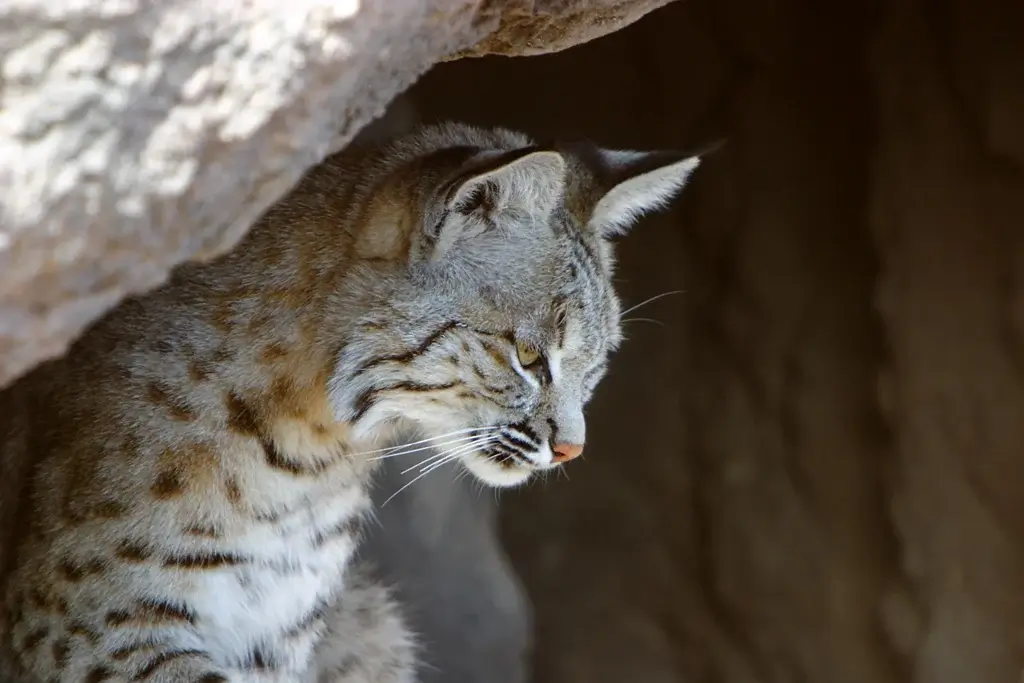
Bobcats are about twice the size of a domestic cat. They are generally tan to yellowish brown with dark brown or black streaks. The under parts are usually white with black spots and the insides of the legs are marked with black bars. The bobcat’s ears are pointed with short, black tufts while the tail is short and gives the appearance of being "bobbed." The young have mottled or spotted fur with more distinct facial marking than the adults.
Habitat & Range
Widely distributed throughout Florida in deep forest, swamps, and hammock land. Thick patches of saw palmetto and dense shrub thickets are important as den and resting sites. In rural areas, bobcats can range five or six square miles and generally cover their territory in a slow, careful fashion. In urban to suburban areas, the range of territory usually decreases to 1 or 2 miles.
Life History
The female bobcat can breed after one year. In Florida, bobcats breed from August to March with the peak in February and March. One to four young are born after a gestation period (the period in which offspring are carried in the uterus) of 50 to 60 days. An efficient hunter, the bobcat hunts by sight and usually at night. Seeing a bobcat during the day is not uncommon because they sleep for only 2 to 3 hours at a time. In Florida, squirrels, rabbits and rats are the primary prey species. Occasionally, a bobcat will take a feral cat or domestic chicken. Since Florida is an important wintering area for migrating birds, the bobcat's winter diet reflects this abundance and includes ground-dwelling birds such as towhees, robins, catbirds and thrashers. This short educational video provides information about tips and strategies for coexisting with bobcats.
Status, Trends & Threats
Bobcats are stealthy animals and not often seen even though their numbers are abundant. Catching even a fleeting glimpse of this secretive and beautiful creature can make anyone's outdoor experience more enjoyable. Living with Bobcats; Living with Bobcats - Spanish; Living with Bobcats(YouTube); Identifying Florida Wild Cats; Bobcats in Florida Infographic
Hunting Season
Statewide Dec 1 - March 31 (hunting); Dec 1 - March 1 (trapping)
Frequently Asked Questions
Regulations for hunting Bobcat in Florida
Bobcat hunting season runs December 1 through March 31 statewide. Trapping season ends March 1. No bag limit. Bobcat may be taken with rifle, shotgun, handgun, muzzleloader, air gun, crossbow, or bow. Check WMA brochures for area-specific regulations.
How can I identify a Florida bobcat?
Bobcats are about twice the size of a domestic cat, tan to yellowish brown with dark brown or black streaks. They have short pointed ears with black tufts and a short 'bobbed' tail.
What do Florida bobcats eat?
In Florida, bobcats primarily hunt squirrels, rabbits, and rats. They also take ground-dwelling birds, especially during winter migration. They hunt by sight, usually at night.
When is Bobcat hunting season in Florida?
Statewide Dec 1 - March 31 (hunting); Dec 1 - March 1 (trapping)
References
| State | Category | Directory | Subcategory | Content | Source |
|---|---|---|---|---|---|
| Florida | Hunting | Regulations | Season Dates | Statewide Dec 1 - March 31 (hunting); Dec 1 - March 1 (trapping) | Link |
| Florida | Hunting | Regulations | Regulations | Bobcat hunting season runs December 1 through March 31 statewide. Trapping season ends March 1. No bag limit. Bobcat may | Link |