Also known as: Lesser scaup, Bluebill
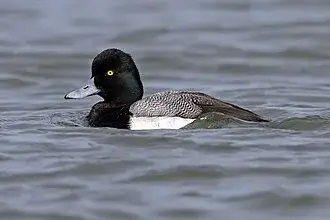
Fuligula affinisEyton, 1838 Thelesser scaup(Aythya affinis) is a smallNorth Americandiving duckthat migrates south as far asCentral Americain winter. It is colloquially known as thelittle bluebillorbroadbillbecause of its distinctive blue bill. The origin of the name scaup may stem from the bird's preference for feeding on scalp—the Scottish word for clams, oysters, and mussels; however, some credit it to the female's discordant scaup call as the name's source.[2]It is apparently a very close relative of theHolarcticgreater scaupor "bluebill" (A. marila), with which it forms asuperspecies.[3][4]The scientific name is derived fromAncient GreekandLatin, withaithuiabeing an Ancient Greek term for an unidentifiedseabird, used byHesychiusandAristotle, among other authors, andaffinis, Latin for "related to", from the lesser scaup's resemblance to the greater scaup.[5] Adults are 38–48 cm (15–19 in) long, 41.7–43 cm (16.4–16.9 in) on average. The species can weigh 454–1,089 g (1.001–2.401 lb); males weigh 820 g (1.81 lb) on average while females weigh noticeably less, at 730 g (1.61 lb) on average.[6]Wing lengths (notwingspans) are about 7.5–7.9 in (19–20 cm) in males and 7.3–7.8 in (19–20 cm) in females. Thetarsusis about 1.4–1.5 in (3.6–3.8 cm) long, and the bill is 1.4–1.7 in (3.6–4.3 cm).[2][3][7][8]The wingspan is 68–78 cm (27–31 in).[6] The adult males (drakes) indefinitive basic (breeding) plumagehave a black, iridescent head and a small tuft at the hindcrown, a black breast, a whitish-grey back, wings with darkervermiculationsand black outer and greyish-brown inner primaryremiges. The underparts are white with someolivevermiculations on the flanks, and therectricesand tail coverts are black. Adult females (hens) have a white band at the base of the bill and often a lighter ear region, and are otherwise dark brown all over, shading to white on the mid-belly. Drakes ineclipse plumagelook similar, but with a very dark head and breast, little or no white on the head and usually some greyish vermiculations on the wings. Immature birds resemble the adult females, but are duller and have hardly any white at the bill base. Both sexes have white secondary remiges, a blue-grey bill with a smallblack "nail" at the tip and grey feet; the drakes have a bright yellowiris, while that of females is orange to yellow varying with age[9]and that of immatures is brown.Downyhatchlings look much like those of related species, with dark brown upperparts and palebuffunderparts, chin,superciliumand back spots.[2][3][7][8] These birds are not very vocal, at least compared todabbling ducks. Hens give the namesake discordantscaup, scaupcall; in courtship drakes produce weak whistles. Hens vocalize more often than those of thegreater scaup—particularly during flight—but their call is weaker, a gutturalbrrtt, brrtt.[2][7][8]
Life History
Fuligula affinisEyton, 1838 Thelesser scaup(Aythya affinis) is a smallNorth Americandiving duckthat migrates south as far asCentral Americain winter. It is colloquially known as thelittle bluebillorbroadbillbecause of its distinctive blue bill. The origin of the name scaup may stem from the bird's preference for feeding on scalp—the Scottish word for clams, oysters, and mussels; however, some credit it to the female's discordant scaup call as the name's source.[2]It is apparently a very close relative of theHolarcticgreater scaupor "bluebill" (A. marila), with which it forms asuperspecies.[3][4]The scientific name is derived fromAncient GreekandLatin, withaithuiabeing an Ancient Greek term for an unidentifiedseabird, used byHesychiusandAristotle, among other authors, andaffinis, Latin for "related to", from the lesser scaup's resemblance to the greater scaup.[5] Adults are 38–48 cm (15–19 in) long, 41.7–43 cm (16.4–16.9 in) on average. The species can weigh 454–1,089 g (1.001–2.401 lb); males weigh 820 g (1.81 lb) on average while females weigh noticeably less, at 730 g (1.61 lb) on average.[6]Wing lengths (notwingspans) are about 7.5–7.9 in (19–20 cm) in males and 7.3–7.8 in (19–20 cm) in females. Thetarsusis about 1.4–1.5 in (3.6–3.8 cm) long, and the bill is 1.4–1.7 in (3.6–4.3 cm).[2][3][7][8]The wingspan is 68–78 cm (27–31 in).[6] The adult males (drakes) indefinitive basic (breeding) plumagehave a black, iridescent head and a small tuft at the hindcrown, a black breast, a whitish-grey back, wings with darkervermiculationsand black outer and greyish-brown inner primaryremiges. The underparts are white with someolivevermiculations on the flanks, and therectricesand tail coverts are black. Adult females (hens) have a white band at the base of the bill and often a lighter ear region, and are otherwise dark brown all over, shading to white on the mid-belly. Drakes ineclipse plumagelook similar, but with a very dark head and breast, little or no white on the head and usually some greyish vermiculations on the wings. Immature birds resemble the adult females, but are duller and have hardly any white at the bill base. Both sexes have white secondary remiges, a blue-grey bill with a smallblack "nail" at the tip and grey feet; the drakes have a bright yellowiris, while that of females is orange to yellow varying with age[9]and that of immatures is brown.Downyhatchlings look much like those of related species, with dark brown upperparts and palebuffunderparts, chin,superciliumand back spots.[2][3][7][8] These birds are not very vocal, at least compared todabbling ducks. Hens give the namesake discordantscaup, scaupcall; in courtship drakes produce weak whistles. Hens vocalize more often than those of thegreater scaup—particularly during flight—but their call is weaker, a gutturalbrrtt, brrtt.[2][7][8] Lesser scaup forage mainly by sifting through the bottom mud, usually after diving and swimming underwater, occasionally by dabbling without diving. They mainly eatmolluskssuch asmusselsandclams, as well as seeds and other parts of aquatic plants like sedges and bulrushes (Cyperaceae), "pondweeds",widgeon-grass(Ruppia cirrhosa), wild celery (Vallisneria americana) orwild rice(Zizania). In winter, but less so in summer, otheraquaticanimals—crustacean,insectand theirlarvaeand smallfishes—form an important part of their diet. It has been reported that both the lesser and the greater scaup have shifted their traditional migration routes to take advantage of the presence of thezebra mussel(Dreissena polymorpha) inLake Erie, which was accidentally introduced in the 1980s and has multiplied enormously. This may pose a risk to these birds because zebra mussels are efficientfilter feedersand so accumulate environmental contaminants rapidly.[2][3][8][18] They nest in a sheltered location on the ground near water, usually among thick vegetation such assedges and bulrushes, sometimes in small loose groups and not rarely next to colonies ofgullsorterns; several females may deposit eggs in a single nest. The drakes court the hens in the winter quarters; pairs form shortly before and during the spring migration. When nesting starts, the males aggregate while theymoultintoeclipse plumage, leaving the task of incubation and raising the young to the females alone.[7] The nest is a shallow depression scraped in the ground and lined with plants and somedown feathers. Breeding begins in May, but most birds nest only in June, later than usual for North Americanwaterfowl. Theclutchnumbers about 9–11 eggs on average; up to 26 eggs have been found in a single nest, but such high numbers are from more than one female. Incubation is by the female only and lasts around 3 weeks. The youngfledgesome 45–50 days after hatching and soon thereafter the birds migrate to winter quarters already. Lesser scaup become sexually mature in their first or second summer. The oldest known individual reached an age of over 18 years.[3][19] Before the start of the population decline (seebelow), about 57% of the lesser scaup nests failed each breeding season because the female was killed or the eggs were eaten or destroyed. The average brood size of nests where eggs hatched successfully was 8.33 hatchlings.[3]
Status, Trends & Threats
Although the lesser scaup has the largest population of any species of diving duck in North America, their population has been steadily declining since the mid-1980s, and reached an all-time low in the early 21st century. Duringbreeding bird surveys, lesser andgreater scaupare counted together due to the impossibility of identifying the species unequivocally when large numbers of birds are involved. Lesser scaup are thought to comprise slightly less than nine-tenths of the scaup population of North America. In the 1970s, the lesser scaup population was estimated at 6.9 million birds on average; in the 1990s it had declined to about half that number, and by the late 2000s it is estimated at 3 million individuals or less. Due to the wide breeding range and the fact that the rate of decline, though remarkable, is still not threatening in respect to the enormous overall numbers, the lesser scaup is classified as a Species ofLeast Concernby theIUCN. An increase of the decline is liable to result in an uplisting toNear Threatenedor evenVulnerablestatus.[1][2][3][8] The causes for this stark—though not threatening yet—decline remain unknown. There are indications that the breeding success is decreasing, but why this is so remains puzzling. On one hand,pollutionandhabitat destruction, especially in the wintering regions, has certainly increased since the early-mid 20th century. On the other hand, the narrow time frame in which lesser scaup breed and raise their young may be tied to some specific ecological conditions—such as abundance of key food, without the ducks being able to adapt. In this regard, it is alternatively or additionally possible that greater scaup, which may be increasing in numbers, is putting the lesser scaup under increasingly severe competition.[citation needed] However, it seems that greater scaup eats larger food items on average,[18]and the species aresympatricin part of their range and presumably have been for millennia without any problems due to competition. The experience of the past as well as the reproduction rate—even if this is declining—suggests thathuntinghas no major impact on lesser scaup populations at present either. Also, the breeding habitat is mainly in regions little-used by humans; habitat destruction on the breeding grounds is also not considered to be problematic.[3]
Hunting Season
Regular duck seasons: Oct-Dec 2026 in three zones.
Frequently Asked Questions
Regulations for hunting Lesser Scaup in Iowa
Lesser scaup hunting follows federal migratory bird regulations with restrictive scaup limits. HIP registration and federal duck stamp (age 16+) are required. Non-toxic shot is required.
When is Lesser Scaup hunting season in Iowa?
Regular duck seasons: Oct-Dec 2026 in three zones.
What is the bag limit for Lesser Scaup in Iowa?
Included in the overall duck limit with species-specific restrictions (typically 1-2 scaup daily in Mississippi Flyway).
What is another name for Lesser Scaup?
Lesser Scaup is also known as Lesser scaup, Bluebill in Iowa.
References
| State | Category | Directory | Subcategory | Content | Source |
|---|---|---|---|---|---|
| Iowa | Hunting | Regulations | Season Dates | Regular duck seasons: Oct-Dec 2026 in three zones. | Link |
| Iowa | Hunting | Regulations | Regulations | Lesser scaup hunting follows federal migratory bird regulations with restrictive scaup limits. HIP registration and fede | Link |