Also known as: Common pheasant, Rooster (male)
The common pheasant, ring-necked pheasant, or blue-headed pheasant, is a bird in the pheasant family (Phasianidae). The genus name comes from Latin phasianus 'pheasant'. The species name colchicus is Latin for 'of Colchis', a country on the Black Sea where pheasants became known to Europeans. Although Phasianus was previously thought to be closely related to the genus Gallus, the genus of junglefowl and domesticated chickens, recent studies show that they are in different subfamilies, having diverged over 20 million years ago.
Life History
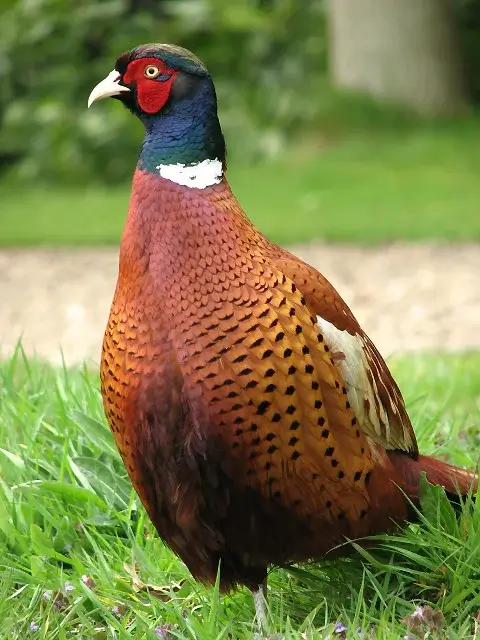
Phasianus phasis Thecommon pheasant(Phasianus colchicus),ring-necked pheasant, orblue-headed pheasant, is a bird in thepheasantfamily(Phasianidae). The genus name comes fromLatinphasianus'pheasant'. The species namecolchicusisLatinfor 'ofColchis' (modern dayGeorgia), a country on theBlack Seawhere pheasants became known to Europeans.[2]AlthoughPhasianuswas previously thought to be closely related to the genusGallus, the genus ofjunglefowland domesticatedchickens, recent studies show that they are in different subfamilies, having diverged over 20 million years ago.[3][4] It is native to Asia, where it is widespread, and also the extreme southeast of Europe in the northern foothills of the Caucasus Mountains. It has been widely introduced elsewhere as agame bird. In parts of its range, mainly in places where none of its relatives occur such as in Europe, where it is naturalised, it is simply known as thepheasant.Ring-necked pheasantis both the collective name for a number ofsubspeciesand their intergrades that have white neck rings, and the name used for the species as a whole in North America. It is a well-knowngamebird, among those of more than regional importance perhaps the most widespread and ancient one in the whole world. The common pheasant is one of the world's most hunted birds;[5]it has been introduced for that purpose to many regions, and is also common on game farms where it is commercially bred. The ring-necked subspecies group in particular are commonly bred and were introduced to many parts of the world; the game farm stock, though no distinctbreedshave been developed yet, can be considered semi-domesticated. The ring-necked pheasant is thestate birdofSouth Dakota, one of only two US state birds that is not a species native to the United States. Thegreen pheasant(P. versicolor) of Japan is sometimes considered a subspecies of the common pheasant. Though the species produce fertilehybridswherever they coexist, this is simply a typical feature amongfowl(Galloanseres), in which postzygoticisolating mechanismsare slight compared to most other birds. The species apparently have somewhat differentecologicalrequirements and at least in its typical habitat, the green pheasant outcompetes the common pheasant. The introduction of the latter to Japan has therefore largely failed. There are many colour forms of the male common pheasant, ranging in colour from nearly white to almost black in some melanistic examples. These are due to captive breeding andhybridisationbetweensubspeciesand with the green pheasant, reinforced by continual releases of stock from varying sources to the wild. For example, the "ring-necked pheasants" common in Europe, North America and Australia do not pertain to any specifictaxon, they rather represent a stereotyped hybrid swarm.[6]Body weight can range from 0.5 to 3 kg (1 to 7 lb), with males averaging 1.2 kg (2 lb 10 oz) and females averaging 0.9 kg (2 lb 0 oz).[7]Wingspan ranges from 56–86 cm (22–34 in).[8] The adult male common pheasant of thenominate subspeciesPhasianus colchicus colchicusis60–89 cm (23+1⁄2–35 in) in length with a long brown streaked black tail, accounting for almost 50 cm (20 in) of the total length. The body plumage is barred bright gold or fiery copper-red and chestnut-brownplumagewith iridescent sheen of green and purple; but rump uniform is sometimes blue. The wing coverage is white or cream and black-barred markings are common on the tail.[9]The head is bottle green with a smallcrestand distinctive redwattle.P. c. colchicusand some other races lack a white neck ring.[10]Behind the face are two ear-tufts, that make the pheasant appear more alert.[11] The female (hen) and juveniles aremuch less showy, with a duller mottled brown plumage all over and measuring50–63 cm (19+1⁄2–25 in) long including a tail of around 20 cm (8 in). Juvenile birds have the appearance of the female with a shorter tail until young males begin to grow characteristic bright feathers on the breast, head and back at about 10 weeks after hatching.[9] Thegreen pheasant(P. versicolor) is very similar, and hybridisation often makes the identity of individual farmed birds difficult to determine. Green pheasant males on average have a shorter tail than the common pheasant and have darker plumage that is uniformly bottle-green on the breast and belly; they always lack a neck ring. Green pheasant females are darker, with many black dots on the breast and belly. In addition, various colourmutationsare commonly encountered, mainlymelanistic(black) and flavistic (isabellineorfawn) specimens. The former are rather commonly released in some areas and are named "tenebrosus pheasant"[citation needed]or simply "melanistic mutant".[12] Common pheasants are native to Asia and parts of Europe, their original range extending from the easternBlack Seaand theCaspian SeatoManchuria,Siberia,Korea, Mainland China, andTaiwan. The birds are found in woodland, farmland, scrub, and wetlands. In their natural habitat, common pheasants live in grassland near water with smallcopsesof trees, and are tolerant of both dry and humid soils.[30][23]Extensively cleared farmland, however, is marginal habitat that cannot maintain self-sustaining populations for long.[31][32] Common pheasants are gregarious birds and outside the breeding season form loose flocks. However, captive bred common pheasants can show strong sexual segregation, in space and time, with sex differences in the use of feeding stations throughout the day.[33]Wherever they are hunted they are always timid once they associate humans with danger, and will quickly retreat for safety after hearing the arrival of hunting parties in the area.[citation needed] While common pheasants are able short-distance fliers, they prefer to run. If startled however, they can suddenly burst upwards at great speed, with a distinctive "whirring" wing sound and often givingkok kok kokcalls to alertconspecifics. Their flight speed is only 43–61 km/h (23–33 kn) when cruising but when chased they can fly up to 90 km/h (49 kn).
Hunting Season
Youth Oct 18-19, 2025; Regular Oct 25, 2025 - Jan 10, 2026. Hunting hours: 8:00 AM to 4:30 PM.
Frequently Asked Questions
Regulations for hunting Ring-necked Pheasant in Iowa
Ring-necked pheasant hunting is Iowa's premier upland game bird sport. Only roosters may be taken. Hunters must wear at least one outer garment of solid blaze orange during upland game bird seasons. Non-toxic shot is required on selected public areas. A foot or fully feathered wing must remain attached for transport. Iowa's 2025 statewide pheasant population was at a 20-year high. Shooting preserves offer additional hunting opportunities.
When is Ring-necked Pheasant hunting season in Iowa?
Youth Oct 18-19, 2025; Regular Oct 25, 2025 - Jan 10, 2026. Hunting hours: 8:00 AM to 4:30 PM.
What is the bag limit for Ring-necked Pheasant in Iowa?
3 roosters daily, 12 possession.
What is another name for Ring-necked Pheasant?
Ring-necked Pheasant is also known as Common pheasant, Rooster (male) in Iowa.
References
| State | Category | Directory | Subcategory | Content | Source |
|---|---|---|---|---|---|
| Iowa | Hunting | Regulations | Season Dates | Youth Oct 18-19, 2025; Regular Oct 25, 2025 - Jan 10, 2026. Hunting hours: 8:00 AM to 4:30 PM. | Link |
| Iowa | Hunting | Regulations | Regulations | Ring-necked pheasant hunting is Iowa's premier upland game bird sport. Only roosters may be taken. Hunters must wear at | Link |