Also known as: Sora rail, Carolina rail, Meadow chicken
The sora, sora rail or Carolina crake is a small waterbird of the rail family Rallidae, sometimes also referred to as the sora rail or sora crake, that occurs throughout much of North America. The genus name Porzana is derived from Venetian terms for small rails, and the specific carolina refers to the Carolina Colony. The common name "Sora" is probably derived from a Native American language.
Habitat & Range
The sora is common across North America,[14]naturally occurring in 49 US states (the exception being Hawaii), all 10 Canadian provinces and two Canadian territories. Outside of the US and Canada, the species is found throughoutCentral America, theCaribbean, and northern South America. The species has been recorded as avagrantinIceland,Great Britain,Portugal, and atLake Titicaca. Soras breed fromNova Scotianorthwest to southernYukonandNorthwest Territories, south to California, Arizona, and New Mexico and northeast to Pennsylvania and New England. Sora wintering grounds include the Caribbean, northern portions of South America, includingEcuador,Colombia, andVenezuela, north through Central America and Mexico to southern California in the West and coastal regions of the Southeast. From southern Kansas south to northern and eastern Texas and east through the inland areas of the southeastern United States, soras are typically only observed during migration in the spring and fall. In a few areas of the western United States, including central California and areas of Arizona and New Mexico, soras may occur year-round.[14] The size of an individual sora'shome rangevaries. Sora brood-rearing home ranges in northwestern Iowa averaged 0.5 acres (0.20 ha).[15]In Arizona, sora home range size varied from 1.5 acres (0.61 ha) in the early breeding season to over 2 acres (0.81 ha) in the postbreeding season. These seasonal differences in sora home range size were not significant (p>0.05).[16] Densities vary from to 12 soras/acre in Colorado[17]to 0.47 pair/ha inIndiana.[18]An average of 1.3 soras/ha responded to calls across sites in Colorado.[19]A similar density of soras was found in southeastern Wisconsin.[20]In Iowa, average density over two years and several marsh habitats was 1.3 pairs/ha.[21]Landscape factors, such as marsh area, habitat edges within marshes, and the number of marshes in a region may influence soras. Although soras occur in marshes of all sizes, they may occur at higher densities in intermediate-sized marshes. Soras were significantly (p≤0.01) positively related with total wetland area and perimeter area of surface water in east and central Maine[22]and were significantly (p<0.05) positively related to area of wetlands in Saskatchewan.[23]In Maine, soras used 10% of 2.5 acres (1.0 ha) wetlands, 40% to 50% of wetlands from 2.5–5 acres (1.0–2.0 ha) in size, and 20% of wetlands larger than 50 acres (20 ha).[22]In western New York, soras were significantly (p=0.007) more abundant in marshes from 100 to 250 acres (40 to 101 ha) in size than in smaller (< 100 acres (40 ha)) or larger (250–380 acres (100–150 ha)) marshes. In addition, sora nests were detected more often in the 100–200 acres (40–81 ha) marshes.[24] Soras are commonly reported in plant communities dominated bycattails(Typhaspp.),[16][19][25][24][26][20]sedges(Carexspp.),[19][26][20][21][27]bulrushes(Scirpusspp.),[16][19][20][21]smartweeds(Polygonumspp.),[26][27]rushes(Juncusspp.),[26][27]rice cutgrass(Leersia oryzoides),[28]andbarnyard grasses(Echinochloaspp.).[27][28] Soras also seem to prefer edge habitats. Breeding sora density was significantly (p<0.001) correlated (r=0.62) with the perimeter:area ratio of northwestern Iowa marshes. The distance from the center of sora territories to a habitat edge was also significantly (p<0.005) less than from the center of Virginia rail territories.[21]In Arizona, habitat edges were closer to sora heavy use areas than random sites.[16] Wetland dynamics at a large scale can affect soras. Indices of sora population at three "levels of response" were significantly (p<0.01) correlated (r≥0.70) with the number of ponds present in theprairie pothole regionof North Dakota in May.[29] Outside of wetlands, soras are most often reported in cultivated areas during migration or in the postbreeding period. For instance, a sora was observed 3 mi (4.8 km) from marshland in a cultivated field in Iowa in the middle of August. A male sora was observed less than 1,000 ft (300 m) from a large wetland in a soybean (Glycine max) field in northwestern Iowa during the postbreeding period.[15]From early June to mid-July, soras were observed on farms in Saskatchewan sown mainly with wheat (Triticum aestivum).[23] Soras have also been reported in flooded wooded areas.[24][22]In western New York, soras occurred during the breeding season on a study site where 26% of the area was categorized as "flooded timber," and 5% was classed as "scrub/shrub marsh".[24]In eastern and central Maine, an average of 2.1 soras was observed in wooded swamps per 100 hours of observation during the breeding season.[22]On a nonbreeding (August–April) site in southwestern Arizona, soras were found to use a "mixed shrub community" more than expected based on its availability.[16]Soras were observed at low abundances on a site withdouglas-fir(Pseudotsuga menziesii),ponderosa pine(Pinus ponderosa), andtrembling aspen(Populus tremuloides) in British Columbia.[30] Soras use areas with a wide range of water depths. They are often observed in water less than 1 ft (30 cm) deep,[19][20][27][28]although the average water depth of sora heavy-use areas in Arizona was 20 in (51 cm).[16]In northwestern Iowa, average water depth in sora territories was 15 in (38 cm), which was significantly (p<0.025) more shallow than water depths at random locations in the marsh.[21]Sora nesting sites occurred in shallower water than random sites in western New York. Average water depths reported at nest sites range from 4 in (10 cm) for 4 sora nests in Colorado to nearly 10 in (25 cm) for sora nests in western New York.[24]In areas of deep water, soras typically wade on mats of floating vegetation.[15] Water level fluctuations may result in nest abandonment. For example, at a site in Colorado where water level increased more than 8 in (20 cm), a sora nest with 7 eggs was abandoned.[19]In Alberta, soras nested in more vegetation types during a drought year, most likely due to substantially reduced water levels in the vegetation used the previous year.[26] Soras use areas with shallower water in fall than in spring.[16][27][28]Soras typically avoid open water. There is a significant (p≤0.05) negative relationship between area of open water and sora use of wetlands in Maine[22]and sora relative abundance in Saskatchewan.[23]In western New York, sora nesting sites had a lower percentage of open water than random sites,[24]and in Arizona soras used open water areas less than their availability.[16] Sora nesting sites had larger percentage of emergent vegetation than random sites in marshes of western New York.[24]Sora numbers in wetlands of northeastern North Dakota were significantly (p<0.05) positively correlated (r=0.45) with hectares of live emergent vegetation. In east and central Maine, wetlands used by soras had significantly (p=0.01) greater area of emergent vegetation than unused wetlands.[22] Density of emergent vegetation in sora habitat varies. Reported density of emergent vegetation ranges from an average of 121.9 stems/m2in sora territories in northwestern Iowa[21]to 333 stems/m2on sites in northeastern Missouri used during fall migration.[28]In western New York, cover was greater than 70% at 95% of sora nests. In addition, nesting sites had more horizontal cover at 20 inches (0.5 m) above water level than random sites.[24]However, average stem density on sora territories was not significantly (p>0.05) different from random sites in northwestern Iowa.[21] Height of emergent vegetation in sora habitat also varies. It ranged from 8 to 11 in (20 to 28 cm) in the spring after a winter disturbance in northwestern Iowa[21]to 84 in (210 cm) in areas heavily used by soras in Arizona.[16]In marshes of western New York, average vegetation height at sora nesting sites was shorter than at random locations.[24]However, the average height of emergent vegetation in sora territories in northeastern Iowa was not significantly (p>0.05) different from the height of vegetation in random plots.[21] In Arizona, both cover and height of vegetation used by soras varied with seasons. Conway suggested the differences likely reflected the varied diet of the sora.[16]The availability of habitat in different seasons is another possible source of seasonal differences in sora habitat.[27] Extent of woody vegetation surrounding South Dakota wetlands was not significantly (p=0.6) associated with sora occurrence. However, in marshes of western New York, there was a significant (p=0.041) negative relationship between percent flooded timber on a site and sora relative abundance.[24] Soras may prefer some cover types. In Arizona, 65.3% of sora use was insouthern cattail(Typha domingensis), although it accounted for only 16.5% of the vegetation.Bulrushesand a mixed-shrub community were also used more than their availability, whilesaltcedar(Tamarix chinensis) andarrowweed(Pluchea sericea) were avoided.[16]A literature review notes sora avoidance ofpurple loosestrife(Lythrum salicaria)-dominated sites. In east and central Maine, wetlands used by soras had significantly (p=0.05) more ericaceous vegetation, such asleatherleaves(Chamaedaphnespp.),sweetgales(Myricaspp.), andlaurels(Kalmiaspp.).[22]In marshes of northwestern Iowa,broadleaf arrowhead(Sagittaria latifolia) occurred in sora territories significantly (p<0.01) more often than at random sites. Johnson and Dinsmore[21]imply that this likely results from both species preferring similar site conditions. In May and June in Wisconsin, soras were detected significantly (p<0.025) more often incattail(Typhaspp.) survey areas than in sedge areas. However, in southeastern Wisconsin during the breeding season, there was no significant (p=0.943) difference in sora densities between habitats composed predominantly of cattail, sedge, or bulrush.[20]In addition, soras' use ofglaucous cattail(Typha × glauca),broadfruit bur-reed(Sparganium eurycarpum),sedge,river bulrush(Schoenoplectus fluviatilis), andhardstem bulrush(S. acutus var. acutus) habitats in marshes of northwestern Iowa generally reflected availability of these habitats.[21] Seasonal differences in sora habitat use have been reported. In northeastern Missouri in spring, the likelihood of detecting sora in robust emergents, such as cattail (Typhaspp.) andlongroot smartweed(Polygonum amphibium var. emersum), was over 6 times that of detecting soras in these areas in fall. However, availability of habitats during various times of the year was not addressed.[28]In a study performed in southeastern Missouri, plant species used by sora during spring and fall migration differed significantly (p=0.005). However, the author qualifies this finding with his observation of major seasonal differences in vegetation availability.[27] Temperature may also influence sora abundance. In Colorado, average April temperature was significantly (p<0.01) negatively correlated (r= -0.94) with sora abundance. On sites that had average April temperatures ≤ 42 °F (6 °C), soras were more abundant than the closely relatedVirginia rail(Rallus limicola), while on warmer sites the sora to Virginia rail ratio declined.[19]
Life History
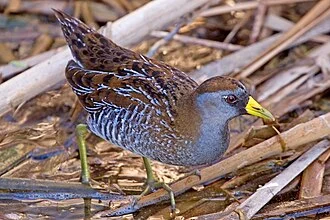
Rallus carolinusLinnaeus, 1758 Thesora, sora railorCarolina crake(Porzana carolina) is a small waterbird of the rail familyRallidae, sometimes also referred to as the sora rail or sora crake, that occurs throughout much of North America. The genus namePorzanais derived fromVenetianterms for small rails, and the specificcarolinarefers to theCarolina Colony. The common name "Sora" is probably derived from a Native American language. Theymigrateto the southernUnited Statesand northernSouth America. The sora is a very rare vagrant to westernEurope, where it can be confused withspotted crake. However, the latter species always has spotting on the breast, a streaked crown stripe, and a different wing pattern. Soras forage while walking or swimming. They areomnivores, eatingseeds,insectsandsnails. Although soras are more often heard than seen, they are sometimes seen walking near open water. They are fairly common, despite a decrease in suitable habitat in recent times. The call is a slow whistledker-whee, or a descending whinny. Adult soras are 19–30 cm (7.5–11.8 in)[9][10][11]long, with dark-marked brown upperparts, a blue-grey face and underparts, and black and white barring on the flanks. They have a short thick yellow bill, with black markings on the face at the base of the bill and on the throat. Sexes are similar, but young soras lack the black facial markings and have a whitish face and buff breast. They weigh about 49–112 g (1.7–4.0 oz)[9]and have a wingspan of 35–40 cm.[12]Soras have two common calls: a loud, squeaking "whinny" that decelerates and descends in pitch, often used to advertise territories; and a softer, ascending "ker-wee" or "sor-ah".[13]The latter call is sometimes presented as a possible origin for the species' common name.
Hunting Season
Sep 5 - Nov 13 (2026 season). HIP registration required.
Frequently Asked Questions
Regulations for hunting Sora in Iowa
Sora rail hunting follows federal migratory bird regulations. HIP registration is required. Sora are found in freshwater marshes with dense vegetation. Non-toxic shot is required.
When is Sora hunting season in Iowa?
Sep 5 - Nov 13 (2026 season). HIP registration required.
What is the bag limit for Sora in Iowa?
Check current Iowa migratory game bird regulations for daily and possession limits.
What is another name for Sora?
Sora is also known as Sora rail, Carolina rail, Meadow chicken in Iowa.
References
| State | Category | Directory | Subcategory | Content | Source |
|---|---|---|---|---|---|
| Iowa | Hunting | Regulations | Season Dates | Sep 5 - Nov 13 (2026 season). HIP registration required. | Link |
| Iowa | Hunting | Regulations | Regulations | Sora rail hunting follows federal migratory bird regulations. HIP registration is required. Sora are found in freshwater | Link |