Also known as: Whitetail, Virginia deer
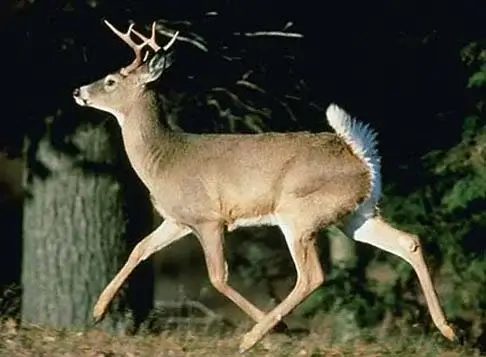
The white-tailed deer, also known commonly as the whitetail and the Virginia deer, is a medium-sized species of deer native to North and South America. It is the most widely distributed mainland ungulate herbivore in the Americas; coupled with its natural predator, the mountain lion, it is one of the most widely distributed terrestrial mammal species in the Americas and the world. Highly adaptable, the various subspecies of white-tailed deer inhabit many different ecosystems, from arid grasslands to the Amazon and Orinoco basins; from the Llanos to the high-elevation terrain of the Andes.
Habitat & Range
In North America, the white-tailed deer is very common (even considered a nuisance in some areas) in states to the east and south of theRocky Mountains, including southwesternArizona, with the exception of the AmericanWest CoastandBaja California Peninsula, where its ecological niche is filled by theblack-tailed deer(in thePacific Northwest) or themule deer(Odocoileus hemionus) from that point west except for mixeddeciduousripariancorridors, river valley bottomlands, and lower foothills of the northern Rocky Mountain region fromWyomingwest to easternWashingtonand easternOregon, and north to northeasternBritish Columbiaand southernYukon, including in theMontana valley and foothill grasslands. The westernmost population of the species, known as theColumbian white-tailed deer, was once widespread in the mixed forests along theWillametteandCowlitz Rivervalleys of western Oregon and southwestern Washington, but current numbers are considerably reduced, and it is classified asnear-threatenedby theIUCN. This population is separated from other white-tailed deer populations.[5] Texas is home to by far the most individual white-tailed deer of all U.S. states, Canadian provinces, or Latin American countries, with an estimated population of 5.3million, with both wild deer and farmedherds, the latter raised for largeracksize and breeding.[6][7][better source needed][8]High populations of white-tailed deer are known to exist on theEdwards PlateauofCentral Texas, as well as inIllinois,Indiana,Iowa,Maryland,Michigan,Minnesota,Mississippi,Missouri,New Jersey,New York,North Dakota,Ohio,Pennsylvania, andWisconsin. The conversion of land adjacent to theCanadian Rockiesto agricultural use, and partial clear-cutting ofconiferous trees(resulting in widespread deciduous vegetation), has been favorable to the white-tailed deer and has extended its distribution to as far northwest as the Yukon. Populations of white-tailed deer around theGreat Lakeshave expanded their range north and westward, also due to conversion of land to agricultural use, with localcaribou,elk, andmoosepopulations declining. White-tailed deer arecrepuscular, meaning they are most active at dawn and dusk, sporadically resting throughout the day and night.[9] Globally, the white-tailed deer has been introduced (primarily forsport hunting) toNew Zealand,Nova Scotia(where they killed off the nativecaribouviabrainworm),Prince Edward Island(where they were eradicated),New Brunswick(although native in some areas aroundQuebec), theGreater Antillesof theCaribbean(Cuba,Jamaica,Hispaniola, andPuerto Rico),[10]and some countries inEurope(mainly theCzech Republic,Finland,France,Germany,RomaniaandSerbia).[11][12]
Life History
38, seetext Dama virginianaZimmermann, 1780; Dama virginianusZimmermann, 1780 Thewhite-tailed deer(Odocoileus virginianus), also knowncommonlyas thewhitetailand theVirginia deer, is a medium-sizedspeciesofdeernative toNorthandSouth America. It is the most widely distributed mainlandungulateherbivorein the Americas; coupled with its natural predator, themountain lion(Puma concolor), it is one of the most widely distributed terrestrialmammalspeciesin the Americas and the world. Highly adaptable, the varioussubspeciesof white-tailed deer inhabit many different ecosystems, from arid grasslands to theAmazonandOrinoco basins; from theLlanosto the high-elevation terrain of theAndes.[4] The white-tailed deer's coat is a reddish-brown in the spring and summer, and turns to a grey-brown throughout the fall and winter. The white-tailed deer can be recognized by the characteristic white underside to its tail. It raises its tail when it is alarmed to warn the predator that it has been detected.[14] An indication of a deer's age is the length of the snout and the color of the coat, with older deer tending to have longer snouts and grayer coats. A population of white-tailed deer in New York is entirely white except for the nose and hooves – notalbino– in color. The formerSeneca Army DepotinRomulus,New York, has the largest known concentration ofwhite deer. Strong conservation efforts have allowed white deer to thrive within the confines of the depot. The white-tailed deer's horizontally slit pupil allows for good night vision and color vision during the day. Whitetails process visual images at a much more rapid rate than humans and are better at detecting motion in low-light conditions.[15] White-tailed deer are generalists and can adapt to a wide variety ofhabitats.[28]The largest deer occur in the temperate regions of North America. The northern white-tailed deer (O. v. borealis), Dakota white-tailed deer (O. v. dacotensis), and northwest white-tailed deer (O. v. ochrourus) are some of the largest animals, with large antlers. The smallest deer occur in the Florida Keys and in partially wooded lowlands in theNeotropics. Although most often thought of as forest animals depending on relatively small openings and edges, white-tailed deer can equally adapt themselves to life in more open prairie, savanna woodlands, and sage communities as in the Southwestern United States and northern Mexico. These savanna-adapted deer have relatively large antlers in proportion to their body size and large tails. Also, a noticeable difference exists in size between male and female deer of the savannas. The Texas white-tailed deer (O. v. texanus), of the prairies and oak savannas of Texas and parts of Mexico, are the largest savanna-adapted deer in the Southwest, with impressive antlers that might rival deer found in Canada and the northern United States. Populations ofArizona(O. v. couesi) and Carmen Mountains (O. v. carminis) white-tailed deer inhabit montane mixed oak and pine woodland communities.[29]The Arizona and Carmen Mountains deer are smaller, but may also have impressive antlers, considering their size. The white-tailed deer of theLlanosregion of Colombia and Venezuela (O. v. apurensisandO. v. gymnotis) have antler dimensions similar to the Arizona white-tailed deer. In some western regions of North America the white-tailed deer range overlaps with those of themule deer. White-tail incursions in theTrans-Pecosregion of Texas have resulted in some hybrids. In the extreme north of the range, their habitat is also used bymoosein some areas. White-tailed deer may occur in areas that are also exploited byelk(wapiti) such as in mixed deciduous river valley bottomlands and formerly in the mixed deciduous forest of eastern United States. In places such asGlacier National Parkin Montana and several national parks in the Columbian Mountains (Mount Revelstoke National Park) and Canadian Rocky Mountains, as well as in the Yukon Territory (Yoho National ParkandKootenay National Park), white-tailed deer are shy and more reclusive than the coexisting mule deer, elk and moose. Central American white-tailed deer prefertropical and subtropical dry broadleaf forests, seasonal mixed deciduous forests, savanna, and adjacent wetland habitats over densetropical and subtropical moist broadleaf forests. South American subspecies of white-tailed deer live in two types of environment. The first type, similar to the Central American deer, consists of savannas, dry deciduous forests, and riparian corridors that cover much of Venezuela and eastern Colombia.[30]The other type is the higher elevation mountain grassland/mixed forest ecozones in the Andes Mountains, from Venezuela to Peru. The Andean white-tailed deer seem to retain gray coats due to the colder weather at high altitudes, whereas the lowland savanna forms retain the reddish brown coats. South American white-tailed deer, like those in Central America, also generally avoid dense moist broadleaf forests. Since the second half of the 19th century, white-tailed deer have been introduced to Europe.[31]A population in theBrdyarea remains stable today.[32]In 1935, white-tailed deer were introduced toFinland. The introduction was successful, and the deer began spreading through northernScandinaviaand southernKarelia, competing with, and sometimes displacing, native species. The 2020 population of some 109,000 deer originated from four animals provided byFinnish Americansfrom Minnesota.[33][34] White-tailed deer eat large amounts of food, commonly eatinglegumesand foraging on other plants, includingshoots, leaves,cacti(in deserts), prairie forbs,[35]andgrasses. They also eat acorns, fruit, and corn. Their multi-chambered stomachs allow them to eat some foods humans cannot, such asmushrooms(even those that are toxic to humans)[clarification needed]andpoison ivy. Their diets vary by season according to the availability of food sources. They also eat hay, grass, white clover, and other foods they can find in a farmyard. Though almost entirely herbivorous, white-tailed deer have been known to opportunistically feed on nesting songbirds, field mice, and birds trapped inmist nets, if the need arises.[36]When additional amounts of minerals such as calcium are needed in their diet, they can resort toosteophagy, chewing on bones of dead animals.[37]A grown deer can eat around 900 kg (2,000 lb) of vegetable matter annually. A population of around 8 deer per square kilometre (20 /sq mi) can start to destroy the forest environment in their foraging area.[38] Their diet consists mostly of woody shoots, stems, and leaves of woody plants as well as grasses, cultivated crops, nuts, berries, and wildflowers. The items they feed on are not generally abundant in mature forests and are mostly found at "edges".[39]Edges are described as a "mosaic of vegetation types that create numerous interwoven 'edges' where their respective boundaries intersect" and provide optimum cover for browsers such as the white-tailed deer.[40]White-tailed deer can easily thrive in suburban areas, as a combination of increased safety from some predators (including human hunting), high quality and abundance of foods in home gardens, city parks, open farmland, and other factors all create landscapes with an abundance of edge habitat. The white-tailed deer is aruminant, which means it has a four-chambered stomach. Each chamber has a different and specific function that allows the deer to eat a variety of different foods, digesting it at a later time in a safe area of cover. The stomach hosts a complex set of microbes that change as the deer's diet changes through the seasons. If the microbes necessary for digestion of a particular food (e.g., hay) are absent, it will not be digested.[41]Utilizingforegut fermentation, the fermented ingesta (known ascud) is regurgitated and chewed again,[42][43]to mix it with saliva and reduce the particle size. Smaller particle size allows for increased nutrient absorption and the saliva is important because it provides liquid for the microbial population, recirculates nitrogen and minerals, and acts as a buffer for the rumen pH.[44] Males compete for the opportunity to breed with females, with sparring among males determining adominance hierarchy.[81]Bucks attempt to copulate with as many females as possible, gradually losing physical condition since they rarely eat or rest during the rut. The general geographical trend is for the rut to be shorter in duration at increased latitude. Many factors determine how intense the "rutting season" will be; air temperature is a major one. Any time the temperature rises above 4 °C (40 °F), the males do much less traveling looking for females, else they will be subject to overheating or dehydrating.[citation needed]Another factor for the strength of rutting activity is competition. If numerous males are in a particular area, then they compete more with the females. If fewer males or more females are present, then the selection process will not need to be as competitive. Females enterestrus, colloquially called therut, in the autumn, normally in late October or early November, triggered mainly by the decliningphotoperiod. Sexual maturation of females depends onpopulation density, as well as the availability of food.[82]Young females often flee from an area heavily populated with males. Some does may be as young as six months when they reach sexual maturity, but the average age of maturity is 18 months.[83]Copulation consists of a brief copulatory jump.[84][85] Females give birth to one to three spotted young, known as fawns, in mid-to-late spring, generally in May or June. Fawns lose their spots during the first summer and weigh from 20 to 35 kg (44 to 77 lb) by the first winter. Male fawns tend to be slightly larger and heavier than females. For the first four weeks, fawns are hidden in vegetation by their mothers, who nurse them four to five times a day. This strategy keeps scent levels low to avoid predators. After about a month, the fawns[86]are then able to follow their mothers on foraging trips. They are usually weaned after 8–10 weeks, but cases have been seen where mothers have continued to allow nursing long after the fawns have lost their spots (for several months, or until the end of fall) as seen by rehabilitators and other studies. Males leave their mothers after a year and females leave after two. Bucks are generallysexually matureat 1.5 years old and begin to breed even in populations stacked with older bucks.[citation needed]
Hunting Season
2026-2027 seasons: Archery Oct 1 - Dec 4 & Dec 21 - Jan 10; Youth/Disabled Sep 19 - Oct 4; Early Muzzleloader Oct 17 - Oct 25; Gun 1 Dec 5 - Dec 9; Gun 2 Dec 12 - Dec 20; Late Muzzleloader Dec 21 - Jan 10; January Antlerless Jan 11 - Jan 24. Shooting hours: half-hour before sunrise to half-hour after sunset.
Frequently Asked Questions
Regulations for hunting White-tailed Deer in Iowa
White-tailed deer hunting in Iowa is managed through a zone-based system with specific seasons for archery, muzzleloader, and shotgun. Hunters need a valid hunting license, habitat fee, and appropriate deer license. Deer Management Zones have specific quotas. Iowa has a mandatory harvest reporting system (online, phone, or text). CWD monitoring is active. Special programs include the Doe Hunter Registry, HUSH (Help Us Stop Hunger) venison donation, and Deer Exchange. Nonresident application period is first Saturday in May through first Sunday in June.
What is the Iowa deer population?
Iowa has a healthy white-tailed deer population managed through zone-based harvest quotas. The DNR monitors deer health including CWD (Chronic Wasting Disease), EHD, and bluetongue virus.
What weapons are legal for deer hunting in Iowa?
Legal firearms include shotguns, muzzleloaders, and rifles using expanding bullets .350 to .500 inches in diameter. Common calibers include .350 Legend, .450 Bushmaster, .45-70 Govt, and .44 Magnum. Archery equipment (bows, crossbows) is legal during archery seasons. Handguns with minimum 4-inch barrel are legal.
When is White-tailed Deer hunting season in Iowa?
2026-2027 seasons: Archery Oct 1 - Dec 4 & Dec 21 - Jan 10; Youth/Disabled Sep 19 - Oct 4; Early Muzzleloader Oct 17 - Oct 25; Gun 1 Dec 5 - Dec 9; Gun 2 Dec 12 - Dec 20; Late Muzzleloader Dec 21 - Jan 10; January Antlerless Jan 11 - Jan 24. Shooting hours: half-hour before sunrise to half-hour after sunset.
What is the bag limit for White-tailed Deer in Iowa?
Varies by zone and license type. Antlerless-only licenses available in population management zones with specific quotas. Consult the current Iowa Deer Regulations for zone-specific limits.
What is another name for White-tailed Deer?
White-tailed Deer is also known as Whitetail, Virginia deer in Iowa.
References
| State | Category | Directory | Subcategory | Content | Source |
|---|---|---|---|---|---|
| Iowa | Hunting | Regulations | Season Dates | 2026-2027 seasons: Archery Oct 1 - Dec 4 & Dec 21 - Jan 10; Youth/Disabled Sep 19 - Oct 4; Early Muzzleloader Oct 17 - O | Link |
| Iowa | Hunting | Regulations | Regulations | White-tailed deer hunting in Iowa is managed through a zone-based system with specific seasons for archery, muzzleloader | Link |