Also known as: Bay lynx, Wildcat
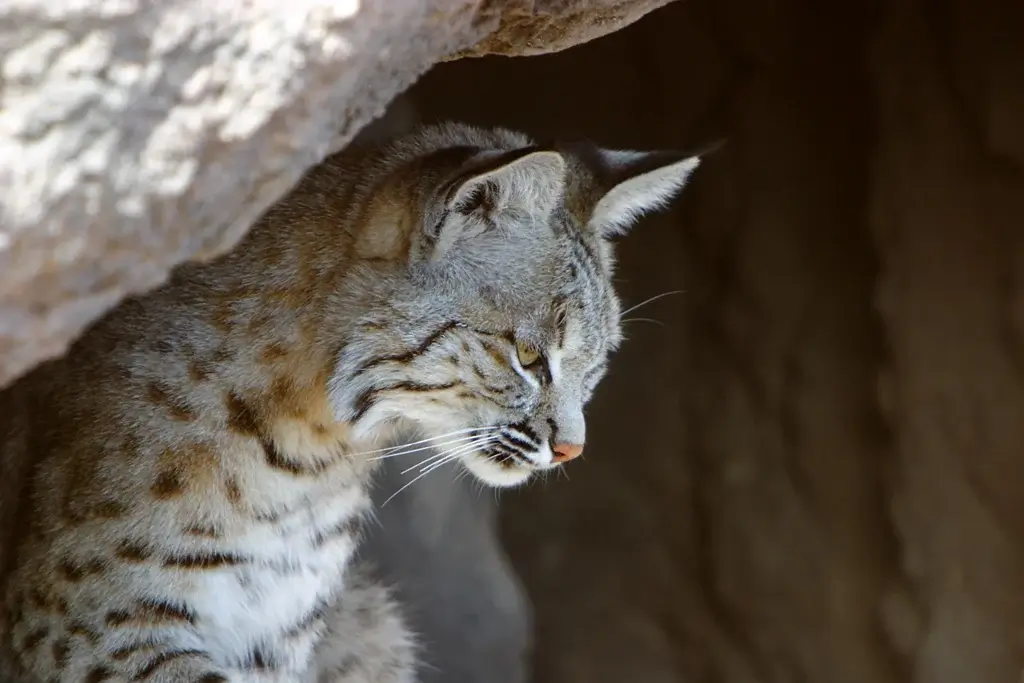
Adult male bobcats weigh 20 to 30 pounds and average three feet in length. Females are considerably smaller. Bobcats can be various shades of buff and brown, with dark brown or black stripes and spots on some parts of the body. The tip of the tail is black on top and white underneath. These cats have short ear tufts; the ruffs of hair on the side of the head give the appearance of sideburns. The print is easily distinguished. It is generally twice the size of a domestic cat's print and loosely resembles that of a coyote or dog but is more rounded and lacks visible toe nails. Members of the dog family leave claw marks; felines do not. There are four toes. At greater speeds the toes of the front foot spread more easily than those of the hind foot, which has a smaller heal pad. Fine, muddy silt leaves the clearest tracks. Although similar in appearance to other cat tracks, bobcat tracks (at about two inches in diameter) are considerably smaller than those of cougar or lynx. Lynx and bobcats are not easy to distinguish. The tail is the best point of comparison. The tip of a bobcat’s tail is black on top and white beneath; a lynx’s tail is completely black tipped. The feet of a bobcat are noticeably smaller than those of a lynx. In addition, bobcats have shorter ear tufts and a less uniform coat color than a lynx. Lynx: Bobcat: How To Prevent Or Resolve Conflicts With Bobcat: Although bobcat will kill small livestock (e.g., chickens), it is rare for bobcats to kill domestic animals. Should there be a pattern, homeowners can use some management strategies to minimize conflicts. Learn more about how to prevent or resolve conflicts with bobcats
Habitat & Range
Bobcats use all of the habitats that are found throughout their range in Maine, from agricultural areas to dense woods. Rock cliffs, outcroppings, and ledges are important to bobcats for shelter, raising young, and resting sites. Large brush or log piles and hollow trees or logs are used in wooded areas. Finding bobcats in open fields, meadows and agricultural areas is not uncommon, provided enough brushy or timbered areas for escape cover is nearby. Bobcats occur less frequently in areas of deep winter snow. Historically, it is thought that bobcat populations expanded north since the 1980s, but can often struggle in an attempt to survive severe winters in Maine’s northern areas. Unlike lynx, bobcats have relatively small feet so snow greatly reduces their mobility and ability to catch prey. Home range size of bobcats in Maine varies from about 36 square miles for adult males and about 18 square miles for adult females.
Life History
Diet: Bobcats are opportunistic and will prey upon a wide variety of animals. Food sources include mice, voles, snowshoe hare, grouse, woodchucks, beaver, deer (full grown and fawns), and turkeys. They also feed upon insects, reptiles, small birds, and carrion. Bobcats hunt primarily by sight and sound, which means they spend much of their time sitting or crouching, watching, and listening. Once they've located prey, they stalk until they are close enough to make a quick dash, then attack. A bobcat will often cover, orcache, the remains of a large kill with snow, grass, or leaves, revisiting the carcass until most of it is consumed. Once bobcats have located prey, they stalk within range of a quick dash and then pounce. In undisturbed areas, bobcats hunt at dawn or dusk if prey is available, but they can be active any time of day. These cats typically limit their activity in areas occupied by humans to evening hours. In dim light, bobcats can see up to six times better than humans. People rarely see bobcats because of the animal's elusive nature and caution around humans. Nocturnal/Diurnal: Bobcats are often nocturnal and are active hunters during dawn and dusk, likely because their prey may be active during these times and the bobcats have more rods and cones in their eyes, allowing for better vision in the dark. Additionally, the bobcat’s eye (along with most felines) have an elliptical eye shape with larger corneas allowing more light to enter the eye so prey or predators are more prominent at night. Seasonal Changes: Physical characteristics of bobcat change slightly to allow for better camouflage in its habitat, reddish-brown in the summer and tawny-gray in winter months. Mating occurs between February and March, but bobcat seasonal home ranges and movement increase during spring and summer months when travel is easier. Reproduction & Family Structure: Bobcats are solitary animals. Males and females only associate for the brief time required for courtship and mating, usually in late February to late March. A litter of one to five kittens is usually born in May on a day-bed located in thick vegetation to deter predators. Young bobcats leave the family group as early as eight months, but often stay with their mother until their first birthday. Bobcats can breed with other felines such as Canada lynx.
Status, Trends & Threats
Bobcats have been known to live up to 12 years in the wild, but the average life expectancy is probably closer to three to four years. Few predators other than fisher and humans are able to kill an adult bobcat. Adult bobcats may receive fatal or debilitating injuries from prey animals. Eagles, great horned owls, coyotes, foxes, bears, and adult male bobcats are known to kill young bobcats. Historically, it is thought that bobcat populations expanded north since the 1980s but can often struggle in an attempt to survive severe winters in Maine’s northern areas. While bobcats are considered a stable species and are currently classified as Least Concern, threats to the population include deforestation and loss of habitat, vehicle collisions, and exposure to rat poison. MDIFW regulates and manages the hunting and trapping of bobcats. All bobcats harvested must be registered with the Department, along with submission of a tooth and tissue samples to determine age and sex of the animals. Biologists monitor the harvest data to ensure that hunting and trapping levels are sustainable.
Hunting Season
Hunting: Dec 1 - Feb 20, 2026-2027. Trapping: General trapping season Nov 2 - Dec 31.
Frequently Asked Questions
Regulations for hunting Bobcat in Maine
Bobcat hunting season in Maine runs Dec 1 through Feb 20. No bag limit during hunting season. Trappers may take bobcat during the general trapping season (Nov 2 - Dec 31). Successful hunters must register bobcat pelts with IFW staff and submit a lower jaw, canine tooth, or lateral incisor along with a meat sample for aging and research.
When is Bobcat hunting season in Maine?
Hunting: Dec 1 - Feb 20, 2026-2027. Trapping: General trapping season Nov 2 - Dec 31.
What is the bag limit for Bobcat in Maine?
No limit (hunting). Trapping follows general trapping regulations.
What's another name for Bobcat?
Bobcat is also known as Bay lynx, Wildcat in Maine.
What is the scientific name of the bobcat?
The bobcat's scientific name is Lynx rufus.
References
| State | Category | Directory | Subcategory | Content | Source |
|---|---|---|---|---|---|
| Maine | Hunting | Regulations | Season Dates | Hunting: Dec 1 - Feb 20, 2026-2027. Trapping: General trapping season Nov 2 - Dec 31. | Link |
| Maine | Hunting | Regulations | Regulations | Bobcat hunting season in Maine runs Dec 1 through Feb 20. No bag limit during hunting season. Trappers may take bobcat d | Link |