Also known as: Woodcock, Timberdoodle
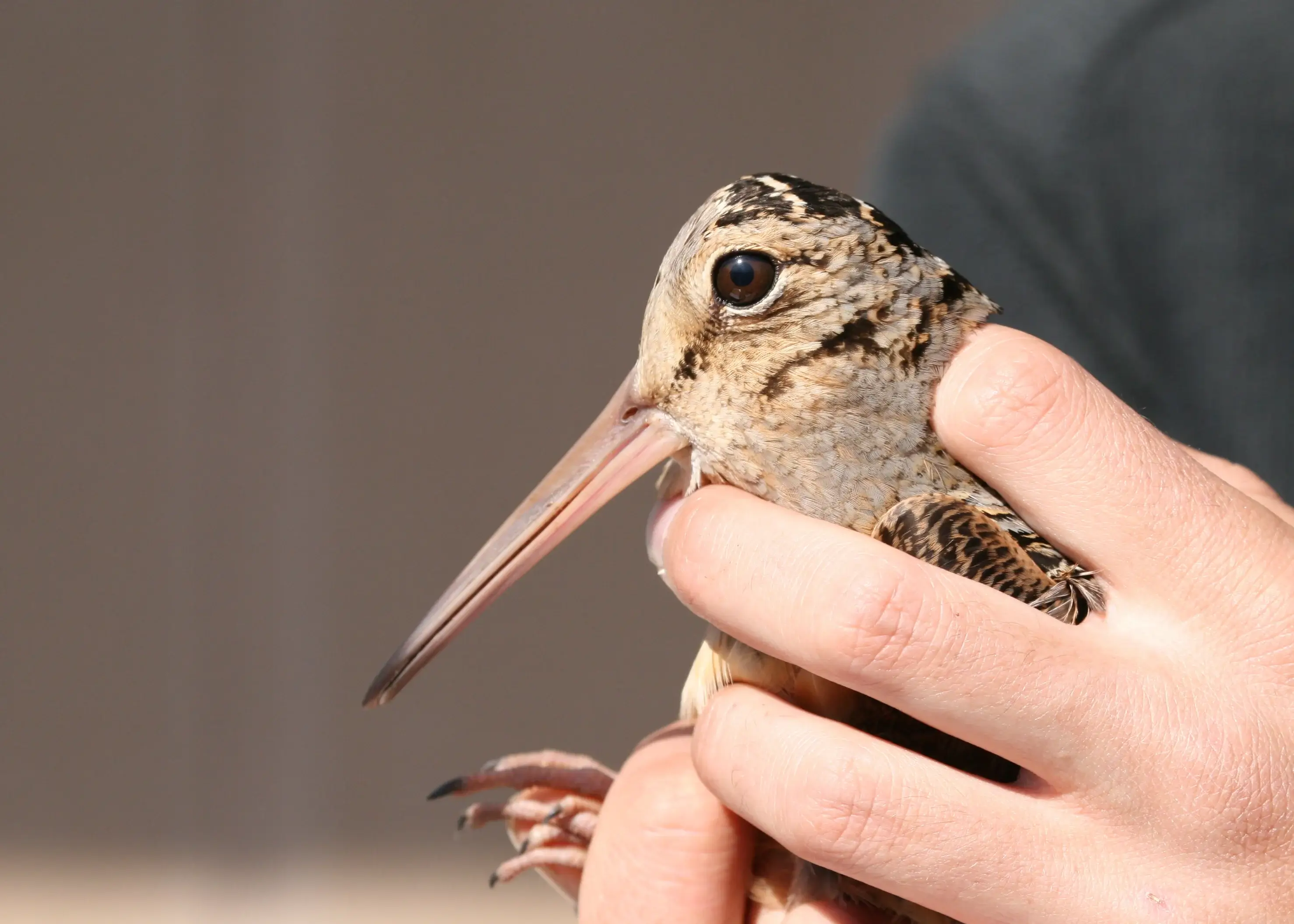
The American woodcock (Scolopax minor), sometimes colloquially referred to as the timberdoodle, mudbat, becasse, bogsucker, brush snipe, night partridge, or Labrador twister is a small shorebird species found primarily in the eastern half of North America. Woodcocks spend most of their time on the ground in brushy, young-forest habitats, where the birds' brown, black, and gray plumage provides excellent camouflage.
The American woodcock is the only species of woodcock inhabiting North America. Although classified with the sandpipers and shorebirds in the family Scolopacidae, the American woodcock lives mainly in upland settings.
The population of the American woodcock has fallen by an average of slightly more than 1% annually since the 1960s. Most authorities attribute this decline to a loss of habitat caused by forest maturation and urban development. It is also a popular game bird, with about 540,000 killed annually by some 133,000 hunters in the United States.
In 2008, wildlife biologists and conservationists released an American woodcock conservation plan presenting figures for the acreage of early successional habitat that must be created and maintained in the United States and Canada to stabilize the woodcock population at current levels, and to return it to 1970s densities.
Description
The American woodcock has a plump body, short legs, a large, rounded head, and a long, straight prehensile bill. Adults are 10 to 12 inches (25 to 30 cm) long and weigh 5 to 8 ounces (140 to 230 g). Females are considerably larger than males. The bill is 2.5 to 2.8 inches (6.4 to 7.1 cm) long. Wingspans range from 16.5 to 18.9 inches (42 to 48 cm).
The plumage is a cryptic mix of different shades of browns, grays, and black. The chest and sides vary from yellowish-white to rich tans. The nape of the head is black, with three or four crossbars of deep buff or rufous. The feet and toes, which are small and weak, are brownish gray to reddish brown. Woodcocks have large eyes located high in their heads, and their visual field is probably the largest of any bird, 360° in the horizontal plane and 180° in the vertical plane.
The woodcock uses its long, prehensile bill to probe in the soil for food, mainly invertebrates and especially earthworms. A unique bone-and-muscle arrangement lets the bird open and close the tip of its upper bill, or mandible, while it is sunk in the ground. Both the underside of the upper mandible and the long tongue are rough-surfaced for grasping slippery prey.
Taxonomy
The genus Scolopax was introduced in 1758 by the Swedish naturalist Carl Linnaeus in the tenth edition of his Systema Naturae. The genus name is Latin for a snipe or woodcock. The type species is the Eurasian woodcock (Scolopax rusticola).
Distribution and habitat
Woodcocks inhabit forested and mixed forest-agricultural-urban areas east of the 98th meridian. Woodcocks have been sighted as far north as York Factory, Manitoba, and east to Labrador and Newfoundland. In winter, they migrate as far south as the Gulf Coast of the United States and Mexico.
The primary breeding range extends from Atlantic Canada (Nova Scotia, Prince Edward Island, and New Brunswick) west to southeastern Manitoba, and south to northern Virginia, western North Carolina, Kentucky, northern Tennessee, northern Illinois, Missouri, and eastern Kansas. A limited number breed as far south as Florida and Texas. The species may be expanding its distribution northward and westward.
After migrating south in autumn, most woodcocks spend the winter in the Gulf Coast and southeastern Atlantic Coast states. Some may remain as far north as southern Maryland, eastern Virginia, and southern New Jersey. The core of the wintering range centers on Louisiana, Mississippi, Alabama, and Georgia. Based on the Christmas Bird Count results, winter concentrations are highest in the northern half of Alabama.
American woodcocks live in wet thickets, moist woods, and brushy swamps. Ideal habitats featur
Hunting Season
Sep 20 – Nov 3
Frequently Asked Questions
Regulations for hunting American Woodcock in North Dakota
American woodcock hunting in North Dakota: Sep 20 – Nov 3. Bag limit: 3 daily, 9 possession. Follows federal migratory bird regulations. Non-toxic shot required.
When is American Woodcock hunting season in North Dakota?
Sep 20 – Nov 3
What is the bag limit for American Woodcock in North Dakota?
3 daily / 9 possession
What's another name for American Woodcock?
American Woodcock is also known as Woodcock, Timberdoodle in North Dakota.
References
| State | Category | Directory | Subcategory | Content | Source |
|---|---|---|---|---|---|
| North Dakota | Hunting | Regulations | Season Dates | Sep 20 – Nov 3 | Link |
| North Dakota | Hunting | Regulations | Regulations | American woodcock hunting in North Dakota: Sep 20 – Nov 3. Bag limit: 3 daily, 9 possession. Follows federal migratory b | Link |