Also known as: Ring-necked pheasant, Rooster pheasant, Chinese pheasant
The common pheasant (Phasianus colchicus), ring-necked pheasant, or blue-headed pheasant, is a bird in the pheasant family (Phasianidae). The genus name comes from Latin phasianus 'pheasant'. The species name colchicus is Latin for 'of Colchis' (modern day Georgia), a country on the Black Sea where pheasants became known to Europeans. Although Phasianus was previously thought to be closely related to the genus Gallus, the genus of junglefowl and domesticated chickens, recent studies show that they are in different subfamilies, having diverged over 20 million years ago.
It is native to Asia, where it is widespread, and also the extreme southeast of Europe in the northern foothills of the Caucasus Mountains. It has been widely introduced elsewhere as a game bird. In parts of its range, mainly in places where none of its relatives occur such as in Europe, where it is naturalised, it is simply known as the pheasant. Ring-necked pheasant is both the collective name for a number of subspecies and their intergrades that have white neck rings, and the name used for the species as a whole in North America.
It is a well-known gamebird, among those of more than regional importance perhaps the most widespread and ancient one in the whole world. The common pheasant is one of the world's most hunted birds; it has been introduced for that purpose to many regions, and is also common on game farms where it is commercially bred. The ring-necked subspecies group in particular are commonly bred and were introduced to many parts of the world; the game farm stock, though no distinct breeds have been developed yet, can be considered semi-domesticated. The ring-necked pheasant is the state bird of South Dakota, one of only two US state birds that is not a species native to the United States.
The green pheasant (P. versicolor) of Japan is sometimes considered a subspecies of the common pheasant. Though the species produce fertile hybrids wherever they coexist, this is simply a typical feature among fowl (Galloanseres), in which postzygotic isolating mechanisms are slight compared to most other birds. The species apparently have somewhat different ecological requirements and at least in its typical habitat, the green pheasant outcompetes the common pheasant. The introduction of the latter to Japan has therefore largely failed.
Description
There are many colour forms of the male common pheasant, ranging in colour from nearly white to almost black in some melanistic examples. These are due to captive breeding and hybridisation between subspecies and with the green pheasant, reinforced by continual releases of stock from varying sources to the wild. For example, the "ring-necked pheasants" common in Europe, North America and Australia do not pertain to any specific taxon, they rather represent a stereotyped hybrid swarm. Body weight can range from 0.5 to 3 kg (1 to 7 lb), with males averaging 1.2 kg (2 lb 10 oz) and females averaging 0.9 kg (2 lb 0 oz). Wingspan ranges from 56–86 cm (22–34 in).
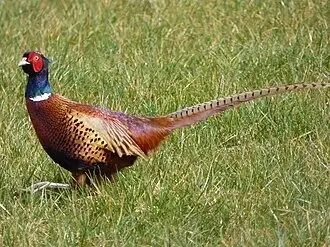
The adult male common pheasant of the nominate subspecies Phasianus colchicus colchicus is 60–89 cm (23+1⁄2–35 in) in length with a long brown streaked black tail, accounting for almost 50 cm (20 in) of the total length. The body plumage is barred bright gold or fiery copper-red and chestnut-brown plumage with iridescent sheen of green and purple; but rump uniform is sometimes blue. The wing coverage is white or cream and black-barred markings are common on the tail. The head is bottle green with a small crest and distinctive red wattle. P. c. colchicus and some other races lack a white neck ring. Behind the face are two ear-tufts, that make the pheasant appear more alert.
The female (hen) and juveniles are much less showy, with a duller mottled brown plumage all over and measuring 50–63 cm (19+1⁄2–25 in) long including a tail of around 20 cm (8 in). Juvenile birds have the appearance of the female with a shorter tail until young males begin to grow characteri
Hunting Season
Oct 11 – Jan 4; Youth Season: Oct 4-5
Frequently Asked Questions
Regulations for hunting Ring-necked Pheasant in North Dakota
Ring-necked pheasant hunting in North Dakota: Oct 11 – Jan 4. Youth season (ages 15 & under): Oct 4-5. Bag limit: 3 roosters daily, 12 possession. Shotgun capacity max 3 shells. Non-toxic shot required on USFWS lands. Nonresidents restricted on PLOTS/WMAs Oct 11-17.
When is Ring-necked Pheasant hunting season in North Dakota?
Oct 11 – Jan 4; Youth Season: Oct 4-5
What is the bag limit for Ring-necked Pheasant in North Dakota?
3 daily (male only) / 12 possession
What's another name for Ring-necked Pheasant?
Ring-necked Pheasant is also known as Ring-necked pheasant, Rooster pheasant, Chinese pheasant in North Dakota.
References
| State | Category | Directory | Subcategory | Content | Source |
|---|---|---|---|---|---|
| North Dakota | Hunting | Regulations | Season Dates | Oct 11 – Jan 4; Youth Season: Oct 4-5 | Link |
| North Dakota | Hunting | Regulations | Regulations | Ring-necked pheasant hunting in North Dakota: Oct 11 – Jan 4. Youth season (ages 15 & under): Oct 4-5. Bag limit: 3 roos | Link |