Also known as: Eastern cottontail, Cottontail rabbit
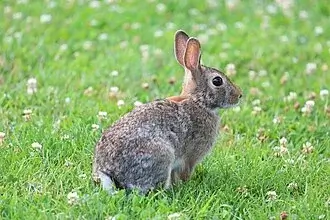
The eastern cottontail (Sylvilagus floridanus) is a species of rabbit in the family Leporidae. It is the most widespread and abundant rabbit species in North America, inhabiting a wide range that extends from southern Canada throughout most of the United States and into parts of Mexico, Central America, and the northern regions of South America. Known for its distinctive fluffy white tail, which resembles a cotton ball and gives the species its common name, the eastern cottontail typically inhabits open fields, meadows, and brushy areas where it can easily find cover and food. It is a primarily herbivorous, crepuscular mammal that feeds on grasses, herbs, twigs, and bark, and plays an important role in the ecosystem as prey for a variety of predators including foxes, hawks, and owls. Due to its adaptability to human-altered landscapes such as suburban and agricultural areas, the eastern cottontail has maintained stable population levels and is not considered threatened. It is also well known for its high reproductive rate, with females capable of producing multiple large litters annually, which contributes to its widespread presence.
Taxonomy
Sylvilagus floridanus is a member of the family Leporidae within the order Lagomorpha. It was first formally described by French naturalist Charles Alexandre Lesueur in 1827. The genus Sylvilagus includes around 15 species of New World cottontail rabbits, which are widespread throughout the Americas.
Subspecies
There are at least 17 recognized subspecies of Sylvilagus floridanus, distinguished mainly by geographic distribution and minor morphological differences. These subspecies are generally grouped by region:
Morphological and genetic variation across populations reflect adaptation to diverse environments, with some populations showing notable differences in size, coloration, and behavior.
Etymology
The genus name Sylvilagus is derived from Latin silva, meaning "forest" or "woodland," and lagus, a form adapted from Ancient Greek: λαγώς : lagṓs, meaning "hare" or "rabbit," thus translating roughly to "woodland hare."
The species epithet floridanus means "of Florida," referencing the region where the species was first scientifically identified.
Evolution and phylogeny
The eastern cottontail belongs to the Leporidae family, which includes all rabbits and hares. Within this family, Sylvilagus is a New World genus that diverged from Old World rabbits and hares millions of years ago.
Molecular and morphological studies have identified several distinct species and subspecies within Sylvilagus, highlighting a complex evolutionary history shaped by geographic isolation and environmental adaptation. Separate populations of the eastern cottontail found in different regions display markedly different genetic compositions, which may factor into their adaptability to diverse habitats.
Fossil records and genetic data suggest the eastern cottontail expanded its range following the last glacial period, taking advantage of cleared forest landscapes and open habitats. This species continues to be an important subject in studies of mammalian adaptation and speciation. It
Description
The eastern cottontail has a distinctive white spot on its forehead when young and fur that ranges from reddish-brown to grayish-brown, with large hind feet, long ears, and a short, fluffy white tail. Its underside is white, and there is a rusty patch near the tail. It differs from a hare in its overall smaller size and brownish-gray coloring around the head and neck, with a lighter-colored body and a white underside on the tail. The species also has large brown eyes and long ears adapted for detecting predators. During winter, the eastern cottontail's pelage becomes more gray than brown. Kits (young rabbits) develop a similar coloring after a few weeks but are born with a white blaze running down their forehead, which fades as they mature.
This rabbit is medium-sized, measuring 36–48 cm (14–19 in) in total length,
Hunting Season
Year-round (unprotected species)
Frequently Asked Questions
Regulations for hunting Eastern Cottontail in North Dakota
Eastern cottontail rabbits are classified as unprotected species in North Dakota. They may be hunted year-round with no bag limit. No license required for residents. Nonresidents need a nongame license.
When is Eastern Cottontail hunting season in North Dakota?
Year-round (unprotected species)
What's another name for Eastern Cottontail?
Eastern Cottontail is also known as Eastern cottontail, Cottontail rabbit in North Dakota.
References
| State | Category | Directory | Subcategory | Content | Source |
|---|---|---|---|---|---|
| North Dakota | Hunting | Regulations | Season Dates | Year-round (unprotected species) | Link |
| North Dakota | Hunting | Regulations | Regulations | Eastern cottontail rabbits are classified as unprotected species in North Dakota. They may be hunted year-round with no | Link |