Also known as: Gray fox, Tree fox
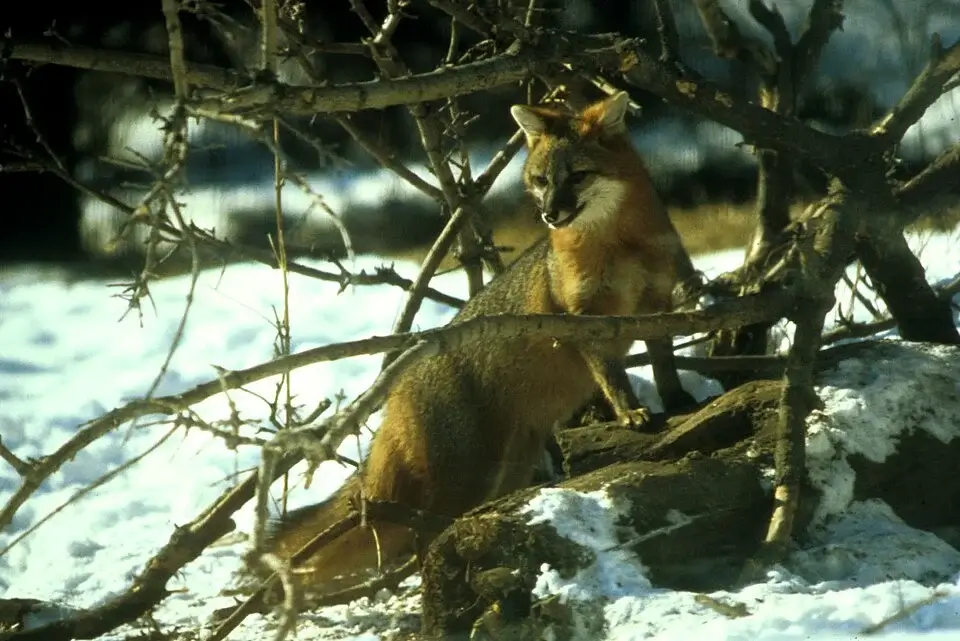
The gray fox (Urocyon cinereoargenteus), or grey fox, is an omnivorous mammal of the family Canidae, widespread throughout North America and Central America. This species and its only congener, the diminutive island fox (Urocyon littoralis) of the California Channel Islands, are the only living members of the genus Urocyon, which is considered to be genetically sister to all other living canids. Its species name cinereoargenteus means "ashen silver".
It was once the most common fox in the eastern United States, and though still found there, human advancement and deforestation allowed the red fox to become the predominant fox-like canid. Despite this post-colonial competition, the gray fox has been able to thrive in urban and suburban environments, one of the best examples being southern Florida. The Pacific States and Great Lakes region still have the gray fox as their prevalent fox.
Etymology
The genus Urocyon comes from Ancient Greek οὐρά (ourá, "tail") + κύων (kúōn, "dog"). The species epithet cinereoargenteus is a combination of 'cinereo' (from 'cinereus') meaning ashen, and 'argenteus' (from argentum), meaning 'silver', referencing the color of the tail.
Description
The gray fox is mainly distinguished from most other canids by its grizzled upper parts, black stripe down its tail and strong neck, ending in a black-tipped tail, while the skull can be easily distinguished from all other North American canids by its widely separated temporal ridges that form a 'U'-shape. Like other canids, the fox's ears and muzzle are angular and pointed. Its claws tend to be lengthier and curved.
There is little sexual dimorphism, save for the females being slightly smaller than males. The gray fox ranges from 76 to 112.5 cm (29.9 to 44.3 in) in total length. The tail measures 27.5 to 44.3 cm (10.8 to 17.4 in) of that length and its hind feet measure 100 to 150 mm (3.9 to 5.9 in). The gray fox typically weighs 3.6 to 7 kg (7.9 to 15.4 lb), though exceptionally large individuals can weigh as much as 9 kg (20 lb). The gray fox is readily distinguished from the red fox by its obvious lack of the "black stockings" that stand out on the red fox. The grey fox has a stripe of black hair that runs along the middle of its tail, and individual guard hairs that are banded with white, gray, and black. The gray fox displays white on the ears, throat, chest, belly, and hind legs. Gray foxes also have black around their eyes, on the lips, and on their noses.
In contrast to the species in genus Vulpes, such as the red fox, the gray fox has oval (instead of slit-like) pupils. The gray fox also has reddish coloration on parts of its body, including the legs, sides, feet, chest, and back and sides of the head and neck. The stripe on the fox's tail ends in a black tip as well. Its weight can be similar to that of a red fox, but the gray fox appears smaller because its fur is not as long and it has shorter limbs.
The dental formula of U. cinereoargenteus is 3.1.4.23.1.4.3 = 42.
Origin and genetics
The gray fox appeared in North America during the mid-Pliocene (Hemphillian land animal age) epoch 3.6 million years ago (AEO) with the first fossil evidence found at the lower 111 Ranch site, Graham County, Arizona with contemporary mammals like the giant sloth, the elephant-like Cuvieronius, the large-headed llama, and the early small horses of Nannippus and Equus. Faunal remains at two northern California cave sites confirm the presence of the gray fox during the late Pleistocene. Genetic analysis has shown that the gray fox migrated into the northeastern United States post-Pleistocene in association with the Medieval Climate Anomaly warming trend.
Genetic analyses of the fox-like canids confirmed that the gray fox is a distinct genus from the red foxes (Vulpes spp.). The genus Urocyon is considered to be sister to the other living canid taxa. Genetically, the gray fox often clusters with two other ancient lineages: The east Asian raccoon dog (Nyctereutes
Hunting Season
Day hunting: year-round. Night hunting: Nov 24 – May 31. Trapping: year-round
Frequently Asked Questions
Regulations for hunting Gray Fox in North Dakota
Gray fox hunting in North Dakota follows the same regulations as red fox. Day hunting year-round. Night hunting: Nov 24 – May 31. Trapping: year-round. No bag limit.
When is Gray Fox hunting season in North Dakota?
Day hunting: year-round. Night hunting: Nov 24 – May 31. Trapping: year-round
What is the bag limit for Gray Fox in North Dakota?
No limit (unlimited take)
What's another name for Gray Fox?
Gray Fox is also known as Gray fox, Tree fox in North Dakota.
References
| State | Category | Directory | Subcategory | Content | Source |
|---|---|---|---|---|---|
| North Dakota | Hunting | Regulations | Season Dates | Day hunting: year-round. Night hunting: Nov 24 – May 31. Trapping: year-round | Link |
| North Dakota | Hunting | Regulations | Regulations | Gray fox hunting in North Dakota follows the same regulations as red fox. Day hunting year-round. Night hunting: Nov 24 | Link |