Also known as: Pinnated grouse, Prairie chicken
The greater prairie-chicken or pinnated grouse (Tympanuchus cupido), sometimes called a boomer, is a large bird in the grouse tribe. This North American species was once abundant but has become extremely rare or extirpated over much of its range due to habitat loss, natural disasters, and overhunting. Conservation measures are underway to ensure the sustainability of existing small populations. One of the most famous aspects of these creatures is the mating ritual called booming.
Carl Linnaeus based his account on the "Le Cocq de bois d'Amerique" that had been described and illustrated by the English naturalist Mark Catesby in his book The Natural History of Carolina, Florida and the Bahama Islands. Catesby had seen greater prairie-chickens in 1743 at the home of the Earl of Wilmington in the then village of Chiswick, 7 mi (11 km) west of London. The Earl believed that that his birds had come from North America but did not know from where. Linnaeus specified the type locality as Virginia but this has been changed to Pennsylvania by the American Ornithologists' Union.
Taxonomy
The greater prairie-chicken was formally described in 1758 by the Swedish naturalist Carl Linnaeus in the tenth edition of his Systema Naturae under the binomial name Tetrao cupido. Linnaeus based his account on the "Le Cocq de bois d'Amerique" that had been described and illustrated by the English naturalist Mark Catesby in his book The Natural History of Carolina, Florida and the Bahama Islands. Catesby had seen greater prairie-chickens in 1743 at the home of the Earl of Wilmington in the then village of Chiswick, 7 mi (11 km) west of London. The Earl believed that that his birds had come from North America but did not know from where. Linnaeus specified the type locality as Virginia but this has been changed to Pennsylvania by the American Ornithologists' Union. The specific epithet cupido was chosen as the erectile neck feathers were thought to resemble the wings of Cupid. The greater prairie-chicken is now placed together with the sharp-tailed grouse and the lesser prairie-chicken in the genus Tympanuchus that was introduced in 1841 by the German zoologist Constantin Gloger.
Three subspecies are recognised:
Description
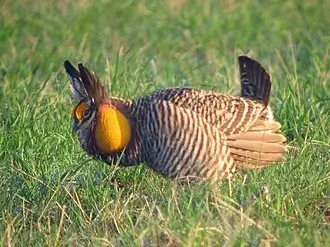
Adults of both sexes are medium to large chicken-like birds, stocky with round wings. They have short tails which are typically rounded. Adult males have orange comb-like feathers over their eyes and dark, elongated head feathers that can be raised or lain along neck. They also possess a circular, un-feathered neck patch which can be inflated while displaying; this, like their comb feathers, is also orange. As with many other bird species, the adult females have shorter head feathers and also lack the male's yellow comb and orange neck patch. Adults are about 43 cm (17 in) long, and weigh between 700–1,200 g (25–42 oz). The greater prairie-chicken has a wingspan range of 69.5–72.5 cm (27.4–28.5 in).
Distribution and habitat
The greater prairie-chicken prefers undisturbed prairie and was originally found in tallgrass prairies. It can tolerate agricultural land mixed with prairie, but sparser population density is found in areas that are more agricultural. Its diet consists primarily of seeds and fruit, but during the summer it also eats green plants and insects such as grasshoppers, crickets, and beetles. This species was once widespread all across the oak savanna and tall grass prairie ecosystem.
Conservation
A steamboat captain recalled seeing great flocks of prairie chickens at Bird's Point in 1840, writing "Then we gazed in wonderment, but very soon our eyes were drawn to something more attractive which caused us to forget the great river. The whole banks or sandbars on either river were a mass of quail or partridges. I have never in my life seen such a grand sight. They had come from the prairies to the river, but unable to fly across either stream there they were by the millions running up and down each river until they ha
Hunting Season
SEASON CLOSED in North Dakota
Frequently Asked Questions
Regulations for hunting Greater Prairie-Chicken in North Dakota
Greater prairie-chicken (pinnated grouse) hunting is CLOSED in North Dakota. No open season for 2025. Check future NDGF proclamations for potential season openings.
Can you hunt greater prairie-chicken in North Dakota?
No, the greater prairie-chicken (pinnated grouse) season is CLOSED in North Dakota. Check future NDGF proclamations for potential season openings.
What does a greater prairie-chicken look like?
The greater prairie-chicken is a medium-sized grouse with a stocky build, barred brown plumage, and a short, dark tail. Males have distinctive yellow-orange combs over their eyes and inflated yellow-orange air sacs on their necks during display.
What's another name for Greater Prairie-Chicken?
Greater Prairie-Chicken is also known as Pinnated grouse, Prairie chicken in North Dakota.
References
| State | Category | Directory | Subcategory | Content | Source |
|---|---|---|---|---|---|
| North Dakota | Hunting | Regulations | Season Dates | SEASON CLOSED in North Dakota | Link |
| North Dakota | Hunting | Regulations | Regulations | Greater prairie-chicken (pinnated grouse) hunting is CLOSED in North Dakota. No open season for 2025. Check future NDGF | Link |