Also known as: Woodchuck, Whistle pig
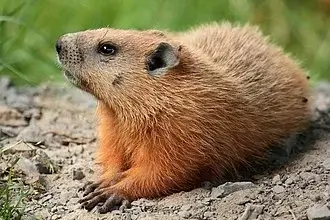
The groundhog (Marmota monax), also known as the woodchuck, is a rodent of the family Sciuridae, belonging to the group of large ground squirrels known as marmots.
A lowland creature of North America, it is found through much of the Eastern United States, across Canada and into Alaska.
It was given its scientific name as Mus monax by Carl Linnaeus in 1758, based on a description of the animal by George Edwards, published in 1743.
The groundhog, being a lowland animal, is exceptional among marmots. Other marmots, such as the yellow-bellied and hoary marmots, live in rocky and mountainous areas. Groundhogs are considered one of the most solitary of marmot species. They live in aggregations, and their social organization and long-term pair bonds varies across populations. The groundhog's male and female interactions are usually limited to the mating season and copulation. However, certain populations of groundhogs have been observed to form long-term adult male-female association throughout the year, and often from year to year.
The groundhog is an important contributor to the maintenance of healthy soil in woodlands and plains; as such, the species is considered a crucial habitat engineer. The groundhog is an extremely intelligent animal, forming complex social networks and kinship with its young; it is capable of understanding social behavior, communicating threats through whistling, and working cooperatively to accomplish tasks such as burrowing.
Etymology
Common names for the groundhog include chuck, wood-chuck, groundpig, whistle-pig, whistler, thickwood badger, Canada marmot, monax, moonack, weenusk, red monk, land beaver and, among French Canadians in eastern Canada, siffleux. The name "thickwood badger" was given in the Northwest to distinguish the animal from the prairie badger. Monax (Móonack) is an Algonquian name of the woodchuck, which means "digger" (cf. Lenape monachgeu). Young groundhogs may be called chucklings.
The etymology of the name woodchuck is not related to wood nor any sense of chucking. It stems from an Algonquian (possibly Narragansett) name for the animal, wuchak. The similarity between the words has led to the popular tongue-twister:
How much wood would a woodchuck chuck
if a woodchuck could chuck wood?
A woodchuck would chuck all the wood he could
if a woodchuck could chuck wood!
Description
The groundhog is the largest sciurid in its geographical range, excluding its presence in British Columbia where its range may be comparable to that of its somewhat larger cousin, the hoary marmot. Adults may measure from 41.8 to 68.5 cm (16+7⁄16 to 26+15⁄16 in) in total length, including a tail of 9.5 to 18.7 cm (3+3⁄4 to 7+3⁄8 in). Weights of adult groundhogs typically fall between 2 and 6.3 kg (4 lb 7 oz and 13 lb 14 oz).
Male groundhogs are slightly larger than females on average and, like all marmots, they are considerably heavier during autumn (when engaged in autumn hyperphagia) than when they emerge from hibernation in spring. Adult males average year-around weight 3.83 kg (8 lb 7 oz), with spring to fall average weights of 3.1 to 5.07 kg (6 lb 13 oz to 11 lb 3 oz) while females average 3.53 kg (7 lb 13 oz), with spring to fall averages of 3.08 to 4.8 kg (6 lb 13 oz to 10 lb 9 oz). Seasonal weight changes reflect circannual deposition and use of fat. Groundhogs attain progressively higher weights each year for the first two or three years, after which weight plateaus.
Groundhogs have four incisors, which grow 1.5 millimetres (1⁄16 in) per week. Constant usage wears them down by about that much each week. Unlike the incisors of many other rodents, the incisors of groundhogs are white to ivory-white. Groundhogs are well-adapted for digging, with powerful, short legs and broad, long claws. The groundhog's tail is shorter than that of other Sciuridae—only about one-fourth of body length.
Distribution and habitat
The groundhog dwells in lowland habitats, unlike other marmots that live in rocky and
Hunting Season
Year-round (unprotected species)
Frequently Asked Questions
Regulations for hunting Groundhog in North Dakota
Groundhogs are classified as unprotected species in North Dakota. They may be hunted year-round with no bag limit. No license required for residents. Nonresidents need a nongame license.
When is Groundhog hunting season in North Dakota?
Year-round (unprotected species)
What's another name for Groundhog?
Groundhog is also known as Woodchuck, Whistle pig in North Dakota.
References
| State | Category | Directory | Subcategory | Content | Source |
|---|---|---|---|---|---|
| North Dakota | Hunting | Regulations | Season Dates | Year-round (unprotected species) | Link |
| North Dakota | Hunting | Regulations | Regulations | Groundhogs are classified as unprotected species in North Dakota. They may be hunted year-round with no bag limit. No li | Link |