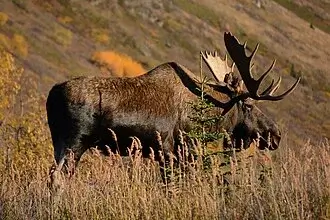
Moose Fact Sheet Tracks: Moose tracks: Front track slightly larger Front–4-1/2" - 7" L, 3-3/4" - 6" W. Rear–4" - 6-1/2" L, 3-1/2" - 4-1/2". W Walking stride: 28" - 44". Fun Facts: Moose are the largest member of the deer family. There are probably more moose in North Dakota today than when Lewis and Clark traveled through the state in 1804-06. Living with Moose in North Dakota Moose are native to North Dakota, but they disappeared following settlement in the late 1800s and early 1900s and did not start reappearing until the 1950s. When moose populations began rebuilding in North Dakota, they flourished in typical moose habitat such as forested areas with rivers, streams and lakes in the Pembina River Gorge and Turtle Mountains. But even in the early days of moose returning to North Dakota, some animals were observed taking up residence in areas that were not traditional moose habitat. That phenomenon has continued to this day, with moose populations established in agricultural river bottom landscapes all across the northern tier of the state, from Walhalla to Williston. As such, moose sightings are not uncommon anywhere in the state, and as the population has expanded, individual moose on occasion have wandered into towns and cities where they warrant real safety concerns. Big and Unpredictable Moose are the largest member of the deer family. Adult bulls can weigh up to 1,300 pounds and stand more than 6 feet tall at the shoulder. Even calves that are a few months old weigh several hundred pounds and are a safety risk if they are threatened or provoked. The key to coexisting with moose is to avoid confrontations by giving moose plenty of space. Never approach a moose. They may look docile, but they are wild animals and may act unpredictably. Always stay at least 100 yards away from any moose. While moose are generally perceived as less dangerous than some other large wild animals like bears and bison, across the country many people are injured each year by moose. Moose will normally flee when they feel threatened, but under certain circumstances, they can become aggressive. When a moose feels threatened, the long hairs on its hump may raise, and it may lay its ears back (much like a dog or a horse). It may also lick its lips, but if you can see this, you are much too close to the moose. A moose that walks slowly toward you is giving you a warning to get away. If a moose comes toward you or charges, run or walk quickly and get behind something solid, like a tree or a car, or retreat to a safe place, like a building or a vehicle In a rural setting such as a farm yard, give the moose space and time to wander away on its own, and call local authorities if you feel it is a danger. Moose and Crops Moose are mostly browsers and do not typically eat hay or other foods meant for cattle. But they are adaptable and at times will eat standing crops such as sunflowers or corn. While they are usually alone or in small groups such as a cow and calves, in the spring and summer moose need about 50 to 60 pounds of food per day. If they hang around in one place for an extended period, they can cause crop damage. In such cases, the Game and Fish Department may be able to direct licensed hunters to landowners experiencing crop damage. The Department’s private lands program may also be able to provide technical assistance to landowners to help minimize crop depredation, or work with landowners to develop wildlife food plots specifically intended for depredation purposes. To find out more about crop damage prevention measures, contact the Game and Fish Department at 701-328-6300. Feeding Moose When moose wander into farm yards or urban areas during winter, it might be tempting to provide a hand-out if these animals look like they are struggling. But feeding moose, or any wild animal for that matter, almost always does more harm than good. Moose fed by humans tend to lose their healthy fear of man, and they may hastily approach the next unsuspecting person they see – or even attack people who don’t have food to offer. If a moose in your neighborhood is fed, the chances it will charge people, especially children, increase greatly. It is often necessary for wildlife officers to kill moose that present a heightened public safety threat. Therefore, by purposely feeding moose, people can potentially contribute to the animal’s death. Moose-Vehicle Collisions In parts of North Dakota, moose are common enough that collisions with vehicles sometimes occur. When driving in moose country, especially in winter, slow down. If a moose moves into the path of your vehicle, stop as quickly as you safely can, but don’t swerve. Swerving may cause you to lose control of your vehicle. The Bottom Line Most people in North Dakota enjoy seeing moose and it is a good thing that their population is expanding. It’s important to remember that they are wild animals and should only be observed from a distance.
Habitat & Range
Aspen and boreal forests with lakes and wetlands. Moose have extended their range into the prairie where forested river bottoms and tree rows provide browse. Found primarily in the Turtle Mountains and along forested rivers in the northern one-third of North Dakota. Scattered family units frequently found along the Canadian border and eastern third of the state.
Life History
Food: Moose browse on a variety of willow species, aspen, birch and green ash. They will also feed on aquatic plants such as pond weed and moist meadow species like horsetail and lichens. In agricultural areas, moose will also eat sunflowers and corn. Mating: Breeding peaks in late September and early October with bulls tending individual cows, and at times defending harems. No permanent pair bonds. Gestation averages about 231 days (range 216-264 days). Young One to two calves born mid-May to mid-June, weighing about 34 pounds. Coat dark brown. Habits: Most active at dawn and dusk. Cows typically accompanied by calves. Outside of the breeding season, males alone or in small bachelor groups.
Hunting Season
Moose Bow: Sep 4 – Sep 27; Regular Season: Oct 9 – Nov 1
Frequently Asked Questions
Regulations for hunting Moose in North Dakota
Moose hunting in North Dakota is by lottery only for ND residents. Units M5-M11. Moose Bow: Sep 4 – Sep 27. Regular season: Oct 9 – Nov 1. Total 296 licenses (181 any moose, 115 antlerless). Firearms: centerfire .25 cal or larger. Orange clothing required. Mandatory harvest reporting by Jan 15.
How big do moose get?
Moose are the largest member of the deer family. Adult bulls can be very large, though specific ND measurements vary by region.
What do moose eat?
Moose are herbivores, feeding on aquatic plants, willow, birch, and other woody vegetation.
When is Moose hunting season in North Dakota?
Moose Bow: Sep 4 – Sep 27; Regular Season: Oct 9 – Nov 1
What is the bag limit for Moose in North Dakota?
1 moose per license (lottery only, ND residents only)
References
| State | Category | Directory | Subcategory | Content | Source |
|---|---|---|---|---|---|
| North Dakota | Hunting | Regulations | Season Dates | Moose Bow: Sep 4 – Sep 27; Regular Season: Oct 9 – Nov 1 | Link |
| North Dakota | Hunting | Regulations | Regulations | Moose hunting in North Dakota is by lottery only for ND residents. Units M5-M11. Moose Bow: Sep 4 – Sep 27. Regular seas | Link |