Also known as: Ruffed grouse, Partridge (colloquial)
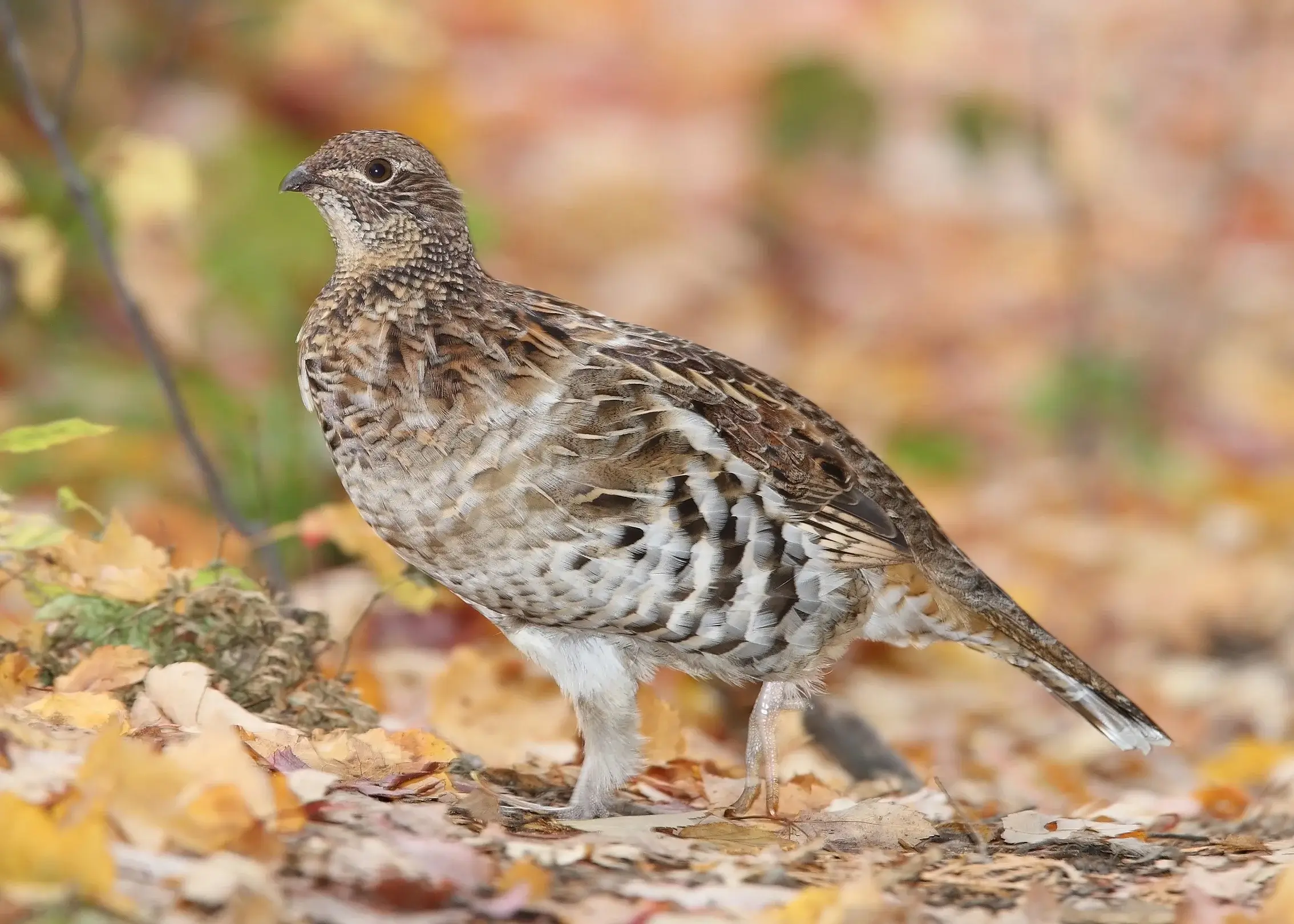
The ruffed grouse (Bonasa umbellus) is a medium-sized grouse occurring in forests from the Appalachian Mountains across Canada to Alaska. It is the most widely distributed game bird in North America. It is not migratory. It is the only species in the genus Bonasa. The ruffed grouse is sometimes incorrectly referred to as a "partridge", an unrelated phasianid, and occasionally confused with the grey partridge, a bird of open areas rather than woodlands.
The ruffed grouse is the state game bird of Pennsylvania, United States.
Taxonomy
Bonasa umbellus was first described by Carl Linnaeus in his 1766 12th edition of Systema Naturae. He classified it as Tetrao umbellus, placing it in a subfamily with Eurasian grouse. The genus Bonasa was applied by British naturalist John Francis Stephens in 1819. Ruffed grouse is the preferred common name because it applies only to this species. Misleading vernacular names abound, however, and it is often called partridge (sometimes rendered pa'tridge, or shortened to pat), pheasant, or prairie chicken, all of which are properly applied to other birds. Other nicknames for ruffed grouse include drummer or thunder-chicken.
The ruffed grouse has 13 recognized subspecies:
B. u. brunnescens (Conover, 1935) - Vancouver Island (Canada)
B. u. castanea (Aldrich & Friedmann, 1943) - Olympic Peninsula (USA)
B. u. incana (Aldrich & Friedmann, 1943) - southeastern Idaho to central Utah (USA)
B. u. labradorensis (Ouellet, 1991) - Labrador Peninsula (Canada)
B. u. mediana (Todd, 1940) - north-central USA
B. u. monticola (Todd, 1940) - central towards east-central USA
B. u. obscura (Todd, 1947) - northern Ontario (Canada)
B. u. phaios (Aldrich & Friedmann, 1943) - southeastern British Columbia (Canada) to south-central Idaho and eastern Oregon (USA)
B. u. sabini (Douglas, 1829) - western coast of Canada and USA
B. u. togata (Linnaeus, 1766) - north-central and northeastern USA and southeastern Canada
B. u. umbelloides (Douglas, 1829) - southeastern Alaska (USA) through central Canada to central Oregon and northwestern Wyoming (USA)
B. u. umbellus (Linnaeus, 1766) - east-central USA
B. u. yukonensis (Grinnell, 1916) - Alaska (USA) and northwestern Canada
Description
Ruffed grouse are chunky, medium-sized birds that weigh from 450–750 g (0.99–1.65 lb), measure from 40 to 50 cm (16 to 20 in) in length, and span 50–64 cm (20–25 in) across their short, strong wings. They have two distinct morphs - grey and brown. In the grey morph, the head, neck, and back are grey-brown; the breast is light with barring, with as much white on the underside and flanks. Overall, the birds have a variegated appearance; the throat is often distinctly lighter. The tail is essentially the same brownish grey, with regular barring and a broad black band near the end ("subterminal"). Brown-morph birds have tails of the same color and pattern. However, the rest of the plumage is much more brown, giving the appearance of a more uniform bird with less light plumage below and a conspicuously grey tail. All sorts of intergrades occur between the most typical morphs; warmer and more humid conditions favor browner birds in general.
The ruffs are on the sides of the neck in both sexes. They also have a crest on top of their head, which sometimes lies flat. Both sexes are similarly marked and sized, making them difficult to tell apart, even in hand. The female often has a broken subterminal tail band. At the same time, males tend to have unbroken tail bands, though the opposite of either can occur. Females may also do a display similar to the male. Another fairly accurate sign is that rump feathers with a single white dot indicate a female; rump feathers with more than one white dot indicate a male.
The average lifespan of a ruffed grouse is one year, although some birds are thought to live for as long as 11 years. Ruffed grouse are polygynous, and males may mate with several females during the breeding season.
Ecology
Like most grouse, the
Hunting Season
Sep 13 – Jan 4 (limited counties: Bottineau, Rolette, Cavalier, Pembina, Walsh, plus J. Clark Salyer NWR portion)
Frequently Asked Questions
Regulations for hunting Ruffed Grouse in North Dakota
Ruffed grouse hunting in North Dakota is limited to select northeastern counties: Bottineau, Rolette, Cavalier, Pembina, Walsh, and a portion of J. Clark Salyer NWR in McHenry County. Season: Sep 13 – Jan 4. Bag limit: 3 daily, 12 possession.
When is Ruffed Grouse hunting season in North Dakota?
Sep 13 – Jan 4 (limited counties: Bottineau, Rolette, Cavalier, Pembina, Walsh, plus J. Clark Salyer NWR portion)
What is the bag limit for Ruffed Grouse in North Dakota?
3 daily / 12 possession
What's another name for Ruffed Grouse?
Ruffed Grouse is also known as Ruffed grouse, Partridge (colloquial) in North Dakota.
References
| State | Category | Directory | Subcategory | Content | Source |
|---|---|---|---|---|---|
| North Dakota | Hunting | Regulations | Season Dates | Sep 13 – Jan 4 (limited counties: Bottineau, Rolette, Cavalier, Pembina, Walsh, plus J. Clark Salyer NWR portion) | Link |
| North Dakota | Hunting | Regulations | Regulations | Ruffed grouse hunting in North Dakota is limited to select northeastern counties: Bottineau, Rolette, Cavalier, Pembina, | Link |