Also known as: Sandhill crane
The sandhill crane (Antigone canadensis) is a species of large crane of North America and extreme northeastern Siberia. The common name of this bird refers to its habitat, such as the Platte River, on the edge of Nebraska's Sandhills on the American Great Plains. Sandhill cranes are known to frequent the edges of bodies of water. The central Platte River Valley in Nebraska is the most important stopover area for the nominotypical subspecies, the lesser sandhill crane (A. c. canadensis), with up to 450,000 of these birds migrating through annually.
Taxonomy
In 1750, British naturalist George Edwards included an illustration and a description of the sandhill crane in the third volume of his A Natural History of Uncommon Birds, referring to the species as the 'Brown and Ash-colour'd Crane.' Edwards based his hand-colored etching on a preserved specimen that had been brought to London from the Hudson Bay area of Canada by James Isham. When in 1758, Swedish naturalist Carl Linnaeus updated his Systema Naturae for the 10th edition, he placed the sandhill crane with herons and cranes in the genus Ardea. Linnaeus included a brief description, coined the binomial name Ardea canadensis, and cited Edwards' work.
The sandhill crane was formerly placed in the genus Grus, but a molecular phylogenetic study published in 2010 found that the genus, as then defined, was polyphyletic. In the resulting rearrangement to create monophyletic genera, four species, including the sandhill crane, were placed in the resurrected genus Antigone that had originally been erected by German naturalist Ludwig Reichenbach in 1853.
The specific epithet canadensis is the modern Latin word for "from Canada".
Five subspecies are recognised:
A. c. canadensis (Linnaeus, 1758) – northeast Siberia through Alaska and northern Canada to Baffin Island
A. c. nesiotes (Bangs & Zappey, 1905) – Cuba and Isla de la Juventud (Isle of Pines)
A. c. pratensis (Meyer, FAA, 1794) – Georgia and Florida
A. c. pulla (Aldrich, 1972) – Mississippi
A. c. tabida (Peters, JL, 1925) – southern Canada and west-central United States
A 2025 study showed a deep genetic divide between the sandhill crane populations, suggesting they should be split into a greater and lesser species. Furthermore, the two species show consistent morphological differences in size, colour, and facial structure that can be observed in field conditions.
Description
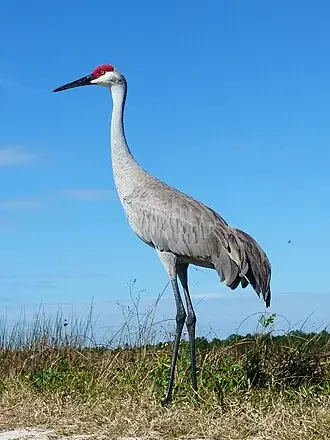
Adults are gray overall; during breeding, their plumage is usually much worn and stained, particularly in the migratory populations, and looks nearly ochre. The average weight of the larger males is 4.57 kg (10.1 lb), while the average weight of females is 4.02 kg (8.9 lb), with a range of 2.7 to 6.7 kg (6.0 to 14.8 lb) across the subspecies. Sandhill cranes have red foreheads, white cheeks, and long, dark, pointed bills. In flight, their long, dark legs trail behind, and their long necks keep straight.
Immature birds have reddish-brown upper parts and gray underparts. The juveniles do not have the characteristic red foreheads, making distinguishing the young from the parents possible, even when they are the same height.
The sexes look alike. Sizes vary among the different subspecies; the typical height of these birds is around 80 to 136 cm (2 ft 7 in to 4 ft 6 in). Their wing chords are typically 41.8–60.0 cm (16.5–23.6 in), tails are 10.0–26.4 cm (3.9–10.4 in), the exposed culmens are 6.9–16 cm (2.7–6.3 in) long, and the tarsi measure 15.5–26.6 cm (6.1–10.5 in). Wingspan is 200 cm (78.7 in).
These cranes frequently give a loud, trumpeting call that suggests a rolled "r" in the throat, and they can be heard from a long distance. Mated pairs of cranes engage in "unison calling". The cranes stand close together, calling in a synchronized and complex duet. The female makes two calls for every one from the male.
Sandhill cranes' large wingspans, typically 1.65 to 2.30 m (5 ft 5 in to 7 ft 7 in), make them very skilled soaring birds, similar in style to hawks
Hunting Season
Sep 20 – Nov 16
Frequently Asked Questions
Regulations for hunting Sandhill Crane in North Dakota
Sandhill crane hunting in North Dakota: Sep 20 – Nov 16. Unit 1 (west of US Hwy 281): 3 daily, 9 possession. Unit 2 (east of US Hwy 281): 2 daily, 6 possession. Requires general game & habitat license + small game or waterfowl license + sandhill crane permit. Shooting hours: 1/2 hr before sunrise to 2 p.m. (extended to sunset on select days). Non-toxic shot required.
When is Sandhill Crane hunting season in North Dakota?
Sep 20 – Nov 16
What is the bag limit for Sandhill Crane in North Dakota?
Unit 1 (west of US 281): 3 daily / 9 possession; Unit 2 (east of US 281): 2 daily / 6 possession
What's another name for Sandhill Crane?
Sandhill Crane is also known as Sandhill crane in North Dakota.
References
| State | Category | Directory | Subcategory | Content | Source |
|---|---|---|---|---|---|
| North Dakota | Hunting | Regulations | Season Dates | Sep 20 – Nov 16 | Link |
| North Dakota | Hunting | Regulations | Regulations | Sandhill crane hunting in North Dakota: Sep 20 – Nov 16. Unit 1 (west of US Hwy 281): 3 daily, 9 possession. Unit 2 (eas | Link |