Also known as: Rocky Mountain goat
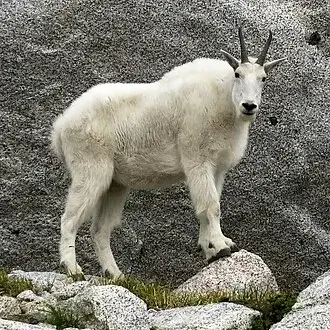
Mountain GoatKnown for their long beard and black horns, Mountain Goats reside in the Ruby Mountains and East Humboldt range of Nevada. They have special adaptations that allow them to survive in the rocky terrain. Their thick white coats protect them from cold temperatures and provide camouflage in the snowy mountains. Cloven hoofs allow them to scale sheer rocky cliffs to find food and avoid predation.
Habitat & Range
Mountain Goats were first introduced into the Ruby Mountains in the mid-1960’s with the release of 12 goats from Washington state. In Nevada, they can be found only in the Ruby Mountains and East Humboldt range. Mountain Goats prefer steep rocky cliffs, projecting pinnacles, ledges, and talus slides.
Life History
Mountain Goats usually consume their food depending on what is available to them at the time. This herbivore eats plants, grasses, mosses, and other alpine vegetation. In the summer they will eat sedges and grasses and in the winter their diet consists of coniferous trees and leaves. They drink water and eat snow to stay hydrated. Groups of Mountain Goats are referred to as bands. Adult males, called “billies,” are larger than the “nannies,” or adult females. They are polygamous animals, with the mating, or “rut,” season occurring from November to January. The gestation period is about 175 to 180 days. Birth generally takes place in late May and early June with one and sometimes two “kids,” or young. Females (nannies) will often form large groups while males (billies) will often remain solitary or with much smaller groups. Their hooves act like suction cups on steep rocky terrain and their young, called “kids,” can walk and jump about 10 minutes after birth. They can experience predation from bears, mountain lions, wolves, golden eagles, and humans.
Status, Trends & Threats
Disease; Habitat Degradation
Hunting Season
Limited draw. Late summer/fall (specific dates vary by unit group). Check current NDOW regulations.
Frequently Asked Questions
Regulations for hunting Mountain Goat in Nevada
Mountain goat hunting in Nevada is limited to the Ruby Mountains and East Humboldt Range, where the population was established from 12 Washington-state goats introduced in the mid-1960s. Tags are extremely limited and awarded through the big game draw. Hunting is physically demanding due to steep alpine terrain. Mandatory harvest reporting required.
When is Mountain Goat hunting season in Nevada?
Limited draw. Late summer/fall (specific dates vary by unit group). Check current NDOW regulations.
What is the bag limit for Mountain Goat in Nevada?
1 goat per tag (limited draw only).
What's another name for Mountain Goat?
Mountain Goat is also known as Rocky Mountain goat in Nevada.
References
| State | Category | Directory | Subcategory | Content | Source |
|---|---|---|---|---|---|
| Nevada | Hunting | Regulations | Season Dates | Limited draw. Late summer/fall (specific dates vary by unit group). Check current NDOW regulations. | Link |
| Nevada | Hunting | Regulations | Regulations | Mountain goat hunting in Nevada is limited to the Ruby Mountains and East Humboldt Range, where the population was estab | Link |