Also known as: Black bear
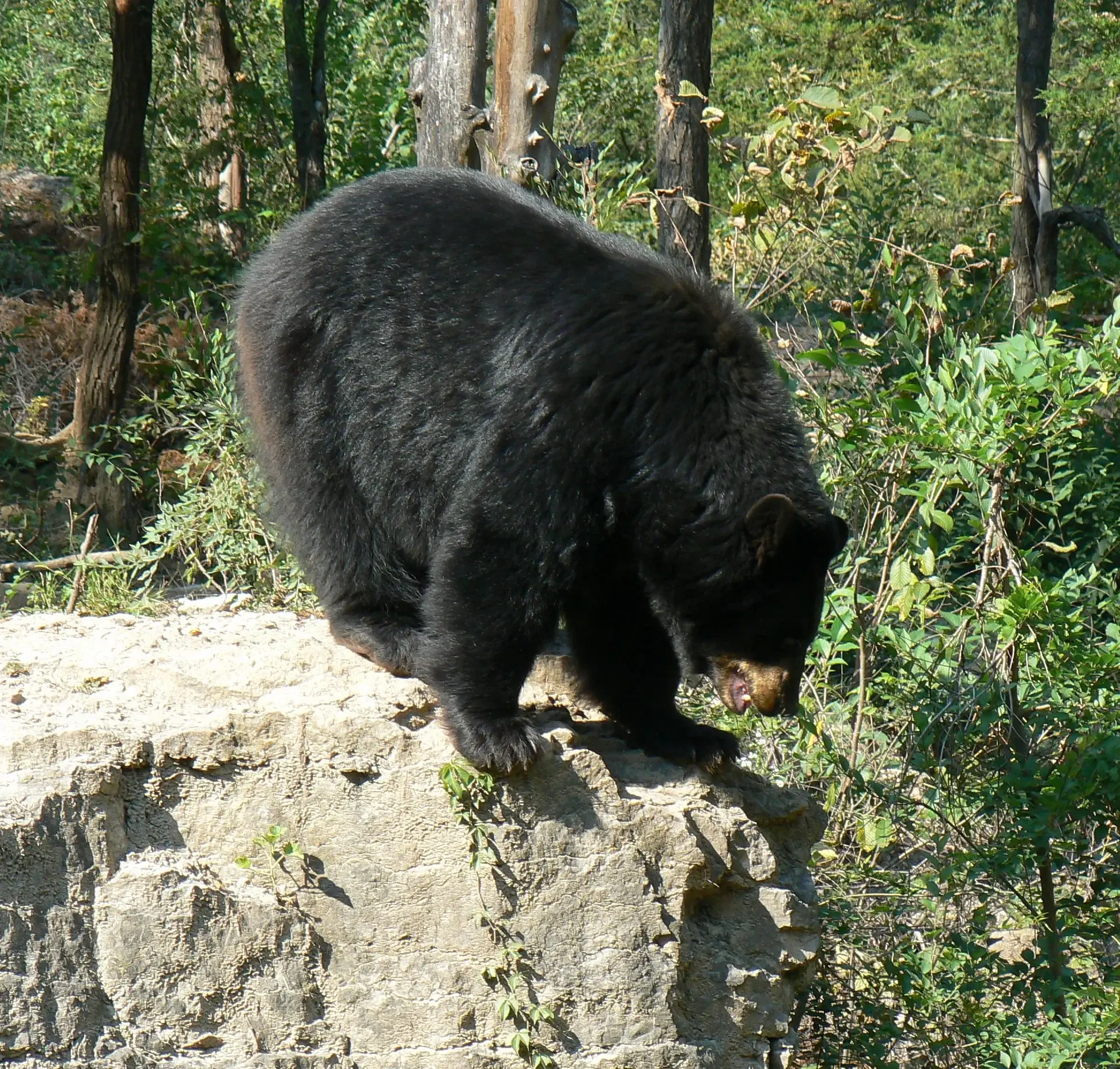
The American black bear (Ursus americanus), or simply black bear, is a species of medium-sized bear which is endemic to North America. It is the continent's smallest and most widely distributed bear species. It is an omnivore, with a diet varying greatly depending on season and location. It typically lives in largely forested areas; it will leave forests in search of food and is sometimes attracted to human communities due to the immediate availability of food. The International Union for Conservation of Nature (IUCN) lists the American black bear as a least-concern species because of its widespread distribution and a large population, estimated to be twice that of all other bear species combined. Along with the brown bear (Ursus arctos), it is one of the two modern bear species not considered by the IUCN to be globally threatened with extinction.
Habitat & Range
Throughout their range, habitats preferred by American black bears have a few shared characteristics. They are often found in areas with relatively inaccessible terrain, thick understory vegetation and large quantities of edible material (especially masts). The adaptation to woodlands and thick vegetation in this species may have originally been because the bear evolved alongside larger, more aggressive bear species, such as the extinct giant short-faced bear and the grizzly bear, that monopolized more open habitats and the historic presence of larger predators, such as Smilodon and the American lion, that could have preyed on black bears. Although found in the largest numbers in wild, undisturbed areas and rural regions, American black bears can adapt to surviving in some numbers in peri-urban regions, as long as they contain easily accessible foods and some vegetative coverage. In most of the contiguous United States, American black bears today are usually found in heavily vegetated mountainous areas, from 400 to 3,000 m (1,300 to 9,800 ft) in elevation. For American black bears living in the American Southwest and Mexico, habitat usually consists of stands of chaparral and Pinyon–juniper woodlands. In this region, bears occasionally move to more open areas to feed on prickly pear cactus. At least two distinct, prime habitat types are inhabited in the Southeastern United States. American black bears in the southern Appalachian Mountains survive in predominantly oak-hickory and mixed mesophytic forests. In the coastal areas of the southeast (such as Florida, the Carolinas and Louisiana), bears inhabit a mixture of flatwoods, bays and swampy hardwood sites. In the northeastern part of the range (the United States and Canada), prime habitat consists of a forest canopy of hardwoods such as beech, maple, birch and coniferous species. Corn crops and oak-hickory mast are also common sources of food in some sections of the northeast; small, thick swampy areas provide exce
Hunting Season
Archery: WMUs 2B, 5C, 5D Sep 19 - Nov 27; WMUs 3C, 3D, 5B Oct 3 - Nov 20; other WMUs Oct 17 - Oct 25. Special Firearms (junior/senior/disabled): Oct 22 - Oct 25. Muzzleloader: Oct 22 - Oct 25. Regular Firearms (statewide): Nov 21 - Nov 24. Extended Firearms (selected WMUs): Nov 28 - Dec 6 or Dec 13.
License & Regulations
A valid Pennsylvania hunting license is required for all resident and non-resident hunters age 16 and older. Hunters under 16 may hunt while accompanied by a licensed adult or with a mentored youth permit. Licenses can be purchased online through the Pennsylvania Game Commission website (HuntFishPA) or at authorized issuing agents. Additional stamps may be required: furtaker license for trapping, federal Migratory Bird Hunting and Conservation Stamp (Duck Stamp) for waterfowl, HIP registration for migratory birds, and special permits for elk, bobcat, fisher, and river otter. All hunters born after June 1, 1965 must successfully complete a hunter-trapper education course before purchasing a license.
Frequently Asked Questions
Regulations for hunting American Black Bear in Pennsylvania
Pennsylvania has one of the largest black bear populations in the eastern United States, with an estimated 18,000 bears. Bear hunting seasons include archery, muzzleloader, special firearms (junior/senior/disabled), and statewide firearms. Extended firearms seasons are available in selected WMUs. Cubs and sows with cubs are protected. All bear harvests must be reported within 24 hours and checked at a PGC official check station.
When is American Black Bear hunting season in Pennsylvania?
The American Black Bear hunting season in Pennsylvania: Archery: WMUs 2B, 5C, 5D Sep 19 - Nov 27; WMUs 3C, 3D, 5B Oct 3 - Nov 20; other WMUs Oct 17 - Oct 25. Special Firearms (junior/senior/disabled): Oct 22 - Oct 25. Muzzleloader: Oct 22 - Oct 25. Regular Firearms (statewide): Nov 21 - Nov 24. Extended Firearms (selected WMUs): Nov 28 - Dec 6 or Dec 13.
What is the bag limit for American Black Bear in Pennsylvania?
The bag limit for American Black Bear in Pennsylvania is: 1 bear per license year.
What's another name for American Black Bear?
American Black Bear is also known as Black bear in Pennsylvania.
What is the population of black bears in Pennsylvania?
Pennsylvania has an estimated 18,000 black bears, one of the largest bear populations in the eastern United States. Bears are found throughout the state, with highest densities in the northern and central mountainous regions.
Do I need to report a bear harvest in Pennsylvania?
Yes, all bear harvests must be reported within 24 hours through the PGC Harvest Reporting System, AND the bear must be presented at a PGC official bear check station for biological data collection.
How to identify American Black Bear?
The American black bear (Ursus americanus), or simply black bear, is a species of medium-sized bear which is endemic to North America. It is the continent's smallest and most widely distributed bear species. It is an omnivore, with a diet varying greatly depending on season and location. It typically lives in largely forested areas; it will leave forests in search of food and is sometimes attracted to human communities due to the immediate availability of food. The International Union for Conser...
References
| State | Category | Directory | Subcategory | Content | Source |
|---|---|---|---|---|---|
| Pennsylvania | Hunting | Regulations | Season Dates | Archery: WMUs 2B, 5C, 5D Sep 19 - Nov 27; WMUs 3C, 3D, 5B Oct 3 - Nov 20; other WMUs Oct 17 - Oct 25. Special Firearms ( | Link |
| Pennsylvania | Hunting | License | License & Fees | A valid Pennsylvania hunting license is required for all resident and non-resident hunters age 16 and older. Hunters und | Link |
| Pennsylvania | Hunting | Regulations | Regulations | Pennsylvania has one of the largest black bear populations in the eastern United States, with an estimated 18,000 bears. | Link |