Also known as: Timberdoodle, Bogsucker
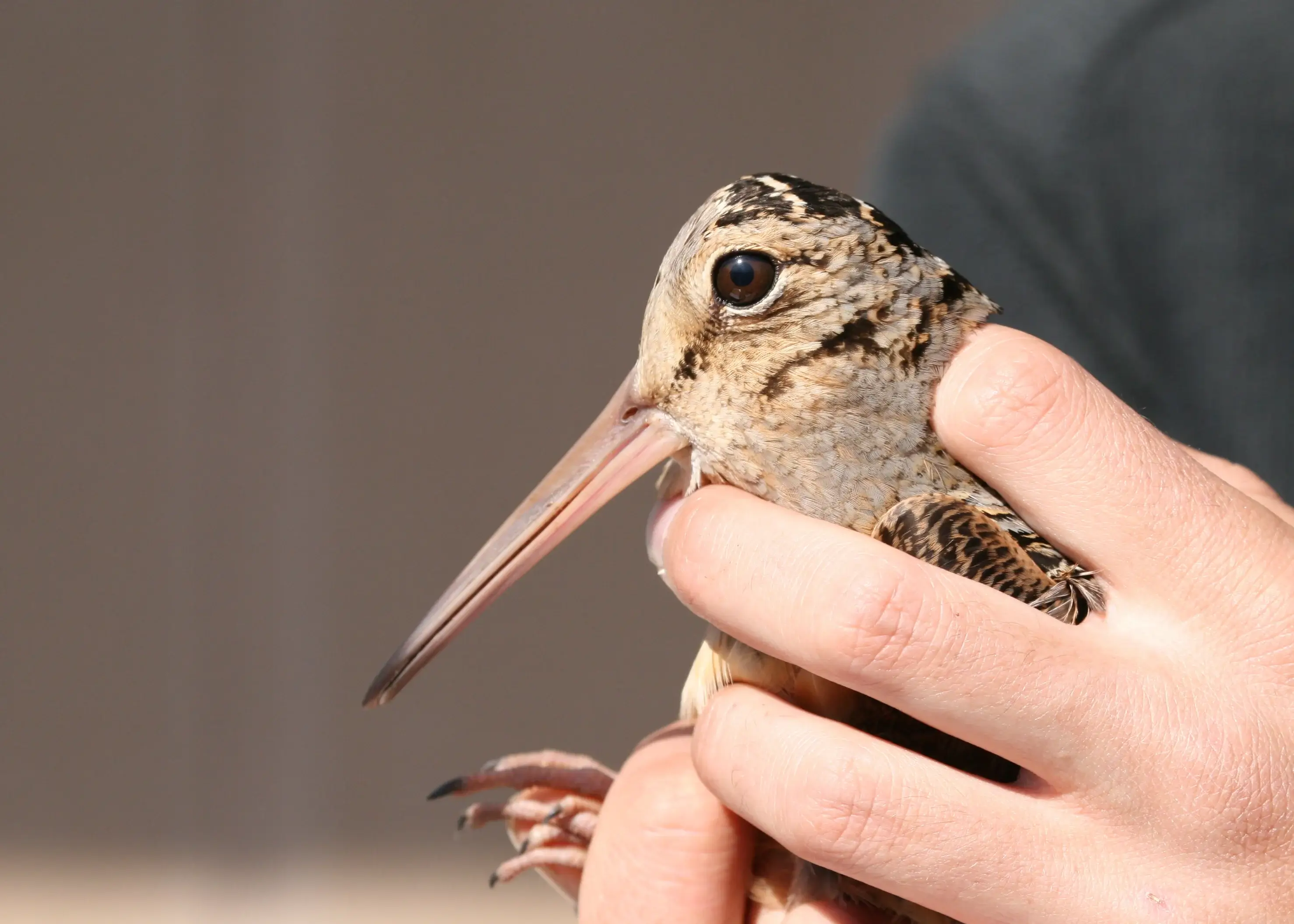
The American woodcock (Scolopax minor), sometimes colloquially referred to as the timberdoodle, mudbat, becasse, bogsucker, brush snipe, night partridge, or Labrador twister is a small shorebird species found primarily in the eastern half of North America. Woodcocks spend most of their time on the ground in brushy, young-forest habitats, where the birds' brown, black, and gray plumage provides excellent camouflage. The American woodcock is the only species of woodcock inhabiting North America. Although classified with the sandpipers and shorebirds in the family Scolopacidae, the American woodcock lives mainly in upland settings. The population of the American woodcock has fallen by an average of slightly more than 1% annually since the 1960s. Most authorities attribute this decline to a loss of habitat caused by forest maturation and urban development. It is also a popular game bird, with about 540,000 killed annually by some 133,000 hunters in the United States. In 2008, wildlife biologists and conservationists released an American woodcock conservation plan presenting figures for the acreage of early successional habitat that must be created and maintained in the United States and Canada to stabilize the woodcock population at current levels, and to return it to 1970s densities. Description The American woodcock has a plump body, short legs, a large, rounded head, and a long, straight prehensile bill. Adults are 10 to 12 inches (25 to 30 cm) long and weigh 5 to 8 ounces (140 to 230 g). Females are considerably larger than males. The bill is 2.5 to 2.8 inches (6.4 to 7.1 cm) long. Wingspans range from 16.5 to 18.9 inches (42 to 48 cm). The plumage is a cryptic mix of different shades of browns, grays, and black. The chest and sides vary from yellowish-white to rich tans. The nape of the head is black, with three or four crossbars of deep buff or rufous. The feet and toes, which are small and weak, are brownish gray to reddish brown. Woodcocks have large eyes locate
Habitat & Range
Woodcocks inhabit forested and mixed forest-agricultural-urban areas east of the 98th meridian. Woodcocks have been sighted as far north as York Factory, Manitoba, and east to Labrador and Newfoundland. In winter, they migrate as far south as the Gulf Coast of the United States and Mexico. The primary breeding range extends from Atlantic Canada (Nova Scotia, Prince Edward Island, and New Brunswick) west to southeastern Manitoba, and south to northern Virginia, western North Carolina, Kentucky, northern Tennessee, northern Illinois, Missouri, and eastern Kansas. A limited number breed as far south as Florida and Texas. The species may be expanding its distribution northward and westward. After migrating south in autumn, most woodcocks spend the winter in the Gulf Coast and southeastern Atlantic Coast states. Some may remain as far north as southern Maryland, eastern Virginia, and southern New Jersey. The core of the wintering range centers on Louisiana, Mississippi, Alabama, and Georgia. Based on the Christmas Bird Count results, winter concentrations are highest in the northern half of Alabama. American woodcocks live in wet thickets, moist woods, and brushy swamps. Ideal habitats feature early successional habitat and abandoned farmland mixed with forest. In late summer, some woodcocks roost on the ground at night in large openings among sparse, patchy vegetation. Courtship/breeding habitats include forest openings, roadsides, pastures, and old fields from which males call and launch courtship flights in springtime. Nesting habitats include thickets, shrubland, and young to middle-aged forest interspersed with openings. Feeding habitats have moist soil and feature densely growing young trees such as aspen (Populus spp.), birch (Betula spp.), and mixed hardwoods less than 20 years of age, and shrubs, particularly alder (Alnus spp.). Roosting habitats are semiopen sites with short, sparse plant cover, such as blueberry barrens, pastures, and recently heavily logged f
Status, Trends & Threats
The American woodcock is not considered globally threatened by the IUCN. It is more tolerant of deforestation than other woodcocks and snipes; as long as some sheltered woodland remains for breeding, it can thrive even in regions that are mainly used for agriculture. The estimated population is 5 million, so it is the most common sandpiper in North America. The American Woodcock Conservation Plan presents regional action plans linked to bird conservation regions, fundamental biological units recognized by the U.S. North American Bird Conservation Initiative. The Wildlife Management Institute oversees regional habitat initiatives intended to boost the American woodcock's population by protecting, renewing, and creating habitat throughout the species' range. Creating young-forest habitat for American woodcocks helps more than 50 other species of wildlife that need early successional habitat during part or all of their lifecycles. These include relatively common animals such as white-tailed deer, snowshoe hare, moose, bobcat, wild turkey, and ruffed grouse, and animals whose populations have also declined in recent decades, such as the golden-winged warbler, whip-poor-will, willow flycatcher, indigo bunting, and New England cottontail. Leslie Glasgow, the assistant secretary of the Interior for Fish, Wildlife, Parks, and Marine Resources from 1969 to 1970, wrote a dissertation through Texas A&M University on the woodcock, with research based on his observations through the Louisiana State University (LSU) Agricultural Experiment Station. He was an LSU professor from 1948 to 1980 and an authority on wildlife in the wetlands.
Hunting Season
Check current West Virginia Migratory Bird Hunting Regulations. Typically Oct-Dec.
License & Regulations
A valid West Virginia hunting license is required for resident and non-resident hunters age 15 and older. Licenses can be purchased online through the West Virginia Division of Natural Resources website or at authorized license retailers. Additional stamps may be required: RB (Resource Ballot) or RRB (Resource Recovery Ballot) for antlerless deer, TRD (Turkey Stamp) for spring turkey, and the federal Migratory Bird Hunting and Conservation Stamp (Duck Stamp) for waterfowl. Hunters born on or after January 1, 1975 must successfully complete a hunter education course.
Frequently Asked Questions
Regulations for hunting American Woodcock in West Virginia
American woodcock is managed under federal migratory bird regulations with state-specific seasons. HIP registration is required. Check the West Virginia Migratory Bird Hunting Regulations for current dates.
When is American Woodcock hunting season in West Virginia?
The American Woodcock hunting season in West Virginia: Check current West Virginia Migratory Bird Hunting Regulations. Typically Oct-Dec.
What is the bag limit for American Woodcock in West Virginia?
The bag limit for American Woodcock in West Virginia is: Follow federal migratory bird regulations and state-specific limits.
What's another name for American Woodcock?
American Woodcock is also known as Timberdoodle, Bogsucker in West Virginia.
How to identify American Woodcock?
The American woodcock (Scolopax minor), sometimes colloquially referred to as the timberdoodle, mudbat, becasse, bogsucker, brush snipe, night partridge, or Labrador twister is a small shorebird species found primarily in the eastern half of North America. Woodcocks spend most of their time on the ground in brushy, young-forest habitats, where the birds' brown, black, and gray plumage provides excellent camouflage. The American woodcock is the only species of woodcock inhabiting North America. A...
References
| State | Category | Directory | Subcategory | Content | Source |
|---|---|---|---|---|---|
| West Virginia | Hunting | Regulations | Season Dates | Check current West Virginia Migratory Bird Hunting Regulations. Typically Oct-Dec. | Link |
| West Virginia | Hunting | License | License & Fees | A valid West Virginia hunting license is required for resident and non-resident hunters age 15 and older. Licenses can b | Link |
| West Virginia | Hunting | Regulations | Regulations | American woodcock is managed under federal migratory bird regulations with state-specific seasons. HIP registration is r | Link |