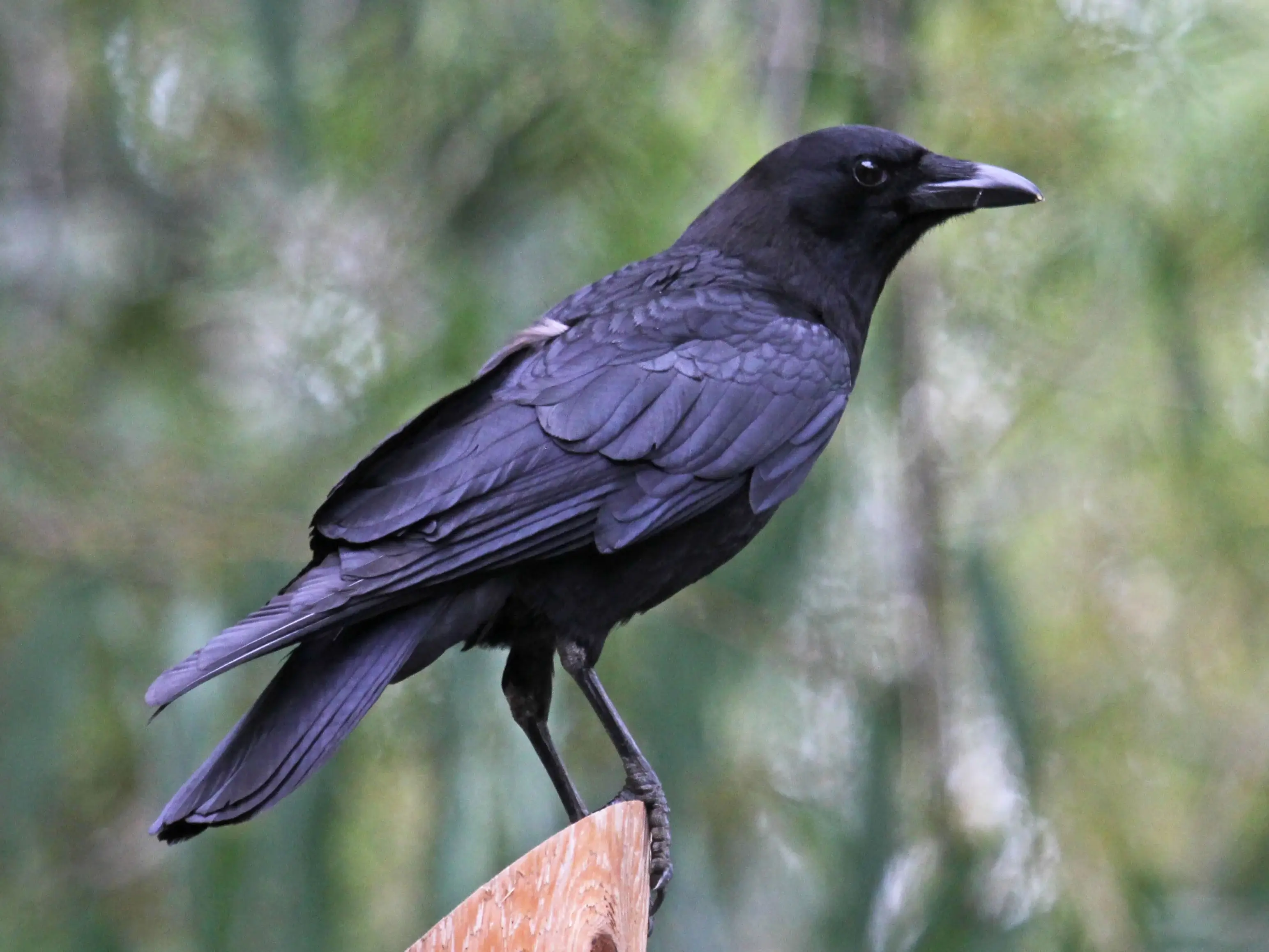
Also known as: Black vulture, Carrion crow
The black vulture (Coragyps atratus), also known as the American black vulture, Mexican vulture, zopilote, urubu, or gallinazo, is a bird in the New World vulture family whose range extends from the southeastern United States to Peru, Central Chile and Uruguay in South America, and common throughout Brazil where it can be seen in large scavenging groups. Although a common and widespread species, it has a somewhat more restricted distribution than its compatriot, the turkey vulture, which breeds well into Canada and all the way south to Tierra del Fuego. It is the only extant member of the genus Coragyps, which is in the family Cathartidae. Despite the similar name and appearance, this species is not closely related to the Eurasian black vulture, an Old World vulture, of the family Accipitridae (which includes raptors like the eagles, hawks, kites, and harriers). For ease of locating animal corpses (their primary source of sustenance), black vultures tend to inhabit relatively open areas with scattered trees, such as chaparral, in addition to subtropical forested areas and parts of the Brazilian pantanal. With a wingspan of 1.5 m (4.9 ft), the black vulture is an imposing bird, though relatively small for a vulture, let alone a raptor. It has black plumage, a featherless, grayish-black head and neck, and a short, hooked beak. These features are all evolutionary adaptations to life as a scavenger; their black plumage stays visibly cleaner than that of a lighter-colored bird, the bare head is adapted for easily digging inside animal carcasses, and the hooked beak is built for stripping the bodies clean of meat. The absence of head feathers helps the birds stay clean and remain (more or less) free of animal blood and bodily fluids, which could become problematic for the vultures and attract parasites; most vultures are known to bathe after eating, provided there is a water source. This water source can be natural or man-made, such as a stream or a livestock water tank.
Habitat & Range
The black vulture has a Nearctic and Neotropic distribution. Its range includes the mid-Atlantic States, the southernmost regions of the Midwestern United States, the southern United States, Mexico, Central America, and most of South America. In the 21st century, the black vulture's range has expanded northward farther into the Midwest and northeastern United States. It is usually a permanent resident throughout its range, although birds at the extreme north of its range may migrate short distances and others across their range may undergo local movements in unfavourable conditions. In South America, its range stretches to Peru, central Chile, Uruguay and Brazil. It also is found as a vagrant on the islands of the Caribbean. It prefers open land interspersed with areas of woods or brush. It is also found in moist lowland forests, shrublands and grasslands, wetlands and swamps, pastures, and heavily degraded former forests. It is usually seen soaring or perched on fence posts or dead trees.
Hunting Season
Check current federal and state regulations. May be taken under depredation permit if causing damage.
License & Regulations
A valid West Virginia hunting license is required for resident and non-resident hunters age 15 and older. Licenses can be purchased online through the West Virginia Division of Natural Resources website or at authorized license retailers. Additional stamps may be required: RB (Resource Ballot) or RRB (Resource Recovery Ballot) for antlerless deer, TRD (Turkey Stamp) for spring turkey, and the federal Migratory Bird Hunting and Conservation Stamp (Duck Stamp) for waterfowl. Hunters born on or after January 1, 1975 must successfully complete a hunter education course.
Frequently Asked Questions
Regulations for hunting Black Vulture in West Virginia
Black vultures are protected under the Migratory Bird Treaty Act. They may only be taken under special depredation permits when causing property damage. Check current WVDNR and USFWS regulations.
When is Black Vulture hunting season in West Virginia?
The Black Vulture hunting season in West Virginia: Check current federal and state regulations. May be taken under depredation permit if causing damage.
What is the bag limit for Black Vulture in West Virginia?
The bag limit for Black Vulture in West Virginia is: Check current regulations.
What's another name for Black Vulture?
Black Vulture is also known as Black vulture, Carrion crow in West Virginia.
How to identify Black Vulture?
The black vulture (Coragyps atratus), also known as the American black vulture, Mexican vulture, zopilote, urubu, or gallinazo, is a bird in the New World vulture family whose range extends from the southeastern United States to Peru, Central Chile and Uruguay in South America, and common throughout Brazil where it can be seen in large scavenging groups. Although a common and widespread species, it has a somewhat more restricted distribution than its compatriot, the turkey vulture, which breeds ...
References
| State | Category | Directory | Subcategory | Content | Source |
|---|---|---|---|---|---|
| West Virginia | Hunting | Regulations | Season Dates | Check current federal and state regulations. May be taken under depredation permit if causing damage. | Link |
| West Virginia | Hunting | License | License & Fees | A valid West Virginia hunting license is required for resident and non-resident hunters age 15 and older. Licenses can b | Link |
| West Virginia | Hunting | Regulations | Regulations | Black vultures are protected under the Migratory Bird Treaty Act. They may only be taken under special depredation permi | Link |