Also known as: Ring-necked pheasant
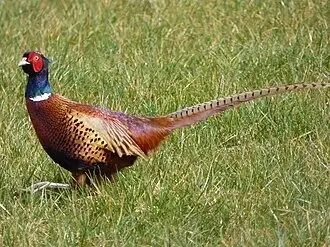
The common pheasant (Phasianus colchicus), ring-necked pheasant, or blue-headed pheasant, is a bird in the pheasant family (Phasianidae). The genus name comes from Latin phasianus 'pheasant'. The species name colchicus is Latin for 'of Colchis' (modern day Georgia), a country on the Black Sea where pheasants became known to Europeans. Although Phasianus was previously thought to be closely related to the genus Gallus, the genus of junglefowl and domesticated chickens, recent studies show that they are in different subfamilies, having diverged over 20 million years ago. It is native to Asia, where it is widespread, and also the extreme southeast of Europe in the northern foothills of the Caucasus Mountains. It has been widely introduced elsewhere as a game bird. In parts of its range, mainly in places where none of its relatives occur such as in Europe, where it is naturalised, it is simply known as the pheasant. Ring-necked pheasant is both the collective name for a number of subspecies and their intergrades that have white neck rings, and the name used for the species as a whole in North America. It is a well-known gamebird, among those of more than regional importance perhaps the most widespread and ancient one in the whole world. The common pheasant is one of the world's most hunted birds; it has been introduced for that purpose to many regions, and is also common on game farms where it is commercially bred. The ring-necked subspecies group in particular are commonly bred and were introduced to many parts of the world; the game farm stock, though no distinct breeds have been developed yet, can be considered semi-domesticated. The ring-necked pheasant is the state bird of South Dakota, one of only two US state birds that is not a species native to the United States. The green pheasant (P. versicolor) of Japan is sometimes considered a subspecies of the common pheasant. Though the species produce fertile hybrids wherever they coexist, this is simply a typical featu
Life History
Common pheasants are native to Asia and parts of Europe, their original range extending from the eastern Black Sea and the Caspian Sea to Manchuria, Siberia, Korea, Mainland China, and Taiwan. The birds are found in woodland, farmland, scrub, and wetlands. In their natural habitat, common pheasants live in grassland near water with small copses of trees, and are tolerant of both dry and humid soils. Extensively cleared farmland, however, is marginal habitat that cannot maintain self-sustaining populations for long. Common pheasants are gregarious birds and outside the breeding season form loose flocks. However, captive bred common pheasants can show strong sexual segregation, in space and time, with sex differences in the use of feeding stations throughout the day. Wherever they are hunted they are always timid once they associate humans with danger, and will quickly retreat for safety after hearing the arrival of hunting parties in the area. While common pheasants are able short-distance fliers, they prefer to run. If startled however, they can suddenly burst upwards at great speed, with a distinctive "whirring" wing sound and often giving kok kok kok calls to alert conspecifics. Their flight speed is only 43–61 km/h (23–33 kn) when cruising but when chased they can fly up to 90 km/h (49 kn).
Hunting Season
Nov 1 - Jan 3. Hillcrest WMA: Nov 8 - Dec 6.
License & Regulations
A valid West Virginia hunting license is required for resident and non-resident hunters age 15 and older. Licenses can be purchased online through the West Virginia Division of Natural Resources website or at authorized license retailers. Additional stamps may be required: RB (Resource Ballot) or RRB (Resource Recovery Ballot) for antlerless deer, TRD (Turkey Stamp) for spring turkey, and the federal Migratory Bird Hunting and Conservation Stamp (Duck Stamp) for waterfowl. Hunters born on or after January 1, 1975 must successfully complete a hunter education course.
Frequently Asked Questions
Regulations for hunting Ring-necked Pheasant in West Virginia
Ring-necked pheasant season runs from November through early January. Only cock birds may be taken. Bag limit is 2 per day statewide, with a reduced 1-bird limit on Hillcrest WMA.
When is Ring-necked Pheasant hunting season in West Virginia?
The Ring-necked Pheasant hunting season in West Virginia: Nov 1 - Jan 3. Hillcrest WMA: Nov 8 - Dec 6.
What is the bag limit for Ring-necked Pheasant in West Virginia?
The bag limit for Ring-necked Pheasant in West Virginia is: 2 cock birds per day, 2 possession limit. Hillcrest WMA: 1 cock bird per day, 1 possession limit.
What's another name for Ring-necked Pheasant?
Ring-necked Pheasant is also known as Ring-necked pheasant in West Virginia.
How to identify Ring-necked Pheasant?
The common pheasant (Phasianus colchicus), ring-necked pheasant, or blue-headed pheasant, is a bird in the pheasant family (Phasianidae). The genus name comes from Latin phasianus 'pheasant'. The species name colchicus is Latin for 'of Colchis' (modern day Georgia), a country on the Black Sea where pheasants became known to Europeans. Although Phasianus was previously thought to be closely related to the genus Gallus, the genus of junglefowl and domesticated chickens, recent studies show that th...
References
| State | Category | Directory | Subcategory | Content | Source |
|---|---|---|---|---|---|
| West Virginia | Hunting | Regulations | Season Dates | Nov 1 - Jan 3. Hillcrest WMA: Nov 8 - Dec 6. | Link |
| West Virginia | Hunting | License | License & Fees | A valid West Virginia hunting license is required for resident and non-resident hunters age 15 and older. Licenses can b | Link |
| West Virginia | Hunting | Regulations | Regulations | Ring-necked pheasant season runs from November through early January. Only cock birds may be taken. Bag limit is 2 per d | Link |