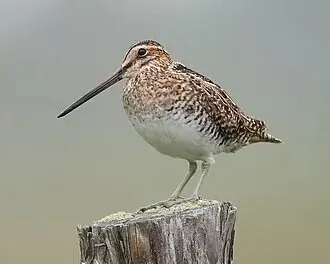
Also known as: Wilson's snipe, Jacksnipe
The common snipe (Gallinago gallinago, formerly also known as Gallinago cælestis) is a small, stocky wader native to the Old World, where it breeds in marshes, bogs, tundra and wet meadows. It is usually shy and well-camouflaged, foraging in soft mud mainly for insects and earthworms but also some plant material. During courtship, males perform a "winnowing" display; flying high in circles and then taking shallow dives to produce a "drumming" sound by vibrating the tail feathers. Distribution and habitat The breeding habitats are marshes, bogs, tundra and wet meadows throughout the Palearctic. In the north, the distribution limit extends from Iceland over the north of the British Isles and northern Fennoscandia, where it occurs at around 70°N, as well as through European Russia and Siberia. Here it is mostly on the northern edge of the Taiga zone at 71°N, but reaches 74°N on the east coast of the Taymyr Peninsula. In the east it extends to Anadyr, Kamchatka, Bering Island and the Kuril Islands, The southern boundary of the distribution area in Europe runs through northern Portugal, central France, northern Italy, Bulgaria, and Ukraine, with populations in the west being only very scattered. In Asia, the distribution extends south to northern Turkestan, locally to Afghanistan and the Middle East, through the Altai and further to Manchuria and Ussuri. It is migratory, with European birds wintering in southern and western Europe and Africa (south to the Equator), and Asian migrants moving to tropical southern Asia. Taxonomy The common snipe was formally described by the Swedish naturalist Carl Linnaeus in 1758 in the tenth edition of his Systema Naturae under the binomial name Scolopax gallinago. The species is now placed with 17 other snipe in the genus Gallinago that was introduced by the French zoologist Mathurin Jacques Brisson in 1760. The name gallinago is Neo-Latin for a woodcock or snipe from Latin gallina, "hen" and the suffix -ago, "resembling". Two subspecie
Habitat & Range
The breeding habitats are marshes, bogs, tundra and wet meadows throughout the Palearctic. In the north, the distribution limit extends from Iceland over the north of the British Isles and northern Fennoscandia, where it occurs at around 70°N, as well as through European Russia and Siberia. Here it is mostly on the northern edge of the Taiga zone at 71°N, but reaches 74°N on the east coast of the Taymyr Peninsula. In the east it extends to Anadyr, Kamchatka, Bering Island and the Kuril Islands, The southern boundary of the distribution area in Europe runs through northern Portugal, central France, northern Italy, Bulgaria, and Ukraine, with populations in the west being only very scattered. In Asia, the distribution extends south to northern Turkestan, locally to Afghanistan and the Middle East, through the Altai and further to Manchuria and Ussuri. It is migratory, with European birds wintering in southern and western Europe and Africa (south to the Equator), and Asian migrants moving to tropical southern Asia.
Status, Trends & Threats
Overall, the species is not threatened. Populations on the southern fringes of the breeding range in Europe are however declining with local extinction in some areas (notably in parts of England and Germany), mainly due to field drainage and agricultural intensification. The Agreement on the Conservation of African-Eurasian Migratory Waterbirds (AEWA) applies to the species.
Hunting Season
Check current West Virginia Migratory Bird Hunting Regulations. Typically Sep-Nov.
License & Regulations
A valid West Virginia hunting license is required for resident and non-resident hunters age 15 and older. Licenses can be purchased online through the West Virginia Division of Natural Resources website or at authorized license retailers. Additional stamps may be required: RB (Resource Ballot) or RRB (Resource Recovery Ballot) for antlerless deer, TRD (Turkey Stamp) for spring turkey, and the federal Migratory Bird Hunting and Conservation Stamp (Duck Stamp) for waterfowl. Hunters born on or after January 1, 1975 must successfully complete a hunter education course.
Frequently Asked Questions
Regulations for hunting Common Snipe in West Virginia
Common snipe is managed under federal migratory bird regulations with state-specific seasons. HIP registration is required. Check the West Virginia Migratory Bird Hunting Regulations for current dates.
When is Common Snipe hunting season in West Virginia?
The Common Snipe hunting season in West Virginia: Check current West Virginia Migratory Bird Hunting Regulations. Typically Sep-Nov.
What is the bag limit for Common Snipe in West Virginia?
The bag limit for Common Snipe in West Virginia is: Follow federal migratory bird regulations and state-specific limits.
What's another name for Common Snipe?
Common Snipe is also known as Wilson's snipe, Jacksnipe in West Virginia.
How to identify Common Snipe?
The common snipe (Gallinago gallinago, formerly also known as Gallinago cælestis) is a small, stocky wader native to the Old World, where it breeds in marshes, bogs, tundra and wet meadows. It is usually shy and well-camouflaged, foraging in soft mud mainly for insects and earthworms but also some plant material. During courtship, males perform a "winnowing" display; flying high in circles and then taking shallow dives to produce a "drumming" sound by vibrating the tail feathers. Distribution an...
References
| State | Category | Directory | Subcategory | Content | Source |
|---|---|---|---|---|---|
| West Virginia | Hunting | Regulations | Season Dates | Check current West Virginia Migratory Bird Hunting Regulations. Typically Sep-Nov. | Link |
| West Virginia | Hunting | License | License & Fees | A valid West Virginia hunting license is required for resident and non-resident hunters age 15 and older. Licenses can b | Link |
| West Virginia | Hunting | Regulations | Regulations | Common snipe is managed under federal migratory bird regulations with state-specific seasons. HIP registration is requir | Link |