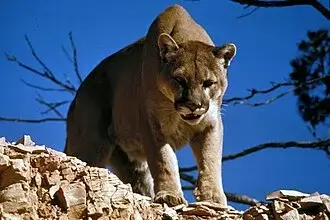
Also known as: Mountain lion, Puma, Panther, Catamount
The cougar (Puma concolor) (, KOO-gər), also called puma, mountain lion, catamount, and panther, is a large feline native to the Americas. It inhabits North, Central and South America, making it the most widely distributed wild, terrestrial mammal in the Western Hemisphere, and one of the most widespread in the world. Its range spans Yukon, British Columbia and Alberta in Canada, the Rocky Mountains and areas in the western United States. Further south, its range extends through Mexico to the Amazon rainforest and the southern Andes Mountains in Patagonia. It is an adaptable generalist species, occurring in most American habitat types. It prefers habitats with dense underbrush and rocky areas for stalking but also lives in open areas. The cougar is largely solitary. Its activity pattern varies from diurnality and cathemerality to crepuscularity and nocturnality between protected and non-protected areas, and is apparently correlated with the presence of other predators, prey species, livestock and humans. It is an ambush predator that pursues a wide variety of prey. Ungulates, particularly deer, are its primary prey, but it also hunts rodents. It is territorial and lives at low population densities. Individual home ranges depend on terrain, vegetation and abundance of prey. While large, it is not always the dominant apex predator in its range, yielding prey to other predators. It is reclusive and mostly avoids people. Fatal attacks on humans are rare but increased in North America as more people entered cougar habitat and built farms. The cougar is listed as Least Concern on the IUCN Red List. Intensive hunting following European colonization of the Americas and ongoing human development into cougar habitat has caused populations to decline in most parts of its historical range. In particular, the eastern cougar population is considered to be mostly locally extinct in eastern North America since the early 20th century, with the exception of the isolated Florida panth
Habitat & Range
The cougar has the most extensive range of any wild land animal in the Americas, spanning 110 degrees of latitude from the Yukon in Canada to the southern Andes in Chile. The species was extirpated from eastern North America, aside from Florida, but they may be recolonizing their former range and isolated populations have been documented east of their contemporary ranges in both the Midwestern US and Canada. The cougar lives in all forest types, lowland and mountainous deserts, and in open areas with little vegetation up to an elevation of 5,800 m (19,000 ft). In the Santa Ana Mountains, it prefers steep canyons, escarpments, rim rocks and dense brush. In Mexico, it was recorded in the Sierra de San Carlos. In the Yucatán Peninsula, it inhabits secondary and semi-deciduous forests in El Eden Ecological Reserve. In El Salvador, it was recorded in the lower montane forest in Montecristo National Park and in a river basin in the Morazán Department above 700 m (2,300 ft) in 2019. In Colombia, it was recorded in a palm oil plantation close to a riparian forest in the Llanos Basin, and close to water bodies in the Magdalena River Valley. In the human-modified landscape of central Argentina, it inhabits bushland with abundant vegetation cover and prey species.
Status, Trends & Threats
The cougar is listed on CITES Appendix II, but the Central American population is on Appendix I. Hunting it is prohibited in Costa Rica, Honduras, Nicaragua, Guatemala, Panama, Venezuela, Colombia, French Guiana, Suriname, Bolivia, Brazil, Chile, Paraguay, Uruguay and most of Argentina. Hunting is regulated in Canada, Mexico, Peru, and the United States. Establishing wildlife corridors and protecting sufficient range areas are critical for the sustainability of cougar populations. Research simulations showed that it faces a low extinction risk in areas larger than 2,200 km2 (850 sq mi). Between one and four new individuals entering a population per decade markedly increases persistence, thus highlighting the importance of habitat corridors. The Florida panther population is afforded protection under the Endangered Species Act. In California, the cougar is protected under the California Wildlife Protection Act of 1990. The Texas Mountain Lion Conservation Project was launched in 2009 and aimed at raising local people's awareness of the status and ecological role of the cougar and mitigating conflict between landowners and cougars.
Hunting Season
No open season. Cougars are classified as a protected species in West Virginia.
License & Regulations
A valid West Virginia hunting license is required for resident and non-resident hunters age 15 and older. Licenses can be purchased online through the West Virginia Division of Natural Resources website or at authorized license retailers. Additional stamps may be required: RB (Resource Ballot) or RRB (Resource Recovery Ballot) for antlerless deer, TRD (Turkey Stamp) for spring turkey, and the federal Migratory Bird Hunting and Conservation Stamp (Duck Stamp) for waterfowl. Hunters born on or after January 1, 1975 must successfully complete a hunter education course.
Frequently Asked Questions
Regulations for hunting Cougar in West Virginia
Cougars (mountain lions) do not have an open hunting season in West Virginia. They are considered extirpated from the state, though occasional sightings are reported. They are protected and may not be taken.
Is there a hunting season for Cougar in West Virginia?
No open season. Cougars are classified as a protected species in West Virginia.
What is the bag limit for Cougar in West Virginia?
The bag limit for Cougar in West Virginia is: No open season.
What's another name for Cougar?
Cougar is also known as Mountain lion, Puma, Panther, Catamount in West Virginia.
How to identify Cougar?
The cougar (Puma concolor) (, KOO-gər), also called puma, mountain lion, catamount, and panther, is a large feline native to the Americas. It inhabits North, Central and South America, making it the most widely distributed wild, terrestrial mammal in the Western Hemisphere, and one of the most widespread in the world. Its range spans Yukon, British Columbia and Alberta in Canada, the Rocky Mountains and areas in the western United States. Further south, its range extends through Mexico to the Am...
References
| State | Category | Directory | Subcategory | Content | Source |
|---|---|---|---|---|---|
| West Virginia | Hunting | Regulations | Season Dates | No open season. Cougars are classified as a protected species in West Virginia. | Link |
| West Virginia | Hunting | License | License & Fees | A valid West Virginia hunting license is required for resident and non-resident hunters age 15 and older. Licenses can b | Link |
| West Virginia | Hunting | Regulations | Regulations | Cougars (mountain lions) do not have an open hunting season in West Virginia. They are considered extirpated from the st | Link |