Also known as: Weasel, Common weasel
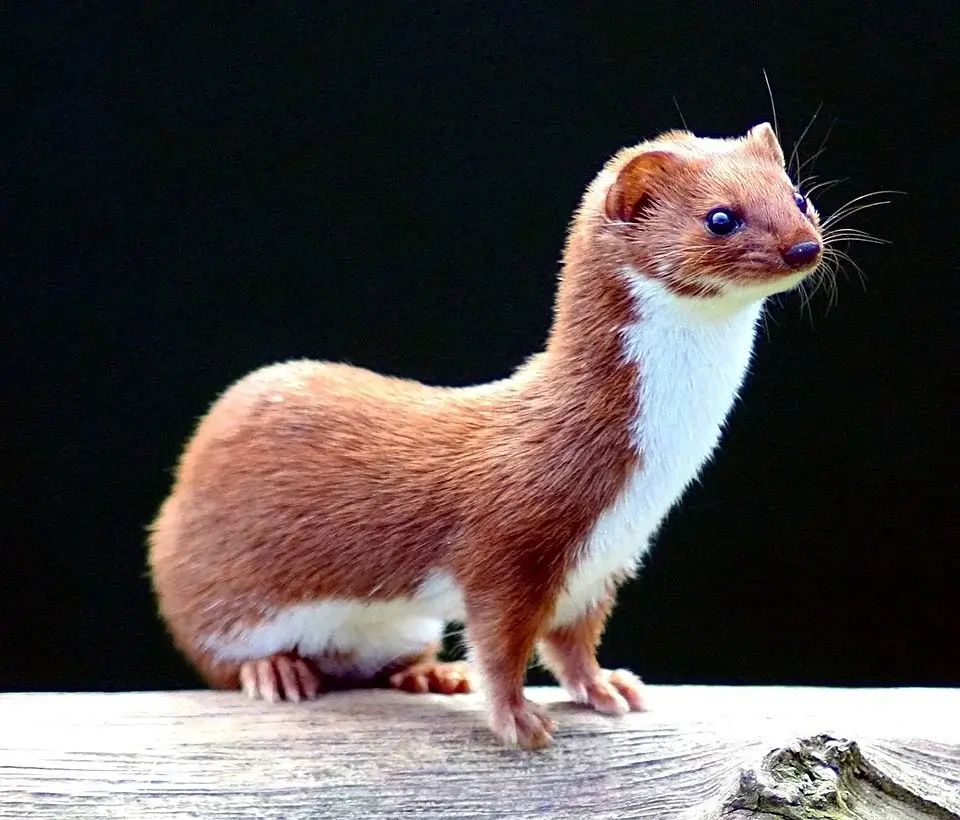
The least weasel, little weasel, common weasel, or simply weasel is the smallest member of the genus Mustela, family Mustelidae and order Carnivora. It is native to Eurasia, North America and North Africa, and has been introduced to New Zealand, Malta, Crete, the Azores, and São Tomé. It is classified as least concern by the IUCN, due to its wide distribution and large population throughout the Northern Hemisphere. Eighteen subspecies are recognised.
Habitat & Range
The least weasel has a circumboreal, Holarctic distribution, encompassing much of Europe and North Africa, Asia and parts of northern North America. It has been introduced to New Zealand, Malta, Crete, the Azores Islands and also São Tomé off West Africa. It occurs throughout Europe, except Ireland, and on all major Mediterranean islands. It also occurs on Honshu and Hokkaido Islands in Japan and on Kunashir, Iturup, and Sakhalin Islands in Russia. The least weasel inhabits fields, open woodland, bushy and rocky areas, parks and gardens at elevations of up to about 3,000 m (9,800 ft). Fossilised remains of the least weasel are known from Denisova Cave.
Life History
The least weasel feeds predominantly on mouse-like rodents, including mice, hamsters, gerbils and others. It usually does not attack adult hamsters and rats. Frogs, fish, small birds and bird eggs are rarely eaten. It can deal with adult pikas and gerbils, but usually cannot overcome brown rats and sousliks. Exceptional cases are known of least weasels killing prey far larger than themselves, such as capercaillie, hazel hen and hares. In England, a favoured prey item is the field vole (Microtus agrestis). These have fluctuations in population size, and in years of abundance may form up to 54% of the weasel's diet. In years of scarcity, birds form a greater proportion of the diet and female least weasels may fail to breed. Despite its small size, the least weasel is a fierce hunter, capable of killing a rabbit five to 10 times its own weight. Although they are commonly taken, the rabbits are usually young specimens, and become an important food source during the spring, when small rodents are scarce and rabbit kits are plentiful. Male least weasels take a higher proportion of rabbits than females, as well as an overall greater variety of prey. This is linked to the fact that being larger, and having vaster territorial ranges than females, males have more opportunities to hunt a greater diversity of prey. The least weasel forages undercover, to avoid being seen by foxes and birds of prey. It is adapted for pursuing its prey down tunnels, though it may also bolt prey from a burrow and kill it in the open. The least weasel kills small prey, such as voles, with a bite to the occipital region of the skull or the neck, dislocating the cervical vertebrae. Large prey typically dies of blood loss or circulatory shock. When food is abundant, only a small portion of the prey is eaten, usually the brain. The average daily food intake is 35 g (1.2 oz), which is equivalent to 30–35% of the animal's body weight.
Status, Trends & Threats
The least weasel is listed as Least Concern on the IUCN Red List, because of its wide global distribution and large population that is thought to be not in decline.
Hunting Season
Year-round. No closed season.
License & Regulations
A valid West Virginia hunting license is required for resident and non-resident hunters age 15 and older. Licenses can be purchased online through the West Virginia Division of Natural Resources website or at authorized license retailers. Additional stamps may be required: RB (Resource Ballot) or RRB (Resource Recovery Ballot) for antlerless deer, TRD (Turkey Stamp) for spring turkey, and the federal Migratory Bird Hunting and Conservation Stamp (Duck Stamp) for waterfowl. Hunters born on or after January 1, 1975 must successfully complete a hunter education course.
Frequently Asked Questions
Regulations for hunting Least Weasel in West Virginia
Least weasels may be hunted and trapped year-round in West Virginia with no bag limit.
When is Least Weasel hunting season in West Virginia?
The Least Weasel hunting season in West Virginia: Year-round. No closed season.
What's another name for Least Weasel?
Least Weasel is also known as Weasel, Common weasel in West Virginia.
How to identify Least Weasel?
The least weasel, little weasel, common weasel, or simply weasel is the smallest member of the genus Mustela, family Mustelidae and order Carnivora. It is native to Eurasia, North America and North Africa, and has been introduced to New Zealand, Malta, Crete, the Azores, and São Tomé. It is classified as least concern by the IUCN, due to its wide distribution and large population throughout the Northern Hemisphere. Eighteen subspecies are recognised.
References
| State | Category | Directory | Subcategory | Content | Source |
|---|---|---|---|---|---|
| West Virginia | Hunting | Regulations | Season Dates | Year-round. No closed season. | Link |
| West Virginia | Hunting | License | License & Fees | A valid West Virginia hunting license is required for resident and non-resident hunters age 15 and older. Licenses can b | Link |
| West Virginia | Hunting | Regulations | Regulations | Least weasels may be hunted and trapped year-round in West Virginia with no bag limit. | Link |