Also known as: Skunk, Polecat
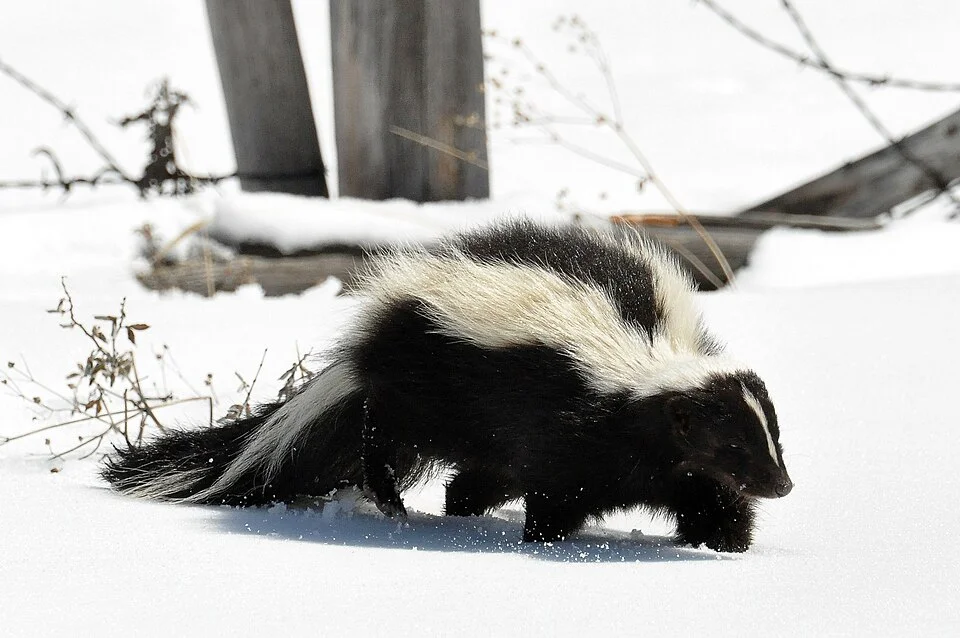
The striped skunk (Mephitis mephitis) is a skunk of the genus Mephitis that occurs across much of North America, including southern Canada, the United States, and northern Mexico. It is currently listed as least concern by the IUCN on account of its wide range and ability to adapt to human-modified environments. Striped skunks are polygamous omnivores with few natural predators, save for birds of prey. Like all skunks, they possess highly developed musk-filled scent glands to ward off predators. They have a long history of association with humans, having been trapped and captively bred for their fur and kept as pets. The striped skunk is one of the most recognizable of North America's animals, and is a popular figure in cartoons and children's books. Taxonomy The striped skunk was first formally named by Johann Christian Daniel von Schreber as Viverra mephitis. The type locality is in eastern Canada. Evolution and subspecies The earliest fossil finds attributable to Mephitis were found in the Broadwater site in Nebraska, dating back to the early Pleistocene less than 1.8 million years ago. By the late Pleistocene (70,000–14,500 years ago), the striped skunk was widely distributed throughout the southern United States, and it expanded northwards and westwards by the Holocene (10,000–4,500 years ago) following the retreat of the Wisconsin glacier. Phylogenetic analyses of the species' cytochrome b gene and microsatellite data in 2012 indicated that there are four phylogroups of striped skunk. The first emerged from the Texas-Mexico region during the Rancholabrean before the Illinoian glaciation and colonized the southeastern United States. The second, still originating in the Texas-Mexico region, expanded westwards to the Rocky Mountains during the Illinoian glacial period. Two subsequent subclades were formed during the Sangamonian interglacial on either side of the Sierra Nevada. The subclade that colonized the Great Basin later expanded eastwards across the norther
Habitat & Range
The striped skunk inhabits a wide variety of habitats, particularly mixed woodlands, brushy corners and open fields interspersed with wooded ravines and rocky outcrops. Some populations, particularly in northwestern Illinois, prefer cultivated areas over uncultivated ones.
Life History
While primarily an insectivore, the striped skunk is adaptable enough to incorporate other animals and even vegetable matter into its diet. The most frequently consumed insects include grasshoppers, beetles, crickets, caterpillars, other insect larvae and bees. Other invertebrates may include worms, crayfish and other non-insect arthropods. In the winter and spring months, the striped skunk will supplement its diet with vertebrates such as white-footed mice, voles, eggs and the chicks of ground nesting birds. The striped skunk is also known to consume amphibians, reptiles, carrion and fish. Striped skunks inhabiting California's coastal areas will feed on crabs and beached fish. While not adapted for chasing fleet-footed prey, at least one specimen was observed pursuing gray cottontails into their burrows. The skunk will also consume vegetable matter, such as apples, blueberries, black cherries, ground cherries, corn and nightshade when in season. Striped skunks are known to use their sharp claws to tear apart rotting logs to find grubs, dig in the soil for insects, and pin down prey. Their practice of digging leaves small-but-noticeable pits in the ground, which can provide evidence of their presence in an area.
Hunting Season
Year-round. No closed season.
License & Regulations
A valid West Virginia hunting license is required for resident and non-resident hunters age 15 and older. Licenses can be purchased online through the West Virginia Division of Natural Resources website or at authorized license retailers. Additional stamps may be required: RB (Resource Ballot) or RRB (Resource Recovery Ballot) for antlerless deer, TRD (Turkey Stamp) for spring turkey, and the federal Migratory Bird Hunting and Conservation Stamp (Duck Stamp) for waterfowl. Hunters born on or after January 1, 1975 must successfully complete a hunter education course.
Frequently Asked Questions
Regulations for hunting Striped Skunk in West Virginia
Striped skunks may be hunted and trapped year-round in West Virginia with no bag limit.
When is Striped Skunk hunting season in West Virginia?
The Striped Skunk hunting season in West Virginia: Year-round. No closed season.
What's another name for Striped Skunk?
Striped Skunk is also known as Skunk, Polecat in West Virginia.
How to identify Striped Skunk?
The striped skunk (Mephitis mephitis) is a skunk of the genus Mephitis that occurs across much of North America, including southern Canada, the United States, and northern Mexico. It is currently listed as least concern by the IUCN on account of its wide range and ability to adapt to human-modified environments. Striped skunks are polygamous omnivores with few natural predators, save for birds of prey. Like all skunks, they possess highly developed musk-filled scent glands to ward off predators....
References
| State | Category | Directory | Subcategory | Content | Source |
|---|---|---|---|---|---|
| West Virginia | Hunting | Regulations | Season Dates | Year-round. No closed season. | Link |
| West Virginia | Hunting | License | License & Fees | A valid West Virginia hunting license is required for resident and non-resident hunters age 15 and older. Licenses can b | Link |
| West Virginia | Hunting | Regulations | Regulations | Striped skunks may be hunted and trapped year-round in West Virginia with no bag limit. | Link |