Also known as: Wild pig, Feral hog, Wild swine
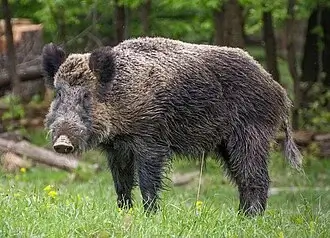
The wild boar (Sus scrofa), also known as the wild swine, common wild pig, Eurasian wild pig, or simply wild pig, is a suid native to much of Eurasia and North Africa, and has been introduced to the Americas and Oceania. The species is now one of the widest-ranging mammals in the world, as well as the most widespread suiform. It has been assessed as least concern on the IUCN Red List due to its wide range, high numbers, and adaptability to a diversity of habitats. It has become an invasive species in part of its introduced range. Wild boars probably originated in Southeast Asia during the Early Pleistocene and outcompeted other suid species as they spread throughout the Old World. As of 2005, up to 16 subspecies are recognized, which are divided into four regional groupings based on skull height and lacrimal bone length. The species lives in matriarchal societies consisting of interrelated females and their young (both male and female). Fully grown males are usually solitary outside the breeding season. The wolf is the wild boar's main predator in most of its natural range except in the Far East and the Lesser Sunda Islands, where it is replaced by the tiger and Komodo dragon respectively. The wild boar has a long history of association with humans, having been the ancestor of most domestic pig breeds and a big-game animal for millennia. Boars have also re-hybridized in recent decades with feral pigs; these boar–pig hybrids have become a serious pest wild animal in the Americas and Australia. Terminology As true wild boars became extinct in Great Britain before the development of Modern English, the same terms are often used for both true wild boar and pigs, especially large or semi-wild ones. The English boar stems from the Old English bār, which is thought to be derived from the West Germanic bair, of unknown origin. Boar is sometimes used specifically to refer to males, and may also be used to refer to male domesticated pigs, especially breeding males that have n
Life History
The wild boar is a highly versatile omnivore, whose diversity in choice of food is comparable to that of humans. Its foods can be divided into four categories: Rhizomes, roots, tubers and bulbs, all of which it digs up throughout the year. Nuts, berries and seeds, which it digs up from under the snow when necessary and consumes when ripened. Leaves, bark, twigs and shoots, along with garbage. In warm periods, it eats earthworms, insects, mollusks, fish, rodents, insectivores, bird eggs, lizards, snakes, frogs and carrion. A 50 kg (110 lb) boar needs around 4,000–4,500 calories of food per day, though this required amount increases during winter and pregnancy, with the majority of its diet consisting of food items dug from the ground, like underground plant material and burrowing animals. Acorns and beechnuts are invariably its most important food items in temperate zones, as they are rich in the carbohydrates necessary for the buildup of fat reserves needed to survive lean periods. In Western Europe, underground plant material favoured by boars includes bracken, willow herb, bulbs, meadow herb roots and bulbs and the bulbs of cultivated crops. Such food is favoured in early spring and summer, but may also be eaten in autumn and winter during beechnut and acorn crop failures. Should regular wild foods become scarce, boars will eat tree bark and fungi, as well as visit cultivated potato and artichoke fields. Boar soil disturbance and foraging have been shown to facilitate invasive plants. Boars of the vittatus subspecies in Ujung Kulon National Park in Java differ from most other populations by their primarily frugivorous diet, which consists of 50 different fruit species, especially figs, thus making them important seed dispersers. The wild boar can consume numerous genera of poisonous plants without ill effect, including Aconitum, Anemone, Calla, Caltha, Ferula and Pteridium. Boars may occasionally prey on small vertebrates like newborn deer fawns, leporids and galliform chicks, as well as small calves, lambs and other livestock. Boars inhabiting the Volga Delta and near some lakes and rivers of Kazakhstan have been recorded to feed extensively on fish like carp and Caspian roach. Boars in the former area also feed on cormorant and heron chicks, bivalved molluscs, trapped muskrats and mice. There is at least one record of a wild boar killing and eating a bonnet macaque in southern India's Bandipur National Park, though this may have been a case of intraguild predation, brought on by interspecific competition for human handouts. There is also at least one recorded case of a group of wild boar attacking, killing, and eating an adult, healthy female axis deer (Axis axis) as a pack. Stable isotope analysis of fossil wild boar tooth enamel from the late Middle Pleistocene found in Thailand indicate that it fed on a versatile mixed vegetation.
Status, Trends & Threats
Piglets are vulnerable to attack from medium-sized felids like Eurasian lynx (Lynx lynx), jungle cats (Felis chaus), and snow leopards (Panthera uncia), as well as other carnivorans like brown bears (Ursus arctos) and yellow-throated martens (Martes flavigula). The wolf (Canis lupus) is the main predator of wild boar throughout most of its range. A single wolf can kill around 50 to 80 boars of differing ages in one year. In Italy and Belarus' Belovezhskaya Pushcha National Park, boars are the wolf's primary prey, despite an abundance of alternative, less powerful ungulates. Wolves are particularly threatening during the winter, when deep snow impedes the boars' movements. In the Baltic regions, heavy snowfall can allow wolves to eliminate boars from an area almost completely. Wolves primarily target piglets and subadults and only rarely attack adult sows. Adult males are usually avoided entirely. Dholes (Cuon alpinus) may also prey on boars, to the point of keeping their numbers down in northwestern Bhutan, despite there being many more cattle in the area. Leopards (Panthera pardus) are predators of wild boar in the Caucasus (particularly Transcaucasia), the Russian Far East, India, China and Iran. In most areas, boars constitute only a small part of the leopard's diet. However, in Iran's Sarigol National Park, boars are the second most frequently targeted prey species after mouflon (Ovis gmelini), though adult individuals are generally avoided, as they are above the leopard's preferred weight range of 10–40 kg (22–88 lb). This dependence on wild boar is largely due in part to the local leopard subspecies' large size. Boars of all ages were once the primary prey of the tiger (Panthera tigris) in Transcaucasia, Kazakhstan, Middle Asia and the Far East up until the late 19th century. In modern times, tiger numbers are too low to have a limiting effect on boar populations. A single tiger can systematically destroy an entire sounder by preying on its members one by one
Hunting Season
Gun: Oct 25 - Nov 1 and Feb 6-8. Archery/Crossbow: Sep 27 - Dec 31 and Feb 6-8.
License & Regulations
A valid West Virginia hunting license is required for resident and non-resident hunters age 15 and older. Licenses can be purchased online through the West Virginia Division of Natural Resources website or at authorized license retailers. Additional stamps may be required: RB (Resource Ballot) or RRB (Resource Recovery Ballot) for antlerless deer, TRD (Turkey Stamp) for spring turkey, and the federal Migratory Bird Hunting and Conservation Stamp (Duck Stamp) for waterfowl. Hunters born on or after January 1, 1975 must successfully complete a hunter education course.
Frequently Asked Questions
Regulations for hunting Wild Boar in West Virginia
Wild boar hunting in West Virginia is limited to Boone, Logan, Raleigh, and Wyoming counties. Both gun and archery/crossbow seasons are available. Bag limit is 1 per day. No size restrictions. Electronic registration required.
When is Wild Boar hunting season in West Virginia?
The Wild Boar hunting season in West Virginia: Gun: Oct 25 - Nov 1 and Feb 6-8. Archery/Crossbow: Sep 27 - Dec 31 and Feb 6-8.
What is the bag limit for Wild Boar in West Virginia?
The bag limit for Wild Boar in West Virginia is: 1 per day.
What's another name for Wild Boar?
Wild Boar is also known as Wild pig, Feral hog, Wild swine in West Virginia.
How to identify Wild Boar?
The wild boar (Sus scrofa), also known as the wild swine, common wild pig, Eurasian wild pig, or simply wild pig, is a suid native to much of Eurasia and North Africa, and has been introduced to the Americas and Oceania. The species is now one of the widest-ranging mammals in the world, as well as the most widespread suiform. It has been assessed as least concern on the IUCN Red List due to its wide range, high numbers, and adaptability to a diversity of habitats. It has become an invasive speci...
References
| State | Category | Directory | Subcategory | Content | Source |
|---|---|---|---|---|---|
| West Virginia | Hunting | Regulations | Season Dates | Gun: Oct 25 - Nov 1 and Feb 6-8. Archery/Crossbow: Sep 27 - Dec 31 and Feb 6-8. | Link |
| West Virginia | Hunting | License | License & Fees | A valid West Virginia hunting license is required for resident and non-resident hunters age 15 and older. Licenses can b | Link |
| West Virginia | Hunting | Regulations | Regulations | Wild boar hunting in West Virginia is limited to Boone, Logan, Raleigh, and Wyoming counties. Both gun and archery/cross | Link |