Also known as: Canada goose, Honker
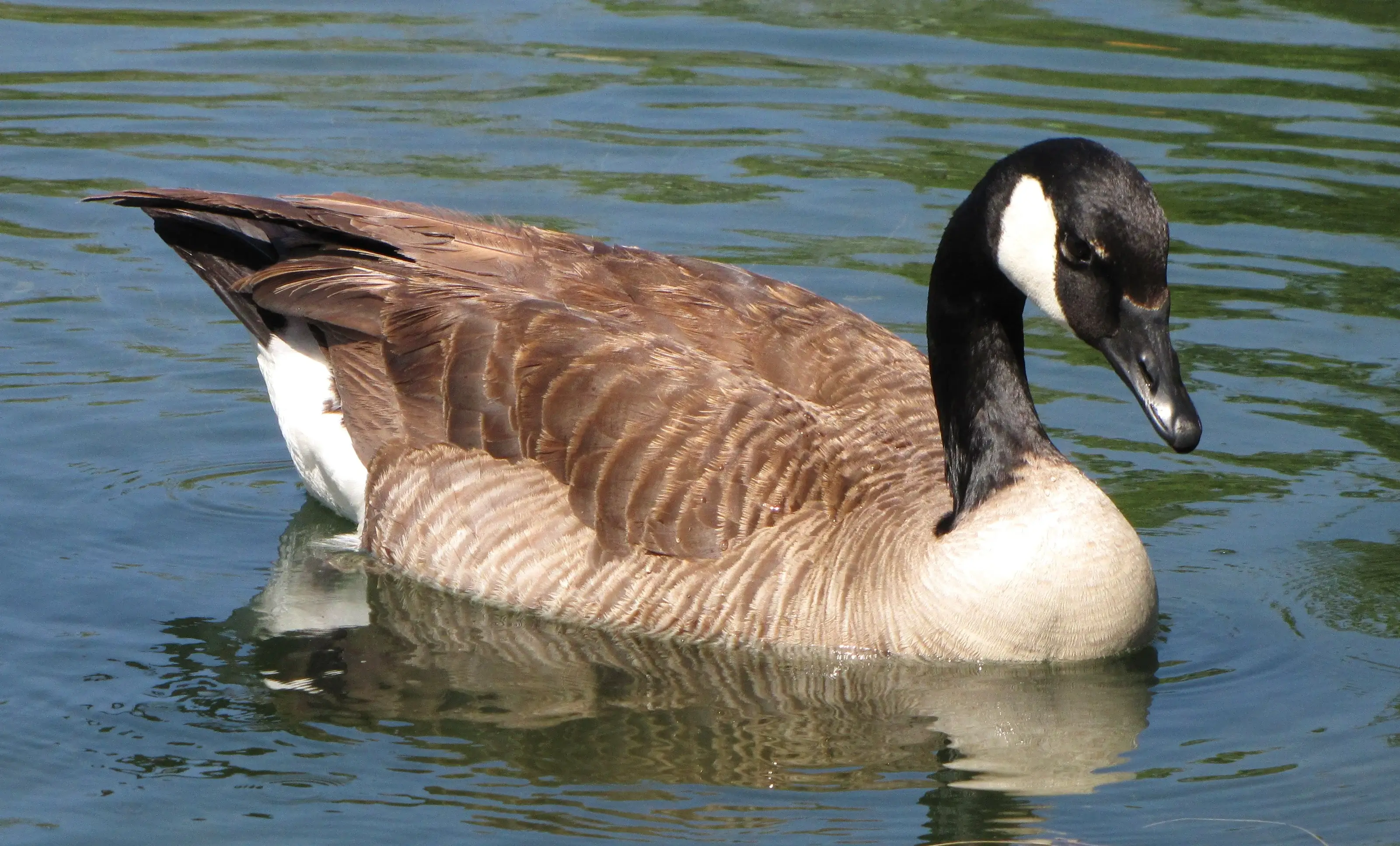
The Canada goose is a large species of goose with a black head and neck, white cheeks, white under its chin, and a brown body. It is native to the Arctic and temperate regions of North America, and it is occasionally found during migration across the Atlantic in northern Europe. It has been introduced to France, the United Kingdom, Ireland, Scandinavia, New Zealand, Japan, Chile, Argentina, and the Falkland Islands. Like most geese, the Canada goose is primarily herbivorous and normally migratory; often found on or close to fresh water, the Canada goose is also common in brackish marshes, estuaries, and lagoons.
Habitat & Range
This species is native to North America. It breeds in Canada and the northern United States in a wide range of habitats. TheGreat Lakes regionmaintains a large population of Canada geese. Canada geese live year-round in the southern part of their breeding range, including the northern half of the United States' eastern seaboard and Pacific Coast, and areas in between. BetweenCaliforniaandSouth Carolinain the southern United States and in northernMexico, Canada geese are mainly present as migrants from further north during the winter.[23] By the early 20th century, overhunting and loss of habitat in the late 19th and early 20th centuries had resulted in a serious decline in the numbers of this bird in its native range. The giant Canada goose subspecies was believed to be extinct in the 1950s until, in 1962, a small flock was discovered wintering inRochester, Minnesota, by Harold Hanson of the Illinois Natural History Survey.[24] In 1964, the Northern Prairie Wildlife Research Center was built near Jamestown, North Dakota. Its first director, Harvey K. Nelson, talked Forrest Lee into leaving Minnesota to head the center's Canada goose production and restoration program. Forrest soon had 64 pens with 64 breeding pairs of screened, high-quality birds. The project involved private, state, and federal resources and relied on the expertise and cooperation of many individuals. By the end of 1981, more than 6,000 giant Canada geese had been released at 83 sites in 26 counties in North Dakota.[25] In recent years,[when?]Canada goose populations in some areas have grown substantially, so much so that many consider thempestsfor their droppings, bacteria in their droppings, noise, and confrontational behavior. This problem is partially due to the removal of naturalpredatorsand an abundance of safe, human-made bodies of water near food sources, such as those found on golf courses, in public parks and beaches, on sports fields, and in planned communities. Due in part to the interbreeding of various migratory subspecies with the introduced non-migratory giant subspecies, Canada geese are frequently a year-round feature of such urban environments.[26] Contrary to its normal migration routine, large flocks of Canada geese have established permanent residence along the Pacific coast of North America from British Columbia's Lower Mainland and Vancouver Island area south to theSan Francisco Bay areaof Northern California. There are also resident Atlantic coast populations, such as onChesapeake Bay, inVirginia'sJames Riverregions, and in theTriangle area of North Carolina(Raleigh, Durham, Chapel Hill), and nearby Hillsborough. Some Canada geese have taken up permanent residence as far south as Florida, in places such asretention pondsin apartment complexes. In 2015, theOhiopopulation of Canada geese was reported as roughly 130,000, with the number likely to continue increasing. Many of the geese, previously migratory, reportedly had become native, remaining in the state even in the summer. The increase was attributed to a lack of natural predators, an abundance of water, and plentiful grass in manicured lawns in urban areas.[27]Canada geese were eliminated in Ohio following theAmerican Civil Warbut were reintroduced in 1956 with 10 pairs. The population was estimated at 18,000 in 1979. The geese are considered protected, though a hunting season is allowed from September 1–15, with a daily bag limit of five.[28]TheOhio Department of Natural Resourcesrecommends several non-lethal scare and hazing tactics for nuisance geese, but if such methods have been used without success, they may issue a permit which can be used from March 11 through August 31 to destroy nests, conduct a goose roundup or exterminate geese.[29]
Life History
B. c. occidentalis; B. c. fulva; B. c. parvipes; B. c. moffitti; B. c. maxima; B. c. interior; B. c. canadensis Anas canadensisLinnaeus, 1758 TheCanada goose(Branta canadensis) is a large species ofgoosewith a black head and neck, white cheeks, white under its chin, and a brown body. It is native to theArcticandtemperate regionsofNorth America, and it is occasionally found duringmigrationacross the Atlantic in northern Europe. It has been introduced to France, the United Kingdom, Ireland, Scandinavia, New Zealand, Japan, Chile, Argentina, and the Falkland Islands.[2]Like most geese, the Canada goose is primarilyherbivorousand normally migratory; often found on or close tofresh water, the Canada goose is also common inbrackishmarshes, estuaries, and lagoons. Extremely adept atliving in human-altered areas, Canada geese have established breeding colonies in urban and cultivated habitats, which provide food and few natural predators. The success of this common park species has led to it often being considered apest species. This is because of itsexcrement, its depredation of crops, its noise, its aggressiveterritorial behaviortoward both humans and other animals, and its habit ofstalkingandbegging for food. The last is a result of humans disobeyingartificial feeding policies toward wild animals. The black head and neck with a white "chinstrap" distinguish the Canada goose from all other goose species except the cackling goose and barnacle goose. (The latter, however, has a black breast and gray rather than brownish body plumage.)[13]Some Canada geese come with a pepper-spotted or brown neck with brown plumage, and these are assumed to be a leucistic variety.[14]On occasion, individuals with dark cheeks, white foreheads or white necks may be seen[15] The seven subspecies of this bird vary widely in size and plumage details but all are recognizable as Canada geese. Some of the smaller races can be hard to distinguish from the cackling goose, which slightly overlap in mass. However most subspecies of the cackling goose (exclusive of Richardson's cackling goose,B. h. hutchinsii) are considerably smaller. The smallest cackling goose,B. h. minima, is scarcely larger than amallard. In addition to the size difference, cackling geese also have a shorter neck and smaller bill, which can be useful when small Canada geese comingle with relatively large cackling geese. Of the "true geese" (i.e. the generaAnserandBranta), the Canada goose is on average the largest living species, although some other species that are geese in name, if not of close relation to these genera, are on average heavier, such as thespur-winged gooseandCape Barren goose. Canada geese range from 75 to 110 cm (30 to 43 in) in length and have a 127–185 cm (50–73 in)wingspan.[16]Among standard measurements, thewing chordcan range from39 to 55 cm (15+1⁄2to21+1⁄2in), thetarsuscan range from6.9 to 10.6 cm (2+11⁄16to4+3⁄16in) and thebillcan range from4.1 to 6.8 cm (1+5⁄8to2+11⁄16in). The largest subspecies isB. c. maxima, or the giant Canada goose, and the smallest (with the separation of the cackling goose group) isB. c. parvipes, or the lesser Canada goose.[17]An exceptionally large male of raceB. c. maxima, which rarely exceed 8 kg (18 lb), weighed 10.9 kg (24 lb) and had a wingspan of 2.24 m (7 ft 4 in). This specimen is the largest wild goose ever recorded of any species.[18] The male Canada goose usually weighs2.6–6.5 kg (5+3⁄4–14+1⁄4lb), averaging amongst all subspecies3.9 kg (8+1⁄2lb). The female looks virtually identical but is slightly lighter at2.4–5.5 kg (5+1⁄4–12+1⁄4lb), averaging amongst all subspecies 3.6 kg (8 lb), and generally 10% smaller in linear dimensions than the male counterparts.[19]Thehonkrefers to the call of the male Canada goose, whilst thehrinkcall refers to the female goose.[20]The calls are similar but thehrinkis shorter and higher pitched than thehonkof males.[20]When agitated or aggressively defending territory, Canada geese will typically initiate an encounter with a high-pitched hiss.[21]Canada geese communicate with ten different vocalizations, each in response to a different situation confronting them.[22] Like most geese, the Canada goose is naturallymigratorywith the wintering range being most of the United States. The calls overhead from large groups of Canada geese flying in aV-shaped formationsignal the transitions into spring and autumn. In some areas, migration routes have changed due to changes in habitat and food sources. In mild climates from southwesternBritish Columbiato California to theGreat Lakes, some of the population has become nonmigratory due to adequate winter food supply and a lack of former predators.[citation needed][38] Males exhibitagonistic behaviorboth on and off breeding and nesting grounds. This behavior rarely involves interspecific killing. One documented case involved a male defending his nest from abrantthat wandered into the area; the following attack lasted for one hour until the death of the brant. The cause of death was suffocation or drowning in mud as a direct result of the Canada goose's pecking the head of the brant into the mud. Researchers attributed it to high hormone levels and the brant's inability to leave the nesting area.[39] Canada geese are primarilyherbivores,[23]although they sometimes eat smallinsectsandfish.[40]Their diet includes green vegetation andgrains. The Canada goose eats a variety ofgrasseswhen on land. It feeds by grasping a blade of grass with the bill, then tearing it with a jerk of the head. The Canada goose also eatsbeansand grains such aswheat,rice, andcornwhen they are available. In the water, it feeds from aquatic plants by sliding its bill at the bottom of the body of water. It also feeds on aquatic plant-like algae, such asseaweed.[18] In urban areas, it is also known to pick food out of garbage bins. They are also sometimes hand-fed a variety of grains and other foods by humans in parks. Canada geese prefer lawn grass in urban areas. They usually graze in open areas with wide clearance to avoid potential predators.[41] During the second year of their lives, Canada geese find a mate. They aremonogamous, and most couples stay together all of their lives. If one dies, the other may find a new mate. The female lays from two to nine eggs with an average of five, and both parents protect the nest while the eggsincubate, but the female spends more time at the nest than the male.[18] Its nest is usually located in an elevated area near water such as streams, lakes, ponds, and sometimes on abeaverlodge. Its eggs are laid in a shallow depression lined with plant material and down. The incubation period, in which the female incubates while the male remains nearby, lasts for 24–32 days after laying. Canada geese can respond to external climatic factors by adjusting their laying date to spring maximum temperatures, which may benefit their nesting success.[42]As the annual summer molt also takes place during the breeding season, the adults lose theirflight feathersfor 20–40 days, regaining flight about the same time as their goslings start to fly.[43] As soon as the goslings hatch, they are immediately capable of walking, swimming, and finding their own food (a diet similar to that of adult geese). Parents are often seen leading their goslings in a line, usually with one adult at the front and the other at the back. While protecting their goslings, parents often violently chase away nearby creatures, from small blackbirds to lone humans who approach: first giving a warning hiss, and then attacking with bites and slaps of the wings. Although parents are hostile to unfamiliar geese, they may form groups of a number of goslings and a few adults, calledcrèches. The offspring enter thefledglingstage any time from six to nine weeks of age. They do not leave their parents until after the spring migration, when they return to their birthplace.[23] On a nest in theMontezuma National Wildlife Refuge; Nest; Eggs, collectionMuseum Wiesbaden, Germany; Gosling in Jersey City, New Jersey, US; Goslings; Geese and goslings on an English canal, showing formation; Pair of adults with goslings,Norfolk
Status, Trends & Threats
In 2000, the North American population of the geese was estimated to be between 4 million and 5 million birds.[96]A 20-year study from 1983 to 2003 inWichita, Kansas, found the size of the winter Canada goose population within the city limits increased from 1,600 to over 18,000 birds.[96]
Hunting Season
Typically Sep-Jan depending on zone. Follow federal migratory bird frameworks. Check WGFD regulations.
Frequently Asked Questions
Regulations for hunting Canada Goose in Wyoming
Canada goose hunting follows federal migratory bird regulations with state-specific season dates and bag limits. HIP registration is required. Federal duck stamp is required for hunters 16 and older. Season dates vary by waterfowl zone in Wyoming. Non-toxic shot is required.
When is Canada Goose hunting season in Wyoming?
Typically Sep-Jan depending on zone. Follow federal migratory bird frameworks. Check WGFD regulations.
What is the bag limit for Canada Goose in Wyoming?
Varies by zone. Typically 2-5 per day following federal frameworks.
What is another name for Canada Goose?
Canada Goose is also known as Canada goose, Honker in Wyoming.
References
| State | Category | Directory | Subcategory | Content | Source |
|---|---|---|---|---|---|
| Wyoming | Hunting | Regulations | Season Dates | Typically Sep-Jan depending on zone. Follow federal migratory bird frameworks. Check WGFD regulations. | Link |
| Wyoming | Hunting | Regulations | Regulations | Canada goose hunting follows federal migratory bird regulations with state-specific season dates and bag limits. HIP reg | Link |