Also known as: Greater sage-grouse, Sage chicken, Sage hen
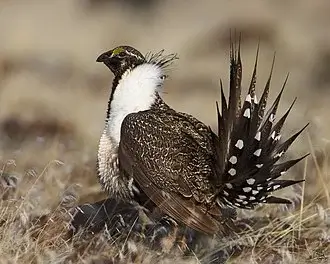
The greater sage-grouse, also known as the sagehen, is the largest grouse in North America. Its range is sagebrush country in the western United States and southern Alberta and Saskatchewan, Canada. It was known as simply the sage grouse until the Gunnison sage-grouse was recognized as a separate species in 2000. The Mono Basin population of sage grouse may also be distinct.
Habitat & Range
Greater sage-grouse are obligate residents of the sagebrush (Artemisiaspp.) ecosystem, usually inhabiting sagebrush-grassland or juniper (Juniperusspp.) sagebrush-grassland communities. Meadows surrounded by sagebrush may be used as feeding grounds.[6]Use of meadows with a crown cover of silver sagebrush (A. cana) is especially important in Nevada during the summer.[7] Greater sage-grouse occur throughout the range of big sagebrush (A. tridentata), except on the periphery of big sagebrush distribution.[8]Greater Sage-Grouse prefer mountain big sagebrush (A. t.ssp.vaseyana) and Wyoming big sagebrush (A. t.ssp.wyomingensis) communities to basin big sagebrush (A. t.ssp.tridentata) communities. Sagebrush cover types other than big sagebrush can fulfill greater sage-grouse habitat requirements; in fact, the grouse may prefer other sagebrush cover types to big sagebrush. Greater sage-grouse inAntelope Valley, California, for example, use black sagebrush (A. nova) cover types more often than the more common big sagebrush cover types.[9]Hens with broods on the National Antelope Refuge in Oregon were most frequently found (54–67% of observations) in low sagebrush (A. arbuscula) cover.[10]Desert shrub habitat may also be used by greater sage-grouse.[11] Sagebrush communities supporting greater sage-grouse include silver sagebrush and fringed sagebrush (A. frigida).[12] Their historic range spanned 16 American states andAlberta,British Columbia, andSaskatchewanin Canada. Between 1988 and 2012, the Canadian population declined by 98%.[13]By 2012, they were extirpated from British Columbia and left with only remnant populations in Alberta with 40 to 60 adult birds, and in Saskatchewan with only 55 to 80 adult birds. By 2013, sage grouse were also extirpated from five U.S. states.[13]In 2013, the Canadian Governor in Council on behalf of theMinister of the Environment, under theSpecies at Risk Act, annexed an emergency order for the protection of the greater sage-grouse.[13]
Life History
C. u. urophasianus; C. u. phaios Thegreater sage-grouse(Centrocercus urophasianus), also known as thesagehen, is the largestgrousein North America. Its range issagebrush countryin the westernUnited Statesand southernAlbertaandSaskatchewan, Canada. It was known as simply thesage grouseuntil theGunnison sage-grousewas recognized as a separate species in 2000.[3]TheMono Basinpopulation of sage grouse may also be distinct.[4] The greater sage-grouse is a permanent resident in its breeding grounds but may move short distances to lower elevations during winter. It makes use of a complexlek system in matingand nests on the ground under sagebrush or grass patches. It forages on the ground, mainly eating sagebrush but also other plants and insects. Greater sage-grouse do not have a muscularcropand are not able to digest hardseedslike other grouse. The species is in decline across its range due tohabitat loss, and has been recognized as threatened or near threatened by several national and international organizations. Adult greater sage-grouse have a long, pointed tail and legs withfeathersto the toes. The adult male has a yellow patch over each eye, is grayish on top with a white breast, and has a dark brown throat and a black belly; two yellowishsacs on the neckare inflated during courtship display. The adult female is mottled gray-brown with a light brown throat and dark belly. Adult males range in length from 26 to 30 inches and weigh between 4 and 7 pounds. Adult females are smaller, ranging in length from 19 to 23 inches and weighing between 2 and 4 pounds.[5]
Status, Trends & Threats
Residential building and energy development have caused the greater sage-grouse population to decline from 16 million 100 years ago to between 200,000 and 500,000 today.[53] This species is in decline due toloss of habitat;[54]the bird's range has shrunk in historical times, having beenextirpatedfrom British Columbia,Kansas, andNebraska. Though the greater sage-grouse as a whole is not considered endangered by theIUCN, local populations may be in serious danger of extinction. In May 2000, the CanadianSpecies at Risk Actlisted the subspeciesCentrocercus urophasianus phaios, formerly found in British Columbia, as being extirpated in Canada.[55]The presence ofsubfossilbones at Conkling Cave andShelter Cavein southern New Mexico show that the species was present south of its current range at the end of thelast ice age, leading some experts to project that the species could become increasingly vulnerable asglobal climate changeincreases the humidity insemiaridregions.[56]
Hunting Season
Typically Sep-Oct. Check current WGFD regulations. Limited seasons in most areas with sufficient populations.
Frequently Asked Questions
Regulations for hunting Greater Sage-Grouse in Wyoming
Greater sage-grouse hunting in Wyoming is managed conservatively. Seasons are limited to areas with healthy populations. Bag limits are typically low. Hunters should check current WGFD regulations for open areas and specific season dates. Conservation concerns have led to restricted hunting opportunities in some regions.
When is Greater Sage-Grouse hunting season in Wyoming?
Typically Sep-Oct. Check current WGFD regulations. Limited seasons in most areas with sufficient populations.
What is the bag limit for Greater Sage-Grouse in Wyoming?
Typically 1-2 per day, 2-4 in possession. Males only in some areas.
What is another name for Greater Sage-Grouse?
Greater Sage-Grouse is also known as Greater sage-grouse, Sage chicken, Sage hen in Wyoming.
References
| State | Category | Directory | Subcategory | Content | Source |
|---|---|---|---|---|---|
| Wyoming | Hunting | Regulations | Season Dates | Typically Sep-Oct. Check current WGFD regulations. Limited seasons in most areas with sufficient populations. | Link |
| Wyoming | Hunting | Regulations | Regulations | Greater sage-grouse hunting in Wyoming is managed conservatively. Seasons are limited to areas with healthy populations. | Link |