Also known as: Gray squirrel
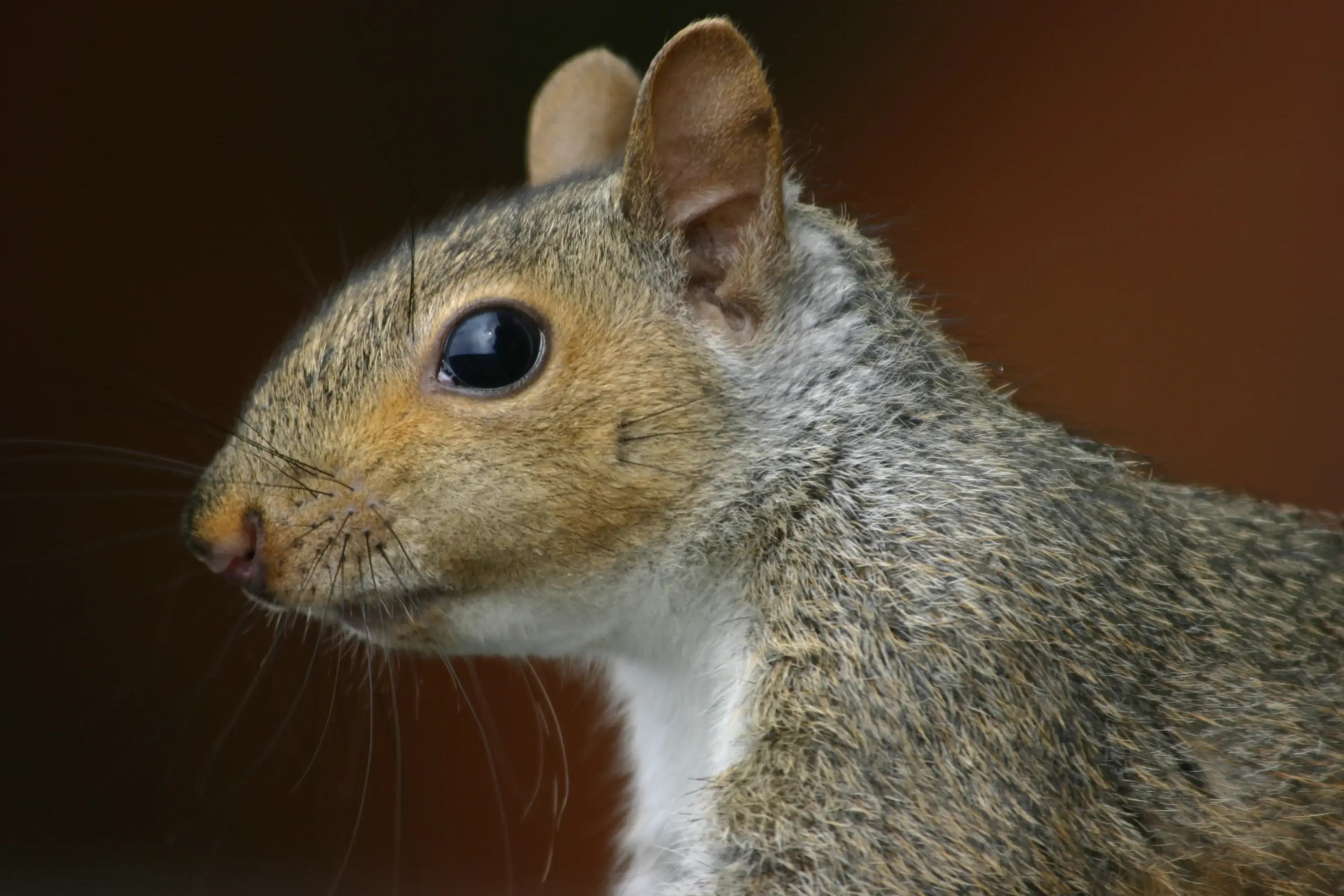
The eastern gray squirrel, spelled as grey squirrel outside of the United States, is a species of tree squirrel in the genus Sciurus. It is native to eastern North America, where it is the most prodigious and ecologically essential natural forest regenerator. Widely introduced to certain places around the world, the eastern gray squirrel in Europe, in particular, is regarded as an invasive species.
Habitat & Range
Sciurus carolinensisis native to theeasternandmidwestern United States, and to the southerly portions of the central provinces ofCanada. In the mid-1800s the population in the midwestern United States was described as being "truly astonishing," but human predation and habitat destruction through deforestation resulted in drastic population reductions, to the point that the animal was almost absent from Illinois by 1900.[10] The native range of the eastern gray squirrel overlaps with that of thefox squirrel(Sciurus niger), with which it is sometimes confused, although the core of the fox squirrel's range is slightly more to the west. The eastern gray squirrel is found from New Brunswick, through southwestern Quebec and throughout southern Ontario plus in southern Manitoba, south toEast Texasand Florida.[3]Breeding eastern gray squirrels are found in Nova Scotia, but whether this population was introduced or came from natural range expansion is not known.[11] A prolific and adaptable species, the eastern gray squirrel has also been introduced to, and thrives in, several regions of thewestern United States. In 1966, this squirrel was introduced onto Vancouver Island in Western Canada in the area of Metchosin, where it is considered highly invasive and a threat to both the local ecosystem and the native squirrel, theAmerican red squirrel.[12] Overseas,eastern gray squirrels in Europeare a concern because they have displaced some of the native squirrels there. For example, in Britain, they have largely displaced the red squirrel;[13]in Ireland, they compete with theEurasian red squirrel.[14][15]They have also been introduced into Italy, South Africa, and Australia (where they wereextirpatedby 1973).[3][13][16] In the wild, eastern gray squirrels can be found inhabiting large areas of mature, densewoodlandecosystems, generally covering 100 acres (40 hectares) of land.[40]These forests usually contain largemast-producing trees such as oaks and hickories, providing ample food sources. Oak-hickory hardwood forests are generally preferred over coniferous forests due to the greater abundance of mast forage.[24]This is why they are found only in parts of eastern Canada which do not contain boreal forest (i.e. they are found in some parts of New Brunswick, in southwestern Quebec, throughout southern Ontario and in southern Manitoba).[ambiguous] Eastern gray squirrels generally prefer constructing their dens upon large tree branches and within the hollow trunks of trees. They also have been known to take shelter within abandoned bird nests. The dens are usually lined with moss plants, thistledown, dried grass, and feathers. These perhaps provide and assist in the insulation of the den, used to reduce heat loss. A cover to the den is usually built afterwards.[46]Eastern gray squirrels also use dens for protection from predators and to help them look after their young. Young survive 40 percent less if they lived in a leaf nest compared to a den. Squirrels tend to claim 2-3 dens at the same time. Canopy and midstory trees are used by squirrels to hide from predators such as hawks and owls. The typical squirrel ranges over 1.5 to 8 acres (0.61 to 3.24 ha) and tends to be smaller where more of them are found.[47] Close to human settlements, eastern gray squirrels are found in parks and back yards of houses within urban environments and in the farmlands of rural environments.[48]
Life History
S. c. carolinensis; S. c. extimus; S. c. fuliginosus; S. c. hypophaeus; S. c. pennsylvanicus; S. c. leucotis Neosciurus carolinensis[5]; S. pennsylvanica; S. hiemalis; S. leucotis; S. fulginosus; S. migratorius Theeastern gray squirrel(Sciurus carolinensis), spelled asgrey squirreloutside of the United States, is a species oftree squirrelin the genusSciurus. It is native to eastern North America, where it is the most prodigious and ecologically essential natural forest regenerator.[6][7]Widely introduced to certain places around the world,the eastern gray squirrel in Europe, in particular, is regarded as aninvasive species. In Europe,Sciurus carolinensisis included (since 2016) in thelist of Invasive Alien Species of Union concern(the Union list).[8]This implies that this species cannot be imported, bred, transported, commercialized, or intentionally released into the environment in the whole of the European Union.[9] Like many members of the familySciuridae, the eastern gray squirrel is ascatter-hoarder; it hoards food in numerous small caches for later recovery.[3]Some caches are quite temporary, especially those made near the site of a sudden abundance of food which can be retrieved within hours or days for reburial in a more secure site. Others are more permanent and are not retrieved until months later. Each squirrel is estimated to make several thousand caches each season. The squirrels have very accuratespatial memoryfor the locations of these caches, using distant and nearby landmarks to retrieve them.Smellis used partly to uncover food caches, and also to find food in other squirrels' caches. Scent can be unreliable when the ground is too dry or covered in snow.[34] Squirrels sometimes use deceptive behavior to prevent other animals from retrieving cached food. For example, they will pretend to bury the object if they feel that they are being watched. They do this by preparing the spot as usual, for instance, digging a hole or widening a crack, miming the placement of the food, while actually concealing it in their mouths, and then covering up the "cache" as if they had deposited the object. They also hide behind vegetation while burying food or hide it high up in trees (if their rival is not arboreal). Such a complex repertoire suggests that the behaviours are not innate, and implytheory of mindthinking.[35][36] The eastern gray squirrel is one of very few mammalian species that can descend a tree head-first. It does this by turning its feet so the claws of its hind paws are backward-pointing and can grip the tree bark.[37][38] Eastern gray squirrels build a type ofnest, known as adrey, in the forks of trees, consisting mainly of dry leaves and twigs. The dreys are roughly spherical, about 30 to 60 cm in diameter and are usually insulated with moss, thistledown, dried grass, and feathers to reduce heat loss.[25]Males and females may share the same nest for short times during the breeding season, and during cold winter spells. Squirrels may share a drey to stay warm. They may also nest in theatticor exterior walls of a house, where they may be regarded as pests, as well as fire hazards due to their habit of gnawing on electrical cables.[39]In addition, squirrels may inhabit a permanent tree den hollowed out in the trunk or a large branch of a tree.[40] Eastern gray squirrels exhibitdiurnalorcrepuscularbehavior depending on the season,[24]and tend to avoid the heat in the middle of a summer day.[40]They do nothibernate.[41] Eastern gray squirrels can breed twice a year, but younger and less experienced mothers normally have a single litter per year in the spring. Depending on forage availability, older and more experienced females may breed again in summer.[42]In a year of abundant food, 36% of females bear two litters, but none will do so in a year of poor food.[18]Their breeding seasons are December to February and May to June, though this is slightly delayed in more northern latitudes.[24][40]The first litter is born in February or March, the second in June or July, though, again, bearing may be advanced or delayed by a few weeks depending on climate, temperature, and forage availability. In any given breeding season, an average of 61 – 66% of females bear young.[18]If a female fails to conceive or loses her young to unusually cold weather or predation, she re-enters estrus and has a later litter. Five days before a female enters estrus, she may attract up to 34 males from up to 500 meters away. Eastern gray squirrels exhibit a form of polyandry, in which the competing males will form a hierarchy of dominance, and the female will mate with multiple males depending on the hierarchy established.[18] Normally, one to four young are born in each litter, but the largest possible litter size is eight.[18]Thegestationperiod is about 44 days.[18]The young areweanedaround 10 weeks, though some may wean up to six weeks later in the wild. They begin to leave the nest after 12 weeks, with autumn born young often wintering with their mother. Only one in four squirrel kits survives to one year of age, with mortality around 55% for the following year. Mortality rates then decrease to around 30% for following years until they increase sharply at eight years of age.[18] Rarely, eastern gray females can enter estrus as early as five and a half months old,[40]but females are not normally fertile until at least one year of age. Their mean age of first estrus is 1.25 years.[18]The presence of a fertile male will induce ovulation in a female going through estrus.[18]Male eastern grays are sexually mature between one and two years of age.[43]Reproductive longevity for females appears to be over 8 years, with 12.5 years documented in North Carolina.[18]These squirrels can live to be 20 years old in captivity, but in the wild live much shorter lives due to predation and the challenges of their habitat. At birth, their life expectancy is 1–2 years; an adult typically can live to be six, with exceptional individuals making it to 12 years. Eastern gray squirrels eat a range of foods, such as many types ofseedsandnuts, includingacorns,walnuts, andhazelnuts, treebuds, flowers,[54]berries, tree bark, and some types of forestfungi, includingfly agaricmushrooms[55]andtruffles.[40]They are also carnivorous, variously eating insects, small birds, eggs, frogs, lizards, and other small rodents,[56]including other squirrels.[57] Eastern tree squirrels can cause damage to trees by tearing the bark and eating the softcambial tissueunderneath. In Europe,sycamoreandbeechsuffer the greatest damage.[58]Mast-bearinggymnospermssuch ascedar,hemlock,pine, andspruceare another food source,[54]as well asangiospermssuch ashickory,oak, andwalnut. These trees produce important foods for them during the spring and fall months. Tree squirrels will vary the species they forage upon seasonally.[47]Tree squirrels also raid gardens forwheat,[54]tomatoes,corn,strawberries, and other garden crops.[59]Sometimes they eat the tomato seeds and discard the rest. On occasion, eastern gray squirrels also prey uponinsects,frogs, small rodents including other squirrels, and small birds, their eggs, and young.[3][40]They also gnaw on bones,antlers, and turtle shells – likely as a source of minerals scarce in their normal diet.[55]In urban and suburban areas, these squirrels scavenge for food in trash bins. However, these foods are not safe for them to digest because they include sugar, fat, as well as additives that can make them sick. Eastern gray squirrels are sometimes mistakenly thought to be herbivores, but they are omnivores.[60] Eastern gray squirrels have a high enough tolerance for humans to inhabit residential neighborhoods and raidbird feedersformillet, corn, andsunflower seeds. Some people who feed and watch birds for entertainment also intentionally feed seeds and nuts to squirrels for the same reason.[61]However, in the UK eastern gray squirrels can take a significant proportion of supplementary food from feeders, preventing access and reducing use by wild birds.[62]Attraction to supplementary feeders can increase local bird nest predation, as eastern gray squirrels are more likely to forage near feeders, resulting in increased likelihood of finding nests, eggs and nestlings of small passerines.[63]
Hunting Season
Typically Sep-Feb. Check current WGFD small game regulations.
Frequently Asked Questions
Regulations for hunting Eastern Gray Squirrel in Wyoming
Eastern gray squirrel hunting is available in suitable woodland habitats, primarily in eastern Wyoming. A valid Wyoming hunting license is required.
When is Eastern Gray Squirrel hunting season in Wyoming?
Typically Sep-Feb. Check current WGFD small game regulations.
What is the bag limit for Eastern Gray Squirrel in Wyoming?
Typically 5-8 per day.
What is another name for Eastern Gray Squirrel?
Eastern Gray Squirrel is also known as Gray squirrel in Wyoming.
References
| State | Category | Directory | Subcategory | Content | Source |
|---|---|---|---|---|---|
| Wyoming | Hunting | Regulations | Season Dates | Typically Sep-Feb. Check current WGFD small game regulations. | Link |
| Wyoming | Hunting | Regulations | Regulations | Eastern gray squirrel hunting is available in suitable woodland habitats, primarily in eastern Wyoming. A valid Wyoming | Link |