Also known as: Prairie chicken, Pinnated grouse
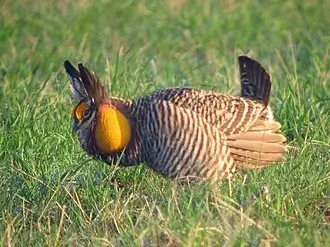
The greater prairie-chicken or pinnated grouse, sometimes called a boomer, is a large bird in the grouse tribe. This North American species was once abundant but has become extremely rare or extirpated over much of its range due to habitat loss, natural disasters, and overhunting. Conservation measures are underway to ensure the sustainability of existing small populations. One of the most famous aspects of these creatures is the mating ritual called booming.
Habitat & Range
The greater prairie-chicken prefers undisturbedprairieand was originally found intallgrass prairies. It can tolerate agricultural land mixed with prairie, but sparser population density is found in areas that are more agricultural. Its diet consists primarily of seeds andfruit, but during the summer it also eats green plants andinsectssuch as grasshoppers, crickets, and beetles.[15]This species was once widespread all across theoak savannaand tall grass prairieecosystem.
Life History
T. c. attwateriT. c. pinnatusT. c. cupido† Tetrao cupidoLinnaeus, 1758 Thegreater prairie-chickenorpinnated grouse(Tympanuchus cupido), sometimes called aboomer,[2]is a largebirdin thegrousetribe. ThisNorth Americanspecieswas once abundant but has become extremely rare orextirpatedover much of its range due tohabitat loss, natural disasters, and overhunting.[2][3]Conservationmeasures are underway to ensure the sustainability of existing small populations. One of the most famous aspects of these creatures is themating ritualcalled booming. Carl Linnaeusbased his account on the "Le Cocq de bois d'Amerique" that had been described and illustrated by the English naturalistMark Catesbyin his bookThe Natural History of Carolina, Florida and the Bahama Islands. Catesby had seen greater prairie-chickens in 1743 at the home of theEarl of Wilmingtonin the then village ofChiswick, 7 mi (11 km) west of London. The Earl believed that that his birds had come from North America but did not know from where.[4]Linnaeus specified thetype localityasVirginiabut this has been changed toPennsylvaniaby theAmerican Ornithologists' Union.[5] Adults of both sexes are medium to large chicken-like birds, stocky with round wings. They have short tails which are typically rounded. Adult males have orange comb-like feathers over their eyes and dark, elongated head feathers that can be raised or lain along neck. They also possess a circular, un-feathered neck patch which can be inflated while displaying; this, like their comb feathers, is also orange. As with many other bird species, the adult females have shorter head feathers and also lack the male's yellow comb and orange neck patch. Adults are about 43 cm (17 in) long, and weigh between 700–1,200 g (25–42 oz).[13]The greater prairie-chicken has a wingspan range of 69.5–72.5 cm (27.4–28.5 in).[14]
Status, Trends & Threats
A steamboat captain recalled seeing great flocks of prairie chickens atBird's Pointin 1840, writing "Then we gazed in wonderment, but very soon our eyes were drawn to something more attractive which caused us to forget the great river. The whole banks or sandbars on either river were a mass of quail or partridges. I have never in my life seen such a grand sight. They had come from the prairies to the river, but unable to fly across either stream there they were by the millions running up and down each river until they had made paths and roads. We killed a great many with sticks and clubs and took them to the boat. We met Dick Bird, the man this point took its name from, and he said we could look for a cold winter, as the quails and prairie chickens were leaving the prairies and trying to get south to escape the cold."[16]: 108 The greater prairie-chicken was almost extinct in the 1930s due to hunting pressure and habitat loss. InIllinoisalone, in the 1800s, the prairie-chicken numbered in the millions. It was a popular game bird, and like many prairie birds, which have also suffered massive habitat loss, it is now on the verge of extinction, with the wild bird population at around 200 inIllinoisin 2019. It now only lives on small parcels of managed prairie land.[17]Throughout North America, it is thought that their current population has declined severely, to approximately 360,000 individuals as of 2020.[1]In May 2000, the Canadian Species at Risk Act listed the greater prairie-chicken as extirpated in its Canadian range (Alberta,Saskatchewan,Manitoba,Ontario).[18]It was again confirmed by the Committee on the Status of Endangered Wildlife in Canada in November 2009.[19]Nonetheless, sightings and encounters continue to occur in the south-central regions of Alberta and Saskatchewan, along with southern Ontario, where sightings are extremely rare.[20] In states such as Iowa and Missouri that once had thriving prairie-chicken populations (estimated to be hundreds of thousands[21]), total numbers have dropped to about 500. However, theMissouri Department of Conservationhas started a program to import prairie-chickens fromKansasandNebraskain the hopes that they will be able to repopulate the state and increase that number to 3,000.[citation needed] Wisconsin is home to a small population of greater prairie-chickens, down from 55,000 when first estimated in 1929 by A.O. Gross.[22]Gross's contemporary,Aldo Leopold, felt that this population estimate was over-optimistic.[23]In 1955, the hunting of prairie chickens was outlawed in Wisconsin.[24][25]By 1998, a census of booming cocks (male birds) counted a total of 649 birds in their remaining habitat in central Wisconsin.[26]As of 2025, up to 307 cocks were counted on booming grounds in central Wisconsin, the highest population recorded since 2007 – this population increase is largely driven by a growing population at the Buena Vista prairie management area.[27]Though this area was predominately spruce and tamarack marsh before European settlement, early pioneers drained the marshes and attempted to farm the poor soil. As the prairies to the south and west were lost to agriculture and development, and the southern half of Wisconsin was logged, the prairies spread northward into the abandoned farmland. Today, over 30,000 acres are managed by theWisconsin Department of Natural Resourcesas greater prairie-chicken habitat. Surveys conducted in 2025 detected that 38 different booming grounds were present in central Wisconsin wildlife areas.[27]Birdwatchers travel from around the world to visit Wisconsin in April for the Central Wisconsin Prairie Chicken Festival, started in 2006 by Golden Sands Resource Conservation & Development Council, Inc.[28] Habitat lossis the greatest historical threat to prairie-chicken populations. More than 95% of alltallgrass prairiein the United States has been converted to cropland. The conversion of native prairie to cropland is very detrimental to these birds. It was found in a radio telemetry study conducted byKansas State Universitythat "most prairie-chicken hens avoided nesting or rearing their broods within a quarter-mile of power lines and within a third-mile of improved roads." (Kansas Department of Wildlife and Parks) It was also found that the prairie-chickens avoided communication towers and rural farms. Studies have found mesopredators such asstriped skunks,raccoons, andopossumssignificantly increase egg mortality; experimental removal of these predators increased nesting success from 33% to 82%.[33]Loss ofapex predatorssuch as bears, wolves, and mountain lions results in increased populations of these mesopredators, and therefore reduces populations of prairie-chickens, an example of a top-downtrophic cascade. Non-nativecommon pheasantsalso reduce prairie-chicken reproduction throughnest parasitism. The small size of some isolated prairie-chicken populations in the Eastern portion of the range resulted in apopulation bottleneck, which reduced thegenetic diversityand ultimately survival of offspring.[34]In Illinois, wildlife management included the "genetic rescue" of small and potentially inbred populations by introducing birds from other areas.[35]
Hunting Season
Typically Sep-Oct. Check current WGFD regulations. Limited hunting opportunity.
Frequently Asked Questions
Regulations for hunting Greater Prairie-Chicken in Wyoming
Greater prairie-chicken hunting in Wyoming is limited. Seasons are short and bag limits conservative to protect populations. Hunting is typically allowed only in specific areas with sufficient populations.
When is Greater Prairie-Chicken hunting season in Wyoming?
Typically Sep-Oct. Check current WGFD regulations. Limited hunting opportunity.
What is the bag limit for Greater Prairie-Chicken in Wyoming?
Typically 1-2 per day, 2-4 in possession.
What is another name for Greater Prairie-Chicken?
Greater Prairie-Chicken is also known as Prairie chicken, Pinnated grouse in Wyoming.
References
| State | Category | Directory | Subcategory | Content | Source |
|---|---|---|---|---|---|
| Wyoming | Hunting | Regulations | Season Dates | Typically Sep-Oct. Check current WGFD regulations. Limited hunting opportunity. | Link |
| Wyoming | Hunting | Regulations | Regulations | Greater prairie-chicken hunting in Wyoming is limited. Seasons are short and bag limits conservative to protect populati | Link |