Also known as: Woodchuck, Whistle pig
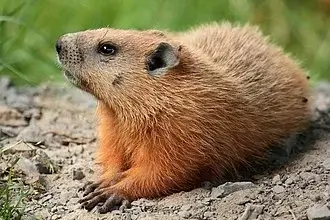
The groundhog, also known as the woodchuck, is a rodent of the family Sciuridae, belonging to the group of large ground squirrels known as marmots. A lowland creature of North America, it is found through much of the Eastern United States, across Canada and into Alaska. It was given its scientific name as Mus monax by Carl Linnaeus in 1758, based on a description of the animal by George Edwards, published in 1743.
Habitat & Range
The groundhog dwells in lowland habitats, unlike other marmots that live in rocky and mountainous areas.Marmota monaxhas a wide geographic range. The groundhog prefers open country and the edges of woodland, being rarely found far from a burrow entrance.[28]It can typically be found in small woodlots, low-elevation forests, fields and pastures, and hedgerows. It constructs dens in well-drained soil, and most groundhogs have summer and winter dens. Human activity has increased food access and abundance, allowingM. monaxto thrive.[29]
Life History
M. m. monaxLinnaeus, 1758; M. m. canadensisErxleben, 1777; M. m. ignavaBangs, 1899; M. m. rufescensA. H. Howell, 1914 Mus monaxLinnaeus, 1758Arctomys monax(Linnaeus, 1758) Thegroundhog(Marmota monax), also known as thewoodchuck, is arodentof the familySciuridae, belonging to the group of largeground squirrelsknown asmarmots.[2]A lowland creature of North America, it is found through much of theEastern United States, acrossCanadaand intoAlaska.[3]It was given its scientific name asMus monaxbyCarl Linnaeusin 1758,[4]based on a description of the animal byGeorge Edwards, published in 1743.[5] The groundhog, being a lowland animal, is exceptional among marmots. Other marmots, such as theyellow-belliedandhoary marmots, live in rocky and mountainous areas. Groundhogs are considered one of the mostsolitaryofmarmot species. They live in aggregations, and their social organization and long-term pair bonds varies acrosspopulations. The groundhog's male and female interactions are usually limited to themating seasonandcopulation. However, certain populations of groundhogs have been observed to form long-term adult male-female association throughout the year, and often from year to year.[6][7] The groundhog is an important contributor to the maintenance of healthy soil inwoodlandsandplains; as such, the species is considered a crucialhabitat engineer.[8][9][10]The groundhog is an extremelyintelligentanimal, forming complexsocial networksandkinshipwith its young; it is capable of understandingsocial behavior,communicatingthreats throughwhistling, and workingcooperativelyto accomplish tasks such asburrowing.[11][12] The groundhog is the largestsciuridin its geographical range, excluding its presence inBritish Columbiawhere its range may be comparable to that of its somewhat larger cousin, thehoary marmot. Adults may measure from41.8 to 68.5 cm (16+7⁄16to26+15⁄16in) in total length, including a tail of9.5 to 18.7 cm (3+3⁄4to7+3⁄8in).[7][21][22]Weights of adult groundhogs typically fall between 2 and 6.3 kg (4 lb 7 oz and 13 lb 14 oz).[22][23][24] Male groundhogs are slightly larger than females on average and, like all marmots, they are considerably heavier during autumn (when engaged inautumn hyperphagia) than when they emerge from hibernation in spring. Adult males average year-around weight 3.83 kg (8 lb 7 oz), with spring to fall average weights of 3.1 to 5.07 kg (6 lb 13 oz to 11 lb 3 oz) while females average 3.53 kg (7 lb 13 oz), with spring to fall averages of 3.08 to 4.8 kg (6 lb 13 oz to 10 lb 9 oz).[7][25]Seasonal weight changes reflectcircannualdeposition and use of fat. Groundhogs attain progressively higher weights each year for the first two or three years, after which weight plateaus.[7] Groundhogs have fourincisors, which grow1.5 millimetres (1⁄16in) per week. Constant usage wears them down by about that much each week.[26]Unlike the incisors of many other rodents, the incisors of groundhogs are white to ivory-white.[27][18]: 20Groundhogs are well-adapted for digging, with powerful, short legs and broad, long claws. The groundhog's tail is shorter than that of other Sciuridae—only about one-fourth of body length. W.J. Schoonmaker reports that groundhogs may hide when they see, smell, or hear an observer.[18]: 41–43Marmot researcher Ken Armitage states that the social biology of the groundhog is poorly studied.[30]Despite their heavy-bodied appearance, groundhogs are accomplished swimmers and occasionally climb trees when escaping predators or when they want to survey their surroundings.[31]They prefer to retreat to their burrows when threatened; if the burrow is invaded, the groundhog tenaciously defends itself with its two largeincisorsand front claws. Groundhogs are generallyagonisticand territorial toward each other and may skirmish to establish dominance.[32][18]: 93Outside their burrow, individuals are alert when not actively feeding. It is common to see one or more nearly motionless individuals standing erect on their hind feet watching for danger. When alarmed, they use a high-pitched whistle to warn the rest of the colony, hence the name "whistle-pig".[33][34]Groundhogs may squeal when fighting, seriously injured, or caught by a predator.[34]Other vocalizations include low barks and a sound produced by grinding their teeth.[34]David P. Barashwrote that he witnessed only two occasions of upright play-fighting among woodchucks and that the upright posture of play-fighting involves sustained physical contact between individuals that may require a degree of social tolerance virtually unknown inM. monax. Alternatively, upright play-fighting may be a part of the woodchuck's behavioral repertoire that rarely is shown because of physical spacing and/or low social tolerance.[35]: 97 Mostlyherbivorous, groundhogs eat primarily wild grasses and other vegetation, including berries, bark, leaves, and agricultural crops, when available.[32][36]In early spring,dandelionandcoltsfootare important groundhog food items. Some additional foods includesheep sorrel,timothy-grass,buttercup,persicaria,agrimony, red and blackraspberries,mulberries,buckwheat,plantain,wild lettuce,alfalfa, and all varieties ofclover. Groundhogs also occasionally eat small animals, such asgrubs,grasshoppers,snails, and even bird eggs and baby birds, but are not asomnivorousas many otherSciuridae.[36][37] An adult groundhog can eat more than 1 lb (0.45 kg) of vegetation daily.[38]In early June, woodchucks'metabolismslows, and while their food intake decreases, their weight increases by as much as 100% as they produce fat deposits to sustain them during hibernation and late winter.[39]Instead of storing food, groundhogs stuff themselves to survive the winter without eating.[40]Thought not to drink water, groundhogs are reported to obtain needed liquids from the juices of edible plants, aided by their sprinkling with rain or dew.[18]: 85[41][14]: 308 Groundhogs are considered the mostsolitaryof themarmot species. They live in aggregations, and their social organization also varies acrosspopulations. Groundhogs do not form stable, long-term pair bonds, and duringmating seasonmale-female interactions are limited tocopulation. Groundhogs inOhio, however, have been observed to have different social organization than groundhogs elsewhere, with adult males and females associating with each other throughout the year and often from year to year.[6][7]Usually groundhogsbreedin their second year, but a small proportion may breed in their first. Thebreeding seasonextends from early March to mid- or late April, after hibernation. Woodchucks arepolygynous[29]but only alpine and woodchuck marmot females have been shown to mate with multiple males.[6]A mated pair remains in the same den throughout the 31- to 32-daygestation period.[54]As birth of the young approaches in April or May, the male leaves the den. One litter is produced annually. Female woodchucks give birth to one to nine offspring, with most litters ranging between 3 and 5 pups.[29]Groundhog mothers introduce their young to the wild once their fur is grown in and they can see. At this time, if at all, the father groundhog comes back to the family.[14]: 316By the end of August, the family breaks up; or at least, the larger number scatter, to burrow on their own.[14]: 318
Hunting Season
Typically year-round or liberal seasons.
Frequently Asked Questions
Regulations for hunting Groundhog in Wyoming
Groundhogs (woodchucks) may be hunted year-round in Wyoming with a valid hunting license. No bag limit. Landowners may take groundhogs on their property without a license when causing damage.
When is Groundhog hunting season in Wyoming?
Typically year-round or liberal seasons.
What is another name for Groundhog?
Groundhog is also known as Woodchuck, Whistle pig in Wyoming.
References
| State | Category | Directory | Subcategory | Content | Source |
|---|---|---|---|---|---|
| Wyoming | Hunting | Regulations | Season Dates | Typically year-round or liberal seasons. | Link |
| Wyoming | Hunting | Regulations | Regulations | Groundhogs (woodchucks) may be hunted year-round in Wyoming with a valid hunting license. No bag limit. Landowners may t | Link |