Also known as: Partridge (colloquial), Ruffie
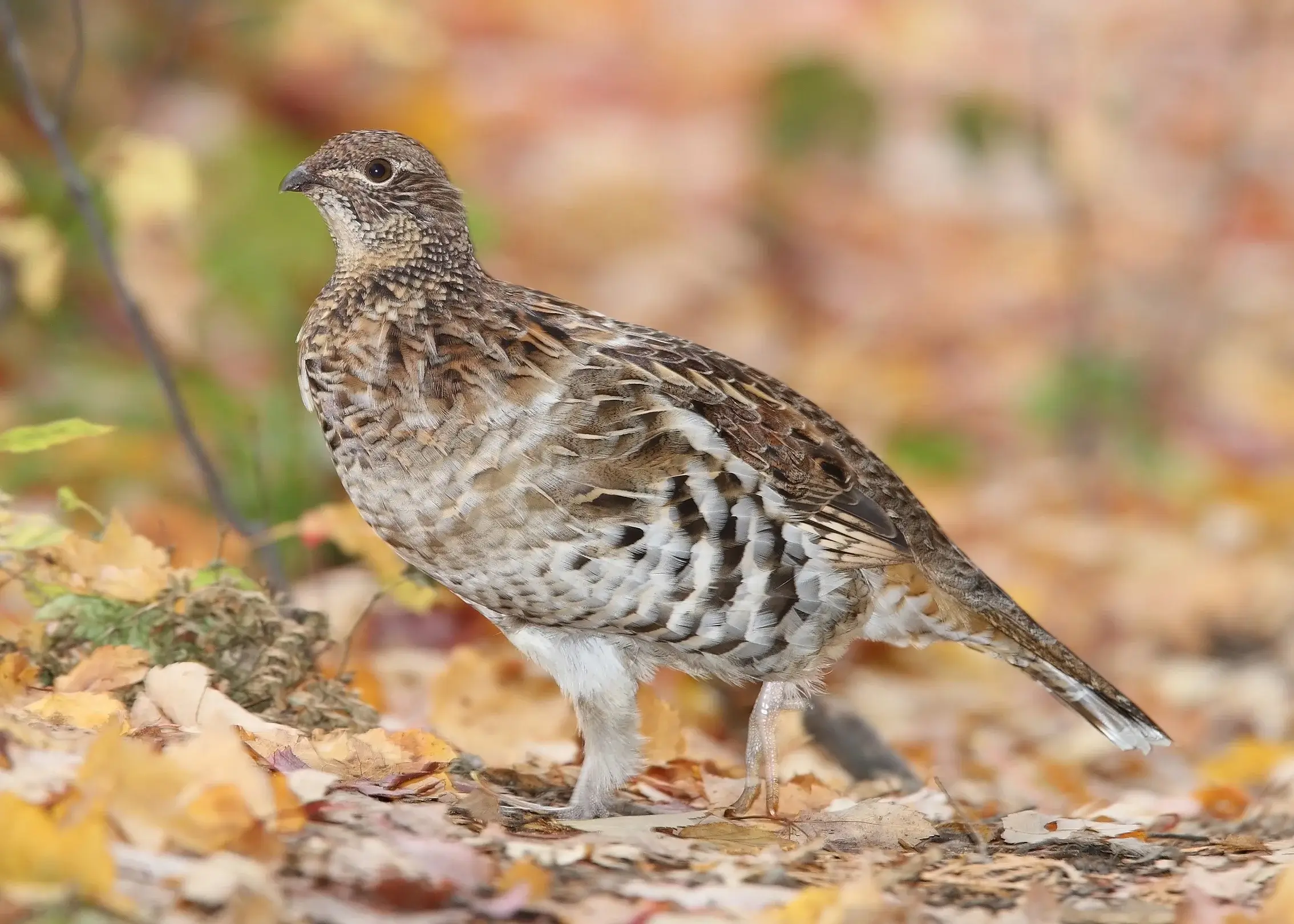
The ruffed grouse is a medium-sized grouse occurring in forests from the Appalachian Mountains across Canada to Alaska. It is the most widely distributed game bird in North America. It is not migratory. It is the only species in the genus Bonasa. The ruffed grouse is sometimes incorrectly referred to as a "partridge", an unrelated phasianid, and occasionally confused with the grey partridge, a bird of open areas rather than woodlands.
Life History
Tetrao umbellusLinnaeus, 1766 Theruffed grouse(Bonasa umbellus) is a medium-sizedgrouseoccurring in forests from theAppalachian Mountainsacross Canada toAlaska. It is the most widely distributed game bird in North America.[2]It is notmigratory. It is the only species in the genusBonasa. The ruffed grouse is sometimes incorrectly referred to as a "partridge", an unrelatedphasianid, and occasionally confused with thegrey partridge, a bird of open areas rather than woodlands.[3] The ruffed grouse is thestate game birdofPennsylvania, United States.[4] Ruffed grouse are chunky, medium-sized birds that weigh from 450–750 g (0.99–1.65 lb), measure from 40 to 50 cm (16 to 20 in) in length, and span 50–64 cm (20–25 in) across their short, strong wings.[11]They have two distinctmorphs- grey and brown. In the grey morph, the head, neck, and back are grey-brown; the breast is light with barring, with as much white on the underside and flanks. Overall, the birds have a variegated appearance; the throat is often distinctly lighter. The tail is essentially the same brownish grey, with regular barring and a broad black band near the end ("subterminal"). Brown-morph birds have tails of the same color and pattern. However, the rest of the plumage is much more brown, giving the appearance of a more uniform bird with less light plumage below and a conspicuously grey tail. All sorts of intergrades occur between the most typical morphs; warmer and morehumidconditions favor browner birds in general.[citation needed] The ruffs are on the sides of the neck in both sexes. They also have a crest on top of their head, which sometimes lies flat. Both sexes are similarly marked and sized, making them difficult to tell apart, even in hand. The female often has a broken subterminal tail band. At the same time, males tend to have unbroken tail bands, though the opposite of either can occur. Females may also do a display similar to the male. Another fairly accurate sign is that rump feathers with a single white dot indicate a female; rump feathers with more than one white dot indicate a male.[citation needed] The average lifespan of a ruffed grouse is one year, although some birds are thought to live for as long as 11 years.[12][13]Ruffed grouse arepolygynous, and males may mate with several females during the breeding season.[citation needed] Like most grouse, they spend most of their time on the ground; mixed woodland rich inaspenseems to be particularly well-liked. These birds forage on the ground or in trees. They areomnivores, eating buds, leaves,berries,seeds, and insects. According to nature writerDon L. Johnson: More than any other characteristic, it is the ruffed grouse's ability to thrive on a wide range of foods that has allowed it to adapt to such a wide and varied range of habitat on this continent. A complete menu of grouse fare might itself fill a book. One grouse crop yielded a livesalamanderin a salad ofwatercress. Another contained a small snake.[14] The ruffed grouse differs from other grouse species in itscourtship display. The ruffed grouse relies entirely on a nonvocal, acoustic display, known as drumming, unlike other grouse species. The drumming itself is a rapid, wing-beating display that creates a low-frequency sound, starting slow and speeding up (thump ... thump ... thump..thump-thump-thump-thump). Even in thick woods, this can be heard for a quarter-mile (400 m) or more. The ruffed grouse spends most of its time quietly on the ground, and when surprised, may explode into flight, beating its wings very loudly. It will burrow into the snow for warmth in the winter and may suddenly burst out of the snow when approached too closely. The male grouse proclaims his territory by engaging in a "drumming" display. This sound is made by beating his wings against the air to create a vacuum.[16]It usually stands on a log, stone, or mound of soil when drumming. It does not strike the log to make the noise, it only uses the "drumming log" as a sort of stage.[17] The ruffed grouse population has a cycle, and follows the cycle no matter how much or how little hunting occurs. The cycle has puzzled scientists for years, and is simply referred to as the "grouse cycle".[18][19][20][21][22][23][24]In spite of this historical cycle, populations have been declining in Pennsylvania and management plans adopted.[25][26]Habitat loss has been a concern for the species,[27][28][29]but the introduction of theWest Nile virushas been seen to be further increasing mortality.[25][26][30][31][32][28]
Hunting Season
Typically Sep-Dec. Check current WGFD upland game bird regulations.
Frequently Asked Questions
Regulations for hunting Ruffed Grouse in Wyoming
Ruffed grouse hunting is available in forested areas of Wyoming, particularly in the Black Hills and mountain regions. Seasons and bag limits vary by area. An upland game bird stamp may be required.
When is Ruffed Grouse hunting season in Wyoming?
Typically Sep-Dec. Check current WGFD upland game bird regulations.
What is the bag limit for Ruffed Grouse in Wyoming?
Typically 2-5 per day, 6-15 in possession (varies by area).
What is another name for Ruffed Grouse?
Ruffed Grouse is also known as Partridge (colloquial), Ruffie in Wyoming.
References
| State | Category | Directory | Subcategory | Content | Source |
|---|---|---|---|---|---|
| Wyoming | Hunting | Regulations | Season Dates | Typically Sep-Dec. Check current WGFD upland game bird regulations. | Link |
| Wyoming | Hunting | Regulations | Regulations | Ruffed grouse hunting is available in forested areas of Wyoming, particularly in the Black Hills and mountain regions. S | Link |