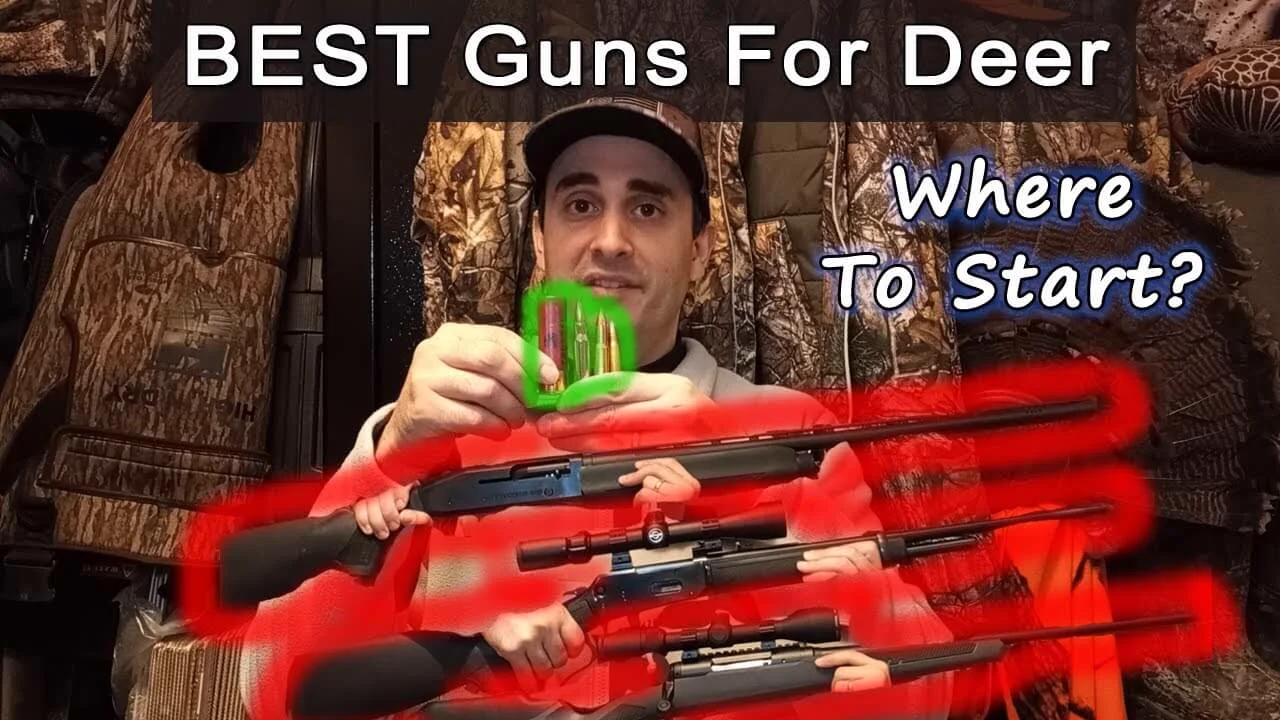
You're ready to start deer hunting, but there's one big question standing between you and the woods: what gun should you use? Maybe you've got a friend offering to lend you something, or you've been eyeing rifles at the local shop but feel overwhelmed by all the options. Here's the honest truth that experienced hunters know well: the best deer hunting firearm for a beginner is usually the one you already have or can borrow easily. It doesn't take a massive, expensive rifle to put venison in the freezer. What matters is having something with enough power, learning to shoot it well, and getting out there.
Let's walk through the practical approach to choosing your first deer gun, including what calibers actually work, what to look for, and why some popular options might surprise you.
Start With What You Already Have
Before you spend any money, look in your closet or ask around. Do you own a rifle, shotgun, or even an AR-15? If it has sufficient power to take down a deer at reasonable ranges, use it. Borrowing a gun from a family member or friend is completely fine for your first season or two. This lets you learn what you like and don't like without committing to a purchase.
The .223 cartridge, which is the same round used in many AR-15s and some bolt-action rifles, produces about 1,200 foot-pounds of force at the muzzle. That's enough to take a deer at around 100 yards with good shot placement. Just make sure you're using expanding ammunition, not full metal jacket rounds. If an AR-15 or a .223 bolt gun is what you've got, it will work for close-range hunting.
Find an Affordable Used Firearm
If you don't have anything suitable to borrow, your next best option is a used gun. Check local gun shops, gun shows, or online marketplaces. Used firearms hold their value well, so you can usually buy one, hunt with it for a season or two, and sell or trade it for close to what you paid.
This approach lets you learn what features matter to you without a big financial risk. Maybe you discover you prefer a lighter gun, or you hate certain types of sights, or you want a better trigger. That's valuable information that will help you make a smarter purchase later.
Understand What Makes a Good Deer Cartridge
When comparing different calibers, the key number to look at is foot-pounds of force. This measures the energy the bullet carries when it leaves the barrel. For deer hunting, you want something above 1,500 foot-pounds for reliable results. Here's how some common options stack up:
- .223 Remington: About 1,200 foot-pounds. Works at close range with good shot placement, but power drops off quickly past 100 yards.
- 30-30 Winchester: Between 1,800 and 2,000 foot-pounds with modern ammunition. This classic deer cartridge has taken more deer in America than probably any other.
- .308 Winchester: Around 2,800 foot-pounds. Significantly more power than you need for deer, but versatile for larger game like elk or bear.
Consider the 30-30 Lever Action Rifle
The 30-30 lever action is the classic American deer rifle for good reason. It's lightweight—around five and a half pounds without a scope—easy to carry all day, and perfect for woods hunting where shots are typically under 100 yards. Many hunters consider it the ideal brush gun.
Modern ammunition like Hornady Lever Revolution has improved the 30-30's performance, giving it flatter trajectories and more energy. With today's ammo, you can confidently shoot out to 200 yards with less than a three-inch drop. The first deer taken with a 30-30 often drops on the spot or runs only a short distance.
The main trade-off is accuracy. A typical 30-30 lever action might shoot three to five inch groups at 100 yards. That's plenty for deer hunting at typical ranges, but it limits your effective range compared to a bolt-action rifle.
Look at a .308 Bolt Action Rifle
If you want more accuracy and range, a .308 bolt action is a popular choice. These rifles are heavier—around eight pounds with a scope—but they're typically capable of one to two inch groups at 100 yards. That precision lets you shoot confidently out to 300 yards or more.
The .308 has about 2,800 foot-pounds of energy, which is more than you need for deer. But that extra power gives you flexibility to hunt larger game later if you choose. Many hunters buy a .308 as their one rifle that can do it all.
However, don't assume you'll need that extra range. Most deer are taken well under 100 yards, especially in wooded areas. A heavy, long-barreled rifle can be a burden to carry through the woods all day.
Don't Overlook a 12 Gauge Shotgun
In some areas, you can't hunt deer with a rifle at all. Certain counties or states restrict deer hunting to shotguns only. Even where rifles are allowed, a shotgun is worth considering because it's the most versatile firearm you can own.
With a slug—a single, large projectile—a 12 gauge shotgun delivers massive energy. A typical slug weighs around 400 grains and hits hard. The trade-off is range. With a standard shotgun and bead sights, you're looking at about 60 to 70 yards of effective range. That's plenty for most woods hunting, but not ideal for open fields.
One thing to avoid as a new hunter is buckshot. Buckshot fires multiple smaller pellets instead of one slug. While it seems like it would give you a better chance of hitting something, it actually encourages taking poor shots. You're more likely to wound an animal or make an unethical shot. Buckshot is best left for experienced hunters who know its limitations.
Match the Gun to Your Hunting Style
Think about where and how you'll hunt. If you're walking through thick woods, still-hunting or tracking, a lightweight lever action or a short-barreled shotgun makes sense. If you're sitting in a stand overlooking a field where shots might be longer, a bolt action with a scope is a better fit.
Your physical comfort matters too. A heavy rifle gets old fast when you're carrying it all day. A gun that's a pleasure to carry is one you'll practice with more and hunt with more often.
Frequently Asked Questions
Q: Is a .223 powerful enough for deer hunting?
A: Yes, at close ranges with good shot placement. The .223 produces about 1,200 foot-pounds of energy, which is sufficient for deer out to about 100 yards. However, it's not ideal for a dedicated deer rifle because power drops off quickly, and poor shot placement is more likely to result in a lost animal.
Q: What's the difference between 30-30 and .308 for deer hunting?
A: The 30-30 is lighter, easier to carry, and perfect for shots under 200 yards. The .308 is heavier, more accurate at longer ranges, and has significantly more power. For most deer hunting in wooded areas, the 30-30 is plenty. The .308 offers more versatility for larger game.
Q: Can I use an AR-15 for deer hunting?
A: Yes, if it's legal in your area. The AR-15 fires the same .223 cartridge as many bolt-action varmint rifles. You'll need to use expanding ammunition, not full metal jacket. It's a capable close-range deer rifle, though not the ideal choice for longer shots.
Q: Should I use buckshot or slugs in a shotgun for deer?
A: Slugs are strongly recommended for new hunters. Buckshot has very limited effective range and encourages taking shots that are likely to wound rather than kill cleanly. Many states also restrict or prohibit buckshot for deer hunting.
Q: How much should I spend on my first deer rifle?
A: There's no set price, but a used firearm is often the smartest choice for beginners. You can find reliable used rifles and shotguns at reasonable prices, use them to learn what you like, and sell or trade them later for something that better fits your needs.
This article analyzes the YouTube video "The BEST Beginners Guns For Deer Hunting - How To Pick A Rifle Or Shotgun To Get Started" by The New Hunters Guide.
Last accessed: 2026-05-22.
All rights to the video content belong to the original creator.