Also known as: Bullfrog
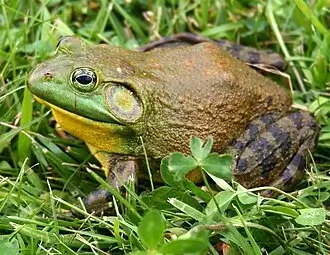
American Bullfrog: American bullfrogs are the largest frogs in Oklahoma and in North America. Their smooth skin is green or brown with greenish patches, and they may have bars on the hind legs. The belly may be white or mottled gray and white. These frogs lack folds on the sides of the back. Males have a tympanum (external eardrum) that is larger than the eye, whereas females have a small tympanum. Bullfrog tadpoles are very large, reaching 4 to 7 inches in length. They are brown or olive in color, with tiny black dots evenly scattered over the dorsum. In cooler regions of their range, they may overwinter for three years before metamorphosis. Bullfrogs have a deep, long call that can be heard from a long distance. It is a common call heard in summer months around large permanent ponds and lakes. The call is sometimes described as sounding like “jug-o-rum.” When they jump, they emit a short squeal, which makes it easy to distinguish them from leopard frogs without actually seeing them. Body length in this species varies from 3.5 to 8 inches. Juveniles, which vary from 3.4 to 5 inches in body length, are more commonly observed than large adults. Bullfrogs occur throughout the eastern half of the United States, with the exception of southern Florida. Their range extends northward into Canada and southward into Mexico as far as Veracruz. Because of its value as a food item, this frog has been introduced into many parts of the world, including many parts of the western U.S. Bullfrogs are summer breeders. They typically call from large ponds or lakes. Males defend territories around the ponds, and a territorial male will attack and wrestle with other males that invade his territory. Males interact with each other by raising their bodies and displaying their bright yellow gular sacs (chins) to each other. Females have white chins and do not display. Females choose males on the basis of territory quality and deposit eggs in his territory. In one study, the presence of leeches, which prey on the eggs, was an indication of a low-quality territory. The circular egg mass floats on the surface of the water; and can contain as many as 7,300 eggs. Calling males are prone to predation by large eastern snapping turtles, plain-bellied and northern diamond-back watersnakes. Juvenile bullfrogs are common in smaller ponds. Bullfrogs can be seen during day and night. At night, one can detect the bright eyeshine of these frogs by using a headlight while walking around a pond or lake edge. They can often be approached if the observer moves slowly and keeps light shining on the frog. During day, juveniles sit along pond shores and can be observed by walking slowly around a pond. Juveniles often give away their presence by emitting a characteristic loud squeal before jumping into the pond. (This profile was created by Dr. Laurie Vitt as part of a partnership between the Wildlife Department and the Sam Noble Oklahoma Museum of Natural History. It was funded as part of a larger State Wildlife Grant to survey and inventory amphibians and reptiles of the Wildlife Management Areas of Oklahoma: T-35-P-1.) American bullfrogs are the largest frogs in Oklahoma and in North America. Their smooth skin is green or brown with greenish patches, and they may have bars on the hind legs. The belly may be white or mottled gray and white. These frogs lack folds on the sides of the back. Males have a tympanum (external eardrum) that is larger than the eye, whereas females have a small tympanum. Bullfrog tadpoles are very large, reaching 4 to 7 inches in length. They are brown or olive in color, with tiny black dots evenly scattered over the dorsum. In cooler regions of their range, they may overwinter for three years before metamorphosis. Bullfrogs have a deep, long call that can be heard from a long distance. It is a common call heard in summer months around large permanent ponds and lakes. The call is sometimes described as sounding like “jug-o-rum.” When they jump, they emit a short squeal, which makes it easy to distinguish them from leopard frogs without actually seeing them. Body length in this species varies from 3.5 to 8 inches. Juveniles, which vary from 3.4 to 5 inches in body length, are more commonly observed than large adults. Bullfrogs occur throughout the eastern half of the United States, with the exception of southern Florida. Their range extends northward into Canada and southward into Mexico as far as Veracruz. Because of its value as a food item, this frog has been introduced into many parts of the world, including many parts of the western U.S. Bullfrogs are summer breeders. They typically call from large ponds or lakes. Males defend territories around the ponds, and a territorial male will attack and wrestle with other males that invade his territory. Males interact with each other by raising their bodies and displaying their bright yellow gular sacs (chins) to each other. Females have white chins and do not display. Females choose males on the basis of territory quality and deposit eggs in his territory. In one study, the presence of leeches, which prey on the eggs, was an indication of a low-quality territory. The circular egg mass floats on the surface of the water; and can contain as many as 7,300 eggs. Calling males are prone to predation by large eastern snapping turtles, plain-bellied and northern diamond-back watersnakes. Juvenile bullfrogs are common in smaller ponds. Bullfrogs can be seen during day and night. At night, one can detect the bright eyeshine of these frogs by using a headlight while walking around a pond or lake edge. They can often be approached if the observer moves slowly and keeps light shining on the frog. During day, juveniles sit along pond shores and can be observed by walking slowly around a pond. Juveniles often give away their presence by emitting a characteristic loud squeal before jumping into the pond. (This profile was created by Dr. Laurie Vitt as part of a partnership between the Wildlife Department and the Sam Noble Oklahoma Museum of Natural History. It was funded as part of a larger State Wildlife Grant to survey and inventory amphibians and reptiles of the Wildlife Management Areas of Oklahoma: T-35-P-1.) American bullfrogs are the largest frogs in Oklahoma and in North America. Their smooth skin is green or brown with greenish patches, and they may have bars on the hind legs. The belly may be white or mottled gray and white. These frogs lack folds on the sides of the back. Males have a tympanum (external eardrum) that is larger than the eye, whereas females have a small tympanum. Bullfrog tadpoles are very large, reaching 4 to 7 inches in length. They are brown or olive in color, with tiny black dots evenly scattered over the dorsum. In cooler regions of their range, they may overwinter for three years before metamorphosis. Bullfrogs have a deep, long call that can be heard from a long distance. It is a common call heard in summer months around large permanent ponds and lakes. The call is sometimes described as sounding like “jug-o-rum.” When they jump, they emit a short squeal, which makes it easy to distinguish them from leopard frogs without actually seeing them. Body length in this species varies from 3.5 to 8 inches. Juveniles, which vary from 3.4 to 5 inches in body length, are more commonly observed than large adults. Bullfrogs occur throughout the eastern half of the United States, with the exception of southern Florida. Their range extends northward into Canada and southward into Mexico as far as Veracruz. Because of its value as a food item, this frog has been introduced into many parts of the world, including many parts of the western U.S. Bullfrogs are summer breeders. They typically call from large ponds or lakes. Males defend territories around the ponds, and a territorial male will attack and wrestle with other males that invade his territory. Males interact with each other by raising their bodies and displaying their bright yellow gular sacs (chins) to each other. Females have white chins and do not display. Females choose males on the basis of territory quality and deposit eggs in his territory. In one study, the presence of leeches, which prey on the eggs, was an indication of a low-quality territory. The circular egg mass floats on the surface of the water; and can contain as many as 7,300 eggs. Calling males are prone to predation by large eastern snapping turtles, plain-bellied and northern diamond-back watersnakes. Juvenile bullfrogs are common in smaller ponds. Bullfrogs can be seen during day and night. At night, one can detect the bright eyeshine of these frogs by using a headlight while walking around a pond or lake edge. They can often be approached if the observer moves slowly and keeps light shining on the frog. During day, juveniles sit along pond shores and can be observed by walking slowly around a pond. Juveniles often give away their presence by emitting a characteristic loud squeal before jumping into the pond. (This profile was created by Dr. Laurie Vitt as part of a partnership between the Wildlife Department and the Sam Noble Oklahoma Museum of Natural History. It was funded as part of a larger State Wildlife Grant to survey and inventory amphibians and reptiles of the Wildlife Management Areas of Oklahoma: T-35-P-1.) American bullfrogs are the largest frogs in Oklahoma and in North America. Their smooth skin is green or brown with greenish patches, and they may have bars on the hind legs. The belly may be white or mottled gray and white. These frogs lack folds on the sides of the back. Males have a tympanum (external eardrum) that is larger than the eye, whereas females have a small tympanum. Bullfrog tadpoles are very large, reaching 4 to 7 inches in length. They are brown or olive in color, with tiny black dots evenly scattered over the dorsum. In cooler regions of their range, they may overwinter for three years before metamorphosis. Bullfrogs have a deep, long call that can be heard from a long distance. It is a common call heard in summer months around large permanent ponds and lakes. The call is sometimes described as sounding like “jug-o-rum.” When they jump, they emit a short squeal, which makes it easy to distinguish them from leopard frogs without actually seeing them. Body length in this species varies from 3.5 to 8 inches. Juveniles, which vary from 3.4 to 5 inches in body length, are more commonly observed than large adults. Bullfrogs occur throughout the eastern half of the United States, with the exception of southern Florida. Their range extends northward into Canada and southward into Mexico as far as Veracruz. Because of its value as a food item, this frog has been introduced into many parts of the world, including many parts of the western U.S. Bullfrogs are summer breeders. They typically call from large ponds or lakes. Males defend territories around the ponds, and a territorial male will attack and wrestle with other males that invade his territory. Males interact with each other by raising their bodies and displaying their bright yellow gular sacs (chins) to each other. Females have white chins and do not display. Females choose males on the basis of territory quality and deposit eggs in his territory. In one study, the presence of leeches, which prey on the eggs, was an indication of a low-quality territory. The circular egg mass floats on the surface of the water; and can contain as many as 7,300 eggs. Calling males are prone to predation by large eastern snapping turtles, plain-bellied and northern diamond-back watersnakes. Juvenile bullfrogs are common in smaller ponds. Bullfrogs can be seen during day and night. At night, one can detect the bright eyeshine of these frogs by using a headlight while walking around a pond or lake edge. They can often be approached if the observer moves slowly and keeps light shining on the frog. During day, juveniles sit along pond shores and can be observed by walking slowly around a pond. Juveniles often give away their presence by emitting a characteristic loud squeal before jumping into the pond. (This profile was created by Dr. Laurie Vitt as part of a partnership between the Wildlife Department and the Sam Noble Oklahoma Museum of Natural History. It was funded as part of a larger State Wildlife Grant to survey and inventory amphibians and reptiles of the Wildlife Management Areas of Oklahoma: T-35-P-1.) American bullfrogs are the largest frogs in Oklahoma and in North America. Their smooth skin is green or brown with greenish patches, and they may have bars on the hind legs. The belly may be white or mottled gray and white. These frogs lack folds on the sides of the back. Males have a tympanum (external eardrum) that is larger than the eye, whereas females have a small tympanum. Bullfrog tadpoles are very large, reaching 4 to 7 inches in length. They are brown or olive in color, with tiny black dots evenly scattered over the dorsum. In cooler regions of their range, they may overwinter for three years before metamorphosis. Bullfrogs have a deep, long call that can be heard from a long distance. It is a common call heard in summer months around large permanent ponds and lakes. The call is sometimes described as sounding like “jug-o-rum.” When they jump, they emit a short squeal, which makes it easy to distinguish them from leopard frogs without actually seeing them. Body length in this species varies from 3.5 to 8 inches. Juveniles, which vary from 3.4 to 5 inches in body length, are more commonly observed than large adults. Bullfrogs occur throughout the eastern half of the United States, with the exception of southern Florida. Their range extends northward into Canada and southward into Mexico as far as Veracruz. Because of its value as a food item, this frog has been introduced into many parts of the world, including many parts of the western U.S. Bullfrogs are summer breeders. They typically call from large ponds or lakes. Males defend territories around the ponds, and a territorial male will attack and wrestle with other males that invade his territory. Males interact with each other by raising their bodies and displaying their bright yellow gular sacs (chins) to each other. Females have white chins and do not display. Females choose males on the basis of territory quality and deposit eggs in his territory. In one study, the presence of leeches, which prey on the eggs, was an indication of a low-quality territory. The circular egg mass floats on the surface of the water; and can contain as many as 7,300 eggs. Calling males are prone to predation by large eastern snapping turtles, plain-bellied and northern diamond-back watersnakes. Juvenile bullfrogs are common in smaller ponds. Bullfrogs can be seen during day and night. At night, one can detect the bright eyeshine of these frogs by using a headlight while walking around a pond or lake edge. They can often be approached if the observer moves slowly and keeps light shining on the frog. During day, juveniles sit along pond shores and can be observed by walking slowly around a pond. Juveniles often give away their presence by emitting a characteristic loud squeal before jumping into the pond. (This profile was created by Dr. Laurie Vitt as part of a partnership between the Wildlife Department and the Sam Noble Oklahoma Museum of Natural History. It was funded as part of a larger State Wildlife Grant to survey and inventory amphibians and reptiles of the Wildlife Management Areas of Oklahoma: T-35-P-1.) American bullfrogs are the largest frogs in Oklahoma and in North America. Their smooth skin is green or brown with greenish patches, and they may have bars on the hind legs. The belly may be white or mottled gray and white. These frogs lack folds on the sides of the back. Males have a tympanum (external eardrum) that is larger than the eye, whereas females have a small tympanum. Bullfrog tadpoles are very large, reaching 4 to 7 inches in length. They are brown or olive in color, with tiny black dots evenly scattered over the dorsum. In cooler regions of their range, they may overwinter for three years before metamorphosis. Bullfrogs have a deep, long call that can be heard from a long distance. It is a common call heard in summer months around large permanent ponds and lakes. The call is sometimes described as sounding like “jug-o-rum.” When they jump, they emit a short squeal, which makes it easy to distinguish them from leopard frogs without actually seeing them. American bullfrogs are the largest frogs in Oklahoma and in North America. Their smooth skin is green or brown with greenish patches, and they may have bars on the hind legs. The belly may be white or mottled gray and white. These frogs lack folds on the sides of the back. Males have a tympanum (external eardrum) that is larger than the eye, whereas females have a small tympanum. Bullfrog tadpoles are very large, reaching 4 to 7 inches in length. They are brown or olive in color, with tiny black dots evenly scattered over the dorsum. In cooler regions of their range, they may overwinter for three years before metamorphosis. Bullfrogs have a deep, long call that can be heard from a long distance. It is a common call heard in summer months around large permanent ponds and lakes. The call is sometimes described as sounding like “jug-o-rum.” When they jump, they emit a short squeal, which makes it easy to distinguish them from leopard frogs without actually seeing them. American bullfrogs are the largest frogs in Oklahoma and in North America. Their smooth skin is green or brown with greenish patches, and they may have bars on the hind legs. The belly may be white or mottled gray and white. These frogs lack folds on the sides of the back. Males have a tympanum (external eardrum) that is larger than the eye, whereas females have a small tympanum. Bullfrog tadpoles are very large, reaching 4 to 7 inches in length. They are brown or olive in color, with tiny black dots evenly scattered over the dorsum. In cooler regions of their range, they may overwinter for three years before metamorphosis. Bullfrogs have a deep, long call that can be heard from a long distance. It is a common call heard in summer months around large permanent ponds and lakes. The call is sometimes described as sounding like “jug-o-rum.” When they jump, they emit a short squeal, which makes it easy to distinguish them from leopard frogs without actually seeing them. American bullfrogs are the largest frogs in Oklahoma and in North America. Their smooth skin is green or brown with greenish patches, and they may have bars on the hind legs. The belly may be white or mottled gray and white. These frogs lack folds on the sides of the back. Males have a tympanum (external eardrum) that is larger than the eye, whereas females have a small tympanum. Bullfrog tadpoles are very large, reaching 4 to 7 inches in length. They are brown or olive in color, with tiny black dots evenly scattered over the dorsum. In cooler regions of their range, they may overwinter for three years before metamorphosis. Bullfrogs have a deep, long call that can be heard from a long distance. It is a common call heard in summer months around large permanent ponds and lakes. The call is sometimes described as sounding like “jug-o-rum.” When they jump, they emit a short squeal, which makes it easy to distinguish them from leopard frogs without actually seeing them. Body length in this species varies from 3.5 to 8 inches. Juveniles, which vary from 3.4 to 5 inches in body length, are more commonly observed than large adults. Size: Body length in this species varies from 3.5 to 8 inches. Juveniles, which vary from 3.4 to 5 inches in body length, are more commonly observed than large adults. Body length in this species varies from 3.5 to 8 inches. Juveniles, which vary from 3.4 to 5 inches in body length, are more commonly observed than large adults. Body length in this species varies from 3.5 to 8 inches. Juveniles, which vary from 3.4 to 5 inches in body length, are more commonly observed than large adults. Bullfrogs occur throughout the eastern half of the United States, with the exception of southern Florida. Their range extends northward into Canada and southward into Mexico as far as Veracruz. Because of its value as a food item, this frog has been introduced into many parts of the world, including many parts of the western U.S. Bullfrogs can be seen during day and night. At night, one can detect the bright eyeshine of these frogs by using a headlight while walking around a pond or lake edge. They can often be approached if the observer moves slowly and keeps light shining on the frog. During day, juveniles sit along pond shores and can be observed by walking slowly around a pond. Juveniles often give away their presence by emitting a characteristic loud squeal before jumping into the pond. (This profile was created by Dr. Laurie Vitt as part of a partnership between the Wildlife Department and the Sam Noble Oklahoma Museum of Natural History. It was funded as part of a larger State Wildlife Grant to survey and inventory amphibians and reptiles of the Wildlife Management Areas of Oklahoma: T-35-P-1.) Bullfrogs can be seen during day and night. At night, one can detect the bright eyeshine of these frogs by using a headlight while walking around a pond or lake edge. They can often be approached if the observer moves slowly and keeps light shining on the frog. During day, juveniles sit along pond shores and can be observed by walking slowly around a pond. Juveniles often give away their presence by emitting a characteristic loud squeal before jumping into the pond. (This profile was created by Dr. Laurie Vitt as part of a partnership between the Wildlife Department and the Sam Noble Oklahoma Museum of Natural History. It was funded as part of a larger State Wildlife Grant to survey and inventory amphibians and reptiles of the Wildlife Management Areas of Oklahoma: T-35-P-1.) Bullfrogs can be seen during day and night. At night, one can detect the bright eyeshine of these frogs by using a headlight while walking around a pond or lake edge. They can often be approached if the observer moves slowly and keeps light shining on the frog. During day, juveniles sit along pond shores and can be observed by walking slowly around a pond. Juveniles often give away their presence by emitting a characteristic loud squeal before jumping into the pond. (This profile was created by Dr. Laurie Vitt as part of a partnership between the Wildlife Department and the Sam Noble Oklahoma Museum of Natural History. It was funded as part of a larger State Wildlife Grant to survey and inventory amphibians and reptiles of the Wildlife Management Areas of Oklahoma: T-35-P-1.)
Habitat & Range
Bullfrogs occur throughout the eastern half of the United States, with the exception of southern Florida. Their range extends northward into Canada and southward into Mexico as far as Veracruz. Because of its value as a food item, this frog has been introduced into many parts of the world, including many parts of the western U.S. Bullfrogs occur throughout the eastern half of the United States, with the exception of southern Florida. Their range extends northward into Canada and southward into Mexico as far as Veracruz. Because of its value as a food item, this frog has been introduced into many parts of the world, including many parts of the western U.S. Bullfrogs occur throughout the eastern half of the United States, with the exception of southern Florida. Their range extends northward into Canada and southward into Mexico as far as Veracruz. Because of its value as a food item, this frog has been introduced into many parts of the world, including many parts of the western U.S. Bullfrogs are summer breeders. They typically call from large ponds or lakes. Males defend territories around the ponds, and a territorial male will attack and wrestle with other males that invade his territory. Males interact with each other by raising their bodies and displaying their bright yellow gular sacs (chins) to each other. Females have white chins and do not display. Females choose males on the basis of territory quality and deposit eggs in his territory. In one study, the presence of leeches, which prey on the eggs, was an indication of a low-quality territory. The circular egg mass floats on the surface of the water; and can contain as many as 7,300 eggs. Calling males are prone to predation by large eastern snapping turtles, plain-bellied and northern diamond-back watersnakes. Juvenile bullfrogs are common in smaller ponds.
Life History
Bullfrogs are summer breeders. They typically call from large ponds or lakes. Males defend territories around the ponds, and a territorial male will attack and wrestle with other males that invade his territory. Males interact with each other by raising their bodies and displaying their bright yellow gular sacs (chins) to each other. Females have white chins and do not display. Females choose males on the basis of territory quality and deposit eggs in his territory. In one study, the presence of leeches, which prey on the eggs, was an indication of a low-quality territory. The circular egg mass floats on the surface of the water; and can contain as many as 7,300 eggs. Calling males are prone to predation by large eastern snapping turtles, plain-bellied and northern diamond-back watersnakes. Juvenile bullfrogs are common in smaller ponds. Bullfrogs are summer breeders. They typically call from large ponds or lakes. Males defend territories around the ponds, and a territorial male will attack and wrestle with other males that invade his territory. Males interact with each other by raising their bodies and displaying their bright yellow gular sacs (chins) to each other. Females have white chins and do not display. Females choose males on the basis of territory quality and deposit eggs in his territory. In one study, the presence of leeches, which prey on the eggs, was an indication of a low-quality territory. The circular egg mass floats on the surface of the water; and can contain as many as 7,300 eggs. Calling males are prone to predation by large eastern snapping turtles, plain-bellied and northern diamond-back watersnakes. Juvenile bullfrogs are common in smaller ponds. Bullfrogs are summer breeders. They typically call from large ponds or lakes. Males defend territories around the ponds, and a territorial male will attack and wrestle with other males that invade his territory. Males interact with each other by raising their bodies and displaying their bright yellow gular sacs (chins) to each other. Females have white chins and do not display. Females choose males on the basis of territory quality and deposit eggs in his territory. In one study, the presence of leeches, which prey on the eggs, was an indication of a low-quality territory. The circular egg mass floats on the surface of the water; and can contain as many as 7,300 eggs. Calling males are prone to predation by large eastern snapping turtles, plain-bellied and northern diamond-back watersnakes. Juvenile bullfrogs are common in smaller ponds. Bullfrogs can be seen during day and night. At night, one can detect the bright eyeshine of these frogs by using a headlight while walking around a pond or lake edge. They can often be approached if the observer moves slowly and keeps light shining on the frog. During day, juveniles sit along pond shores and can be observed by walking slowly around a pond. Juveniles often give away their presence by emitting a characteristic loud squeal before jumping into the pond. (This profile was created by Dr. Laurie Vitt as part of a partnership between the Wildlife Department and the Sam Noble Oklahoma Museum of Natural History. It was funded as part of a larger State Wildlife Grant to survey and inventory amphibians and reptiles of the Wildlife Management Areas of Oklahoma: T-35-P-1.)
Hunting Season
No specific closed season; generally may be taken year-round
Frequently Asked Questions
Regulations for hunting American Bullfrog in Oklahoma
American bullfrogs may generally be taken year-round in Oklahoma. They are the largest frog species in North America. Frogging is a popular traditional activity. Check ODWC regulations for specific methods of take and any local restrictions.
When is American Bullfrog hunting season in Oklahoma?
No specific closed season; generally may be taken year-round
What is the bag limit for American Bullfrog in Oklahoma?
No specific bag limit; check local regulations
What's another name for American Bullfrog?
American Bullfrog is also known as Bullfrog in Oklahoma.
References
| State | Category | Directory | Subcategory | Content | Source |
|---|---|---|---|---|---|
| Oklahoma | Hunting | Regulations | Season Dates | No specific closed season; generally may be taken year-round | Link |
| Oklahoma | Hunting | Regulations | Regulations | American bullfrogs may generally be taken year-round in Oklahoma. They are the largest frog species in North America. Fr | Link |