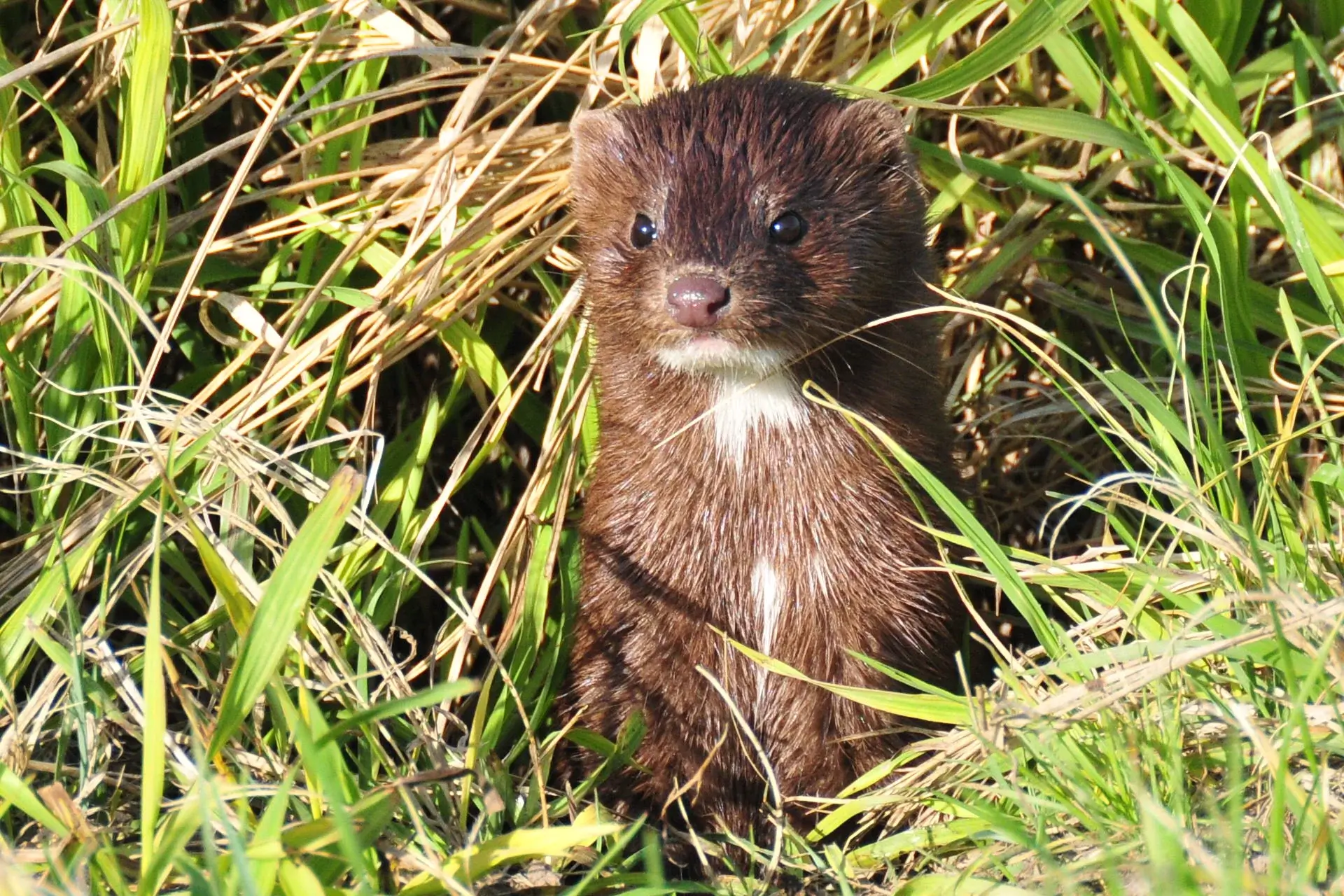
Also known as: Mink
Evolution: As a species, the American mink represents a more specialized form than the European mink in the direction ofcarnivory, as indicated by the more developed structure of the skull.[5]Fossil recordsof the American mink go back as far as theIrvingtonian, though the species is uncommon amongPleistoceneanimals. Its fossil range corresponds with the species' current natural range. The American minks of the Pleistocene did not differ much in size or morphology from modern populations, though a slight trend toward increased size is apparent from the Irvingtonian through to theIllinoianandWisconsinanperiods.[6] Although superficially similar to the European mink, studies indicate the European mink's closest relative is theSiberian weasel(kolonok) of Asia. The American mink has been recorded tohybridizewith European minks andpolecatsin captivity, though the hybrid embryos of the American and European minks are usually reabsorbed.[7] Subspecies: As of 2005[update],[8]15 subspecies are recognised: (Nominate subspecies) borealis(Brass, 1911)nigrescens(Audubon and Bachman, 1854)tatarica(Popov, 1949)winingus(Baird, 1858) rufa(Hamilton-Smith, 1858) Build: The American mink differs from members of the genusMustela(stoatsandweasels), as well as the other members ofNeogale, by its larger size and stouter form, which closely approach those ofmartens. It shares with martens a uniformly enlarged, bushy and somewhat tapering tail, rather than a slender, cylindrical tail with an enlarged bushy tip, as is the case in stoats.[10]The American mink is similar in build to theEuropean mink, but the tail is longer (constituting 38–51% of its body length).[11] The American mink has a long body, which allows the species to enter the burrows of prey. Itsstreamlinedshape helps it to reduce water resistance while swimming.[12]The skull is similar to that of the European mink, but is more massive, narrower, and less elongated, with more strongly developed projections and a wider, shortercranium. The uppermolarsare larger and more massive than those of the European mink.[13]Thedental formulais3.1.3.13.1.3.2. Domestic mink, which are bred in fur farms and are substandard genetically, have 19.6% smaller brains, 8.1% smaller hearts, and 28.2% smaller spleens than wild mink.[14][15]The feet are broad, with webbed digits.[10]They generally have eightnipples, with one pair of inguinal teats and three pairs of abdominal teats.[11]The adult male'spenisis2.2in (5.6cm)long, and is covered by asheath. Thebaculumis well-developed, being triangular incross sectionand curved at the tip.[12] Males measure13–18in (34–45cm)in body length, while females measure12–15in (31–37.5cm). The tail measures6–10 inches (15.6–24.7cm)in males and6–8in (14.8–21.5cm)in females. Weights vary with sex and season, with males being heavier than females. In winter, males weigh1–3lb (500–1,580g)and females1–2lb (400–780g). Maximum heaviness occurs in autumn.[5] Fur: The American mink's winter fur is denser, longer, softer, and more close-fitting than that of the European mink. The winter fur's tone is generally very dark blackish-tawny to light-tawny. Colour is evenly distributed over all the body, with the under side being only slightly lighter than the back. Theguard hairsare bright and dark-tawny, often approaching black on the spine. The underfur on the back is very wavy and greyish-tawny with a bluish tint. The tail is darker than the trunk and sometimes becomes pure black on the tip. The chin and lower lip are white. Captive individuals tend to develop irregular white patches on the lower surface of their bodies, though escaped individuals from Tartaria gradually lost these patches. The summer fur is generally shorter, sparser and duller than the winter fur.[11]The thick underfur and oily guard hairs render the pelage water-resistant, with the length of the guard hairs being intermediate between those ofottersandpolecats, thus indicating the American mink is incompletely adapted to an aquatic life. Itmoultstwice a year, during spring and autumn.[12]It does not turn white in winter.[16]A variety of different colour mutations have arisen from experimental breeding on fur farms.[7] Locomotion: On land, the American mink moves by a bounding gait, with speeds of up to6.5km/h (4.0mph). It also climbs trees and swims well.[17]During swimming, the mink propels itself primarily through undulating movements of the trunk. Whendiving, it undergoesbradycardia, which is likely an adaptation to conserveoxygen.[12]In warm water (24°C (75°F)), the American mink can swim for 3hours without stopping, but in cold water it can die within 27minutes.[18]It generally dives to depths of12in (30cm)for 10seconds, though depths of 3m lasting 60seconds have been recorded. It typically catches fish after five- to 20-second chases.[17] Senses And Scent Glands: The American mink relies heavily onsightwhen foraging. Itseyesightis clearer on land than underwater. Itsauditory perceptionis high enough to detect theultrasonicvocalisations (1–16kHz) of rodent prey. Its sense of smell is comparatively weak. Its twoanal glandsare used forscent marking, either through defecation or by rubbing the anal region on the ground. The secretions of the anal glands are composed of 2,2-dimethylthietane, 2-ethylthietane, cyclicdisulfide, 3,3-dimethyl-1,2-dithiacyclopentane, andindole. When stressed, the American mink can expel the contents of its anal glands at a distance of12in (30cm).[12]Scent glands may also be located on the throat and chest.[19]The smell produced by these scent glands was described byClinton Hart Merriamas more unbearable than that produced byskunks, and added it was "one of the few substances, of animal, vegetable, or mineral origin, that has, on land or sea, rendered me aware of the existence of the abominable sensation callednausea".[20] Social And Territorial Behaviours: American mink territories are held by individual animals with minimal intrasex overlap, but with extensive overlap between animals of the opposite sex. Most territories are in undisturbed, rocky coastal habitats with broadlittoral zonesand dense cover. Some are on estuaries, rivers and canals near urban areas. Home ranges are typically1–6 kilometres (0.62–3.73 miles)long, with male territories larger than females'.[17]As long as it is close to water, the American mink is not fussy about its choice of den. Mink dens typically consist of long burrows inriver banks, holes underlogs,tree stumps, orrootsand hollow trees, though dens located in rock crevices, drains, and nooks under stone piles and bridges are occasionally selected. The burrows they dig themselves are typically about four inches in diameter and may continue along for10–12 feet (300–370cm)at a depth of2–3 feet (61–91cm). The American mink may nest in burrows dug previously bymuskrats,badgersandskunks, and may also dig dens in oldant hills. The nesting chamber is at the end of a four-inch tunnel, and is about a foot in diameter. It is warm, dry, and lined with straw and feathers.[21]The American mink's dens are characterized by a large number of entrances and twisting passages. The number of exits varies from one to eight.[18] The American mink normally only vocalises during close encounters with other minks or predators. The sounds it emits include piercing shrieks and hisses when threatened and muffled chuckling sounds when mating. Kits squeak repeatedly when separated from their mothers.[19]Ernest Thompson Setonreported hearing minks growl and snarl when confronting a threat.[22]During aggressive interactions, mink assert their dominance by arching their backs, puffing up, lashing out their tails, and stomping and scraping the ground with their feet, while also opening their mouth in a threat-gape. Should this be unsuccessful, fights may result, with injuries to the head and neck.[19] Reproduction And Development: The American mink is a promiscuous animal that does not formpair bonds.[17]The start ofmating seasonranges from February in its southern range to April in the north.[12]In its introduced range, the American mink breeds one month earlier than the European mink.[23]Males commonly fight during the mating season, which may result in the formation of loose, temporary dominance hierarchies governing access to receptive females.[17]The mating season lasts for three weeks, withovulationbeing induced by the presence of males. The mating process is violent, with the male typically biting the female on the nape of the neck and pinning her with his forefeet.Matinglasts from 10 minutes to four hours. Females are receptive for seven- to 10-day intervals during the three-week breeding season, and can mate with multiple males. Along with thestriped skunk, the American mink is among the only mammals to mate in spring that have a short delay before implantation. Thisdelayed implantationallows pregnant minks to keep track of environmental conditions and select an ideal time and place forparturition.[12] Thegestation periodlasts from 40 to 75days, with actual embryonic development taking place for 30–32 days, indicating implantation delay can last from eight to 45days. The young are born from April to June, in litters consisting of four kits on average.[12]The litters are often multiply sired.[24]Exceptionally large litters of 11 kits have been recorded in Tartaria and 16 in the United States.[23]The kits are blind at birth, weighing six grams and possessing a short coat of fine, silver-white hairs.[12]The kits are dependent on their mother's milk, which contains 3.8%lipids, 6.2%protein, 4.6%lactoseand 10.66% mineral salts.[23]Their eyes open after 25days, withweaningoccurring after five weeks. The kits begin hunting after 8weeks of age, but stay close to their mother until autumn, when they become independent. Sexual maturity is attained during the kit's first spring, when they are about 10months old.[12] Relationships With Other Predators: The American mink replaces and sometimes kills the European mink wherever their ranges overlap.[35]The decline of European mink populations seems to coincide with the spread of the American mink, but "The early declines in Central Europe and later in Finland took place before the spread of the American mink."[36]The diets of the American mink andEuropean otteroverlap to a great extent. In areas where these two species are sympatric, competition with the otter for fish causes the American mink to hunt land-based prey more frequently.[37] Largebirds of prey, such asbald eagles(Haliaeetus leucocephalus) andgreat horned owls(Bubo virginianus) occasionally hunt American mink.[38][39]InFinland,white-tailed eagles(Haliaeetus albicilla) have become the main natural control and may inhibit the mink from breeding via heavy predation.[40]Eurasian eagle-owls(Bubo bubo) also can be predators of mink in the introduced regions.[41] In Florida (specifically southern Florida), American minks may be eaten by some growth stage of invasive snakes such asBurmese pythons,reticulated pythons,Southern African rock pythons,Central African rock pythons,boa constrictors,yellow anacondas,Bolivian anacondas,dark-spotted anacondas, andgreen anacondas.[42] Intelligence: An early behavioral study was performed in the 1960s to assess visual learning ability in minks,ferrets, skunks, and house cats. Animals were tested on their ability to recognize objects, learn their valences and make object selections from memory. Minks were found to outperform ferrets, skunks, and cats in this task, but this letter (short paper) fails to account for a possible conflation of a cognitive ability (decision making,associative learning) with a largely perceptual ability (invariant object recognition).[43] Natural: The species' natural range encompasses most of North America, fromAlaska, through Canada and further into the United States exceptArizonaand the more arid areas of California,Nevada,Utah,New Mexico, andWest Texas.[1] Introduced: The American mink was deliberately introduced for commercial fur production in several provinces ofPatagoniain 1930. The animals escaped or were released from farms inChubut Provinceand now occur in the Chubut andRío Negro ProvincesandTierra del Fuego.[44]InArgentinathe mink is one of the major menaces of theHooded grebe, which risks becomingextinct.[45] In Chile, American minks were introduced toMagallanes Regionin the 1930s. Ever since minks were freed into nature during the crisis of the fur industry the mink has expanded its range across Chile. Actually it ranges fromAraucanía Regionin the north to Magallanes Region in the south. However, there are isolated territories in between where the mink is not found, probably due tobiogeographic barriers. One of the latest areas where the mink has been found isChiloé Archipelago,-minks were reported there for the first time 2013, making scientists suspect they may have arrived on a ship.[46] FeralAmerican minks in Europe are thought to be ofdomesticatedstock derived from theN. v. vison,N. v. melampeplusandN. v. ingenssubspecies. The first specimens were imported to Europe in 1920 for fur-farming purposes. The American mink was introduced in Italy in the 1950s, and currently resides mostly in the northeastern part of theItalian Peninsula. The majority of these populations do not appear to be self-sufficient, though minks in theMonti PrenestiniandSimbruiniin Lazio have reproduced successfully.[47] Escapees of fur farms established a self-sustaining and expanding population on theIberian Peninsulaby the second half of the 20th century. In 2013, the Spanish government announced a plan to eradicate the species,[48]as a means to protect the falling populations of European mink and other endangered species affected such as thePyrenean desman. The first mink farm in Norway was built in 1927, with escapees establishing wild populations within 30 years of its establishment. The first feral mink populations arose in 1930, establishing territories in southwestern Norway. These feral minks, augmented by further escapees, formed the basis of a strong population inHordalandby the end ofWorld War II. Feral mink colonised eastern Norway in 1930 and had become established in most southeastern counties in the early 1940s. By 1950, feral mink reached central Norway, with further populations occurring in the northern counties ofNordlandandTroms. During the post-World War II period until 1965, mink had colonised most of the country. In modern times, the American mink occupies all of the Norwegian mainland, but is absent on some islands.[49] The American mink was first imported to Great Britain in 1929, though a series of escapes and releases led to the establishment of a self-sufficient feral population inDevonby the late 1950s, and others by the early 1960s. In Ireland, the American mink was not farmed until the early 1950s, thus feral populations established themselves there much later. The species is now widespread in mainland Great Britain and Ireland, though some places remain uncolonised. It has established itself on a few islands, includingArranandLewis and Harris.[17]Until 2005,mink huntingwith packs of hounds occurred in the UK. The total mink population in Great Britain is estimated at 110,000 (England: 46,750;Scotland: 52,250;Wales: 9,750). This population may be declining asEuropean otternumbers increase. There are no estimates for the mink population in Ireland, but it is thought to be low, because of Ireland's strong otter population.[50] In 1933, American minks were released into theVoronezh OblastinEuropean Russia. Until 1963, more minks were introduced in various quantities in theVoronezhandArkhangelsk Oblasts,Karelia, inKalininsk, Gorkovsk,VolgogradandChelyabinsk Oblasts, and intoTatarstanandBashkir, as well as theLithuanianandByelorussian SSRs. Beyond theUrals, American minks were introduced in theSverdlovsk,Tyumen,Omsk,Kemerovo,Novosibirsk,ChitaandIrkutsk Oblasts, in theAltaiandKrasnoyarsk Krai, in theTuvan,BuryatandYakut Autonomous Soviet Socialist Republics, into theMagadan,KamchatkaandAmur Oblasts, into theKhabarovskandPrimorsky Krai, into theChukotka Autonomous Okrugand several other locations, includingSakhalinandUrup Island. In the Caucasus region, American minks were released intoNorth Ossetia. In Central Asia they were released in theTien Shanregion. Originally, captive-bred minks were used, but wild specimens were later released to facilitate the species' acclimatisation within Soviet territories. Several years after the first release, introductions into the ranges already held by native European minks were discontinued, with most releases from then on taking place in Siberia and the Far East. Although considerable areas were occupied by the American mink by the early 1960s, the species' Soviet range was never continuous, as most released populations were isolated from one another.[51] The species has been present inIcelandsince the 1930s, and has become well established, despite it being heavily hunted since 1939. However, its population underwent a 42% decline during the years 2002–2006, which coincided with a decline insand eelpopulations resulting in a drop in the seabird populations on which the minks feed.[52] American mink is considered as one of the most widespread invasive species inChina, especially inNortheasternarea.[53][54]Minks are introduced in some prefecturesJapanas well, especially being problematic inHokkaido, and regulated by law.[55][56] Diseases And Parasites: The American mink often carries lighttickandfleainfestations. Tick species known to infest minks includeIxodes hexagonus,Ixodes canisuga,Ixodes ricinus, andIxodes acuminatus. Flea species known to infest minks includePalaeopsylla minor,Malaraeus penicilliger,Ctenopthalmus noblis,Megabothris walkeri,Typhloceras poppei, andNosopsyllus fasciatus.EndoparasitesincludeSkrjabingylus nasicolaandTroglotrema acutum.[50]TrematodeMetorchis conjunctuscan also infect American minks.[57] Transmissible mink encephalopathy(TME) is apriondisease of mink, similar toBSEin cattle andscrapiein sheep. A 1985 outbreak of TME inStetsonville, Wisconsinresulted in a 60% mortality rate for the minks.[58]Further testing revealed this agent is transmissible between mink, cattle, and sheep. The Stetsonville outbreak may have been due to the mink being fed carcasses or otherwise consuming other infected animals.[59] Toxoplasma gondiihas been recorded in American minks in southern Chile, with 59%seroprevalencein the 73 mink analyzed in one study.Southern river ottersof the area were also found to have highT. gondiiseroprevalence in this study, showing a high exposure ofsemiaquaticmustelidsto the parasite in this part of Chile.[60] Decline Of Wild Mink: Because of numerous incidents of domestic mink escaping fromfur farmsand establishing themselves in the wild, concern has arisen among conservationists of the possible repercussions such escapes may have on natural wild mink populations. Domestic mink are larger than wild mink, which may cause problems with the ecosystem when they escape. Minks are solitary, territorial animals and are intolerant of other minks. In times of overpopulation, they control their own numbers by either killing each other through direct conflict or by causing weaker minks to be driven from territory untilstarvationsets in.[61]When hundreds or thousands of released domestic minks flood an ecosystem, it causes a great disturbance for the wild minks, resulting in the deaths of the majority of the released mink and many of the wild ones from starvation or injuries incurred while fighting overterritory.[61]When a domestic mink survives long enough to reproduce, it may cause problems for the wild mink populations.[62]The adding of weaker domestic mink genes into wild mink populations is believed by some to have contributed to the decline of mink populations in Canada.[62] A 2006 study inDenmarkconcluded, due to frequent escapes from existing mink farms, "Closing mink farms may result in a crash of the free-ranging population, or alternatively it may result in the establishment of a better-adapted, truly feral population that may ultimately outnumber the population that was present before farm closures." The study reported more information would be necessary to determine the outcome.[63]Another Danish study reported a significant majority of the "wild" mink were mink which had escaped fromfur farms. About 47% had escaped within two months, 31% had escaped prior to two months, and 21% "may or may not have been born in nature." The survival rate for recently released minks is reportedly lower than for wild minks, but if feral minks survive at least two months, their survival rate is the same as for wild minks. The authors suggest this is due to the rapid behavioural adaptation of the animals.[64] Disease: The American mink andEuropean mink[65]have both been found to transmitSARS-CoV-2, the virus that causesCOVID-19. Since the 1980s,Rocky Mountain Laboratorieshas used American mink for disease models.[66]Mink are not found in China but are aSARS-CoV-2transmission model.[67][68] Fur Use: American minks are primarily used in manufacturingfur coats, jackets, andcapes. Pelts that are not able to be converted into these items are made intotrimmingfor cloth and fur coats. Minkscarvesandstolesare also manufactured. Jackets and capes are mostly made from small to medium-sized specimens, usually females and young males, while trimming, scarves and stoles are made from adult males.[69]The most valuable peltries come from eastern Canada which, although the smallest, are the silkiest and darkest.[70] Although difficult to catch, the American mink, prior to being commercially farmed, was among the most frequently trapped furbearers as, unlike other furbearing mammals, it did nothibernatein winter, and could thus be caught on a nightly basis even in the far north.[71]Minks were legally trapped from early November to early April, when their pelts were prime.[72]Minks caught in traps cling to life with great tenacity, having been known to break their teeth in trying to extricate themselves from steel traps.[73]Elliott Couesdescribed a trapped mink thusly: One who has not taken a Mink in a steel trap can scarcely form an idea of the terrible expression the animal's face assumes as the captor approaches. It has always struck me as the most nearly diabolical of anything in animal physiognomy. A sullen stare from the crouched, motionless form gives way to a new look of surprise and fear, accompanied with the most violent contortions of the body, with renewed champing of the iron till breathless, with heaving flanks, and open mouth dribbling saliva, the animal settles again, and watches with a look of concentrated hatred, mingled with impotent rage and frightful despair. The countenance of the Mink, its broad, low head, short ears, small eyes, piggish snout, and formidable teeth, is always expressive of the lower and more brutal passions, all of which are intensified at such times. As may well be supposed, the creature must not be incautiously dealt with when in such a frame of mind.[73] OneNative Americanmethod involved using a bait (usually a slit open chicken carcass filled with fish oil and oysters) tied to a rope and dragged around an area laden with traps. A mink would thus follow the trail into one of the traps. Another indigenous method involved placing traps scented with muskrat and female mink musk on top of disused muskrat dens by water bodies. Attracted by the scent of food and a female, the mink would get caught in the trap and drown.[74]On theAmerican prairies, only the steel trap was used, due to the lack of timber.[75] Breeding American minks for their fur began in the late 19th century, as increasing enthusiasm for mink pelts made the harvesting of wild minks insufficient to meet the new demands. American minks are easily kept in captivity, and breed readily.[76]In 2005, the US ranked fourth in production behindDenmark, China and theNetherlands. Minks typically breed in March, and give birth to their litters in May. Farmersvaccinatethe young kits forbotulism, distemper,enteritis, and, if needed,pneumonia. They are harvested in late November and December. Methods for killing animals onfur farms, as on all farms, are detailed in theAmerican Veterinary Medical Association's Report onEuthanasiawhich is used as a voluntary guideline for state departments of agriculture which have jurisdiction over all farms raising domesticated livestock, including minks.[77]In the past, some mink farms successfully provided pools of water for the mink to swim;[78]however, this practice is unheard-of in modern mink production. Minks are motivated to access swimming water, and the absence of water is a source of frustration on modern farms.[79]The ideal diet for farm-bred minks consists of four to five ounces ofhorse meatand a quarter-pint of milk once daily.[78] Selective breedinghas produced a number of different colour shades in mink peltries, ranging from pure white, through beiges, browns, and greys, to a brown that is almost black. The two standard strains are brown and "black cross" which, when paired, produce numerous colour variations. When analbinomink is born, it is standard procedure in fur farms to breed it to other colour mutations to produce grey and light-brown pastel shades. The following graph is a simplification of the main colour strains:[80] As Pets: Wild mink can be tamed if caught young, but can be difficult to handle and are usually not handled bare-handed.[81]In the late 19th century, tame American minks were often reared for ratting, much asferretswere used in Europe. Some modern ratters have revived this practice using farm-raised mink, sometimes alongside ratting dogs.[82]They are sometimes more effectiverattersthanterriers, as they can enter rat holes and drive rats from their hiding places. When mink of wild stock are confined with tame ones, the wild invariably dominate the tamed mink. They have also been known to dominate cats in confrontations.[83]Although intelligent, minks are not quick to learn tricks taught to them by their owners.[84]Because of their fondness for bathing, captive American minks may enterkettlesor other open water-containing vessels. Although domestic minks have been bred in captivity for almost a century, they have not been bred to be tame. Domestic minks have been bred for size, fur quality, and color. However, the U.S. Fur Commission claims "mink are truly domesticated animals", based on the number of years they have been kept onfur farms.[85] Literature: As aninvasive speciesin the United Kingdom, minks have been the subject of at least two novels.Ewan Clarkson's 1968Break for Freedom(published asSyla, the Minkin the US) tells the story of a female mink escaped from a fur farm in arealisticstyle. On the other hand,A.R. Lloyd's 1982Kineis aheroic fantasywith the minks as villains and theweaselsand otherindigenous animalsas heroes.[citation needed] Genome: A chromosome-level genome assembly for the American mink (Neogale vison) was first reported in 2022.[98]The assembly has a genome size of approximately 2.4 Gb and provides a high-quality chromosomal framework for studying mink biology, domestication, and disease susceptibility. This assembly underlies the current NCBI RefSeq genome record for the species. In 2025, a second chromosome-scale genome assembly was produced as part of the Darwin Tree of Life project using a specimen from England.[99]This work complements the earlier North American assembly and contributes to ongoing efforts to generate high-quality reference genomes across vertebrate biodiversity.
Life History
The American mink is a carnivorous animal that feeds onrodents, fish,crustaceans,amphibians, and birds. It killsvertebrateprey by biting the back of the head or neck, leavingcaninepuncture marks9–11mm (0.35–0.43in)apart.[25]The American mink often kills birds, including larger species likeseagullsandcormorants, by drowning. In its natural range, fish are its primary prey. Although inferior to theNorth American river otterin hunting fish,AudubonandBachmanonce reported seeing a mink carrying a foot-longtrout. Mink inhabiting theprairiesloughs primarily target frogs,tadpoles, and mice.[26]It is a formidable predator ofmuskrats, which are chased underwater and killed in their own burrows. Among the rodents killed by the American mink in its native range are rats and mice of thegeneraHesperomys,Microtus,Sigmodon, andNeotoma.Marsh rabbitsare frequently taken in marshy or swampy tracts.[27] InTartaria, the American mink's most important food items arevoles, fish, crustaceans, frogs, and aquatic insects. In winter, aquatic foods predominate, while land-based prey increases in importance during the spring. Within theAltai Mountains, the American mink feeds predominantly on mammals such as rodents, shrews, and moles, as well as birds, reptiles, amphibians, and fish. Among the 11different bird species preyed upon by minks in Altai aredippersandpine grosbeaks. Among fish, small species predominate in the diet of minks in Altai, and includeminnows,gudgeons, and wide-headedsculpins. In theSverdlovskandIrkutsk Oblasts, mouse-like rodents are their most important foods, followed by birds, fish and insects. In theRussian Far East, where crustaceans are scarce, the American mink feeds extensively onamphipods.[28]In theBritish Isles, dietary composition varies seasonally and regionally.European rabbitsare the most commonly taken prey in areas where they are common, especially in summer. A range of small rodents and insectivores are preyed upon, but to a lesser degree.European haresare occasionally attacked. Minks in Britain prey on several bird species, with ducks,moorhens, andcootsbeing most frequently targeted on lakes and rivers, whilegullsare taken in coastal habitats. Marine species preyed upon in Britain includeEuropean eels, rock-pool fish such asblenny,shore crabsandcrayfish.[29]American minks have been implicated in the decline of thewater volein the United Kingdom and linked to the decline of waterfowl across their range in Europe. They are now considered vermin in much of Europe and are hunted for the purpose ofwildlife management.[30]In South America'sCape Horn Biosphere Reserve, mammals, including both native and exotic rodents, are the American mink's main prey throughout the year, though birds are of equal importance during their summer nesting periods.[31] The American mink may pose a threat to poultry. According toClinton Hart Merriam[32]andErnest Thompson Seton,[33]although the American mink is a potential poultry thief, it is overall less damaging than thestoat. Unlike the stoat, which often engages insurplus killing, the mink usually limits itself to killing and eating one fowl during each attack. Studies in Britain indicate poultry and game birds only constitute 1% of the animals' overall diets;[29]small mammals, especially rabbits, tend to dominate, followed by fish and birds, especiallymoorhensandcoots.[34]
Hunting Season
Dec 1 – Feb 28
Frequently Asked Questions
Regulations for hunting American mink in Oklahoma
American mink trapping and hunting in Oklahoma runs Dec 1 through Feb 28. No bag limit. Mink are semiaquatic furbearers found along waterways throughout Oklahoma.
When is American mink hunting season in Oklahoma?
Dec 1 – Feb 28
What's another name for American mink?
American mink is also known as Mink in Oklahoma.
References
| State | Category | Directory | Subcategory | Content | Source |
|---|---|---|---|---|---|
| Oklahoma | Hunting | Regulations | Season Dates | Dec 1 – Feb 28 | Link |
| Oklahoma | Hunting | Regulations | Regulations | American mink trapping and hunting in Oklahoma runs Dec 1 through Feb 28. No bag limit. Mink are semiaquatic furbearers | Link |