Also known as: Timberdoodle, Woodcock
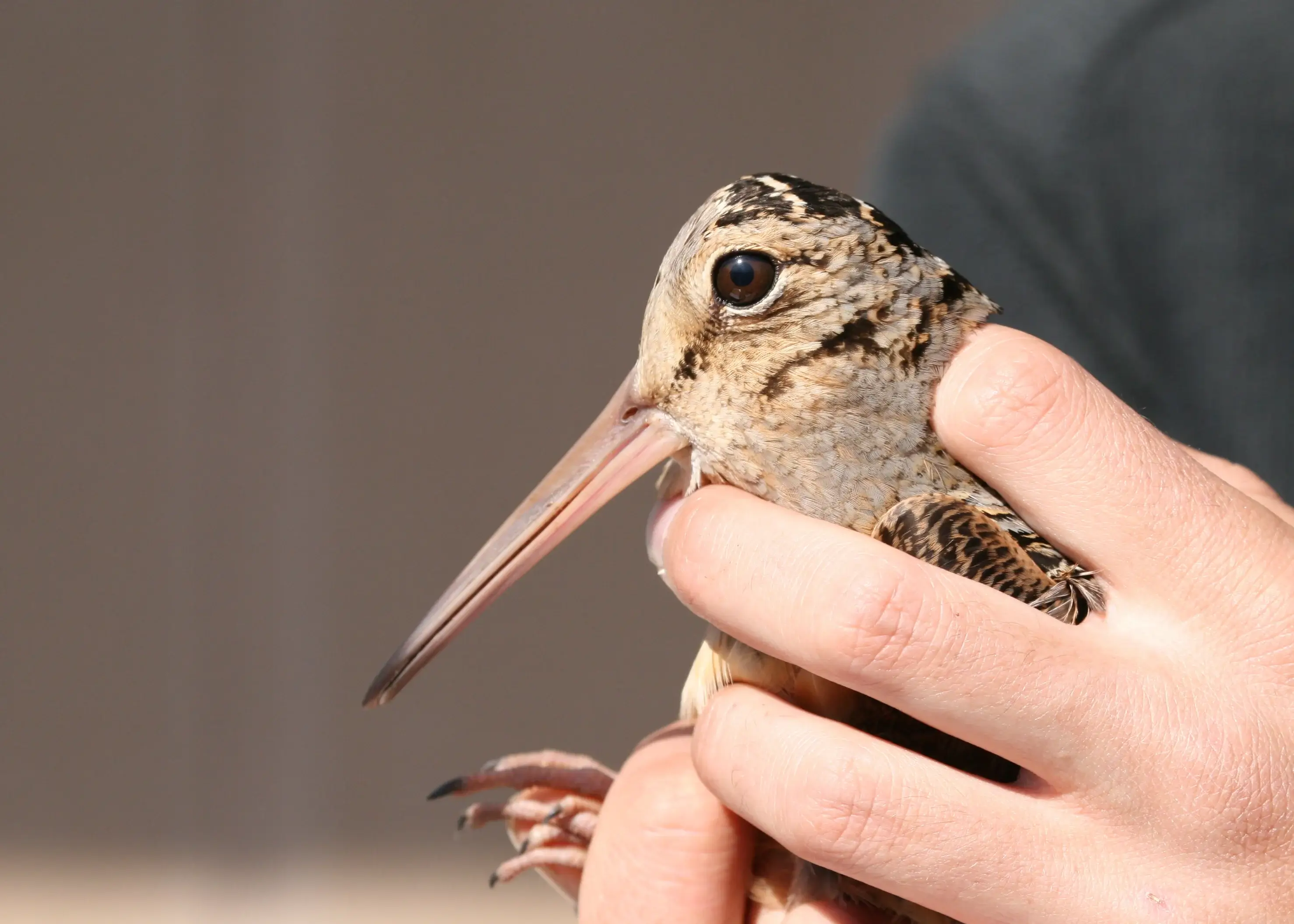
The American woodcock has a plump body, short legs, a large, rounded head, and a long, straight prehensile bill. Adults are10 to 12 inches (25 to 30cm)long and weigh5 to 8 ounces (140 to 230g).[10]Females are considerably larger than males.[11]The bill is2.5 to 2.8 inches (6.4 to 7.1cm)long.[6]Wingspans range from16.5 to 18.9 inches (42 to 48cm).[12] The plumage is a cryptic mix of different shades of browns, grays, and black. The chest and sides vary from yellowish-white to rich tans.[11]The nape of the head is black, with three or four crossbars of deep buff or rufous.[6]The feet and toes, which are small and weak, are brownish gray to reddish brown.[11]Woodcocks have large eyes located high in their heads, and their visual field is probably the largest of any bird, 360° in the horizontal plane and 180° in the vertical plane.[13] The woodcock uses its long, prehensile bill to probe in the soil for food, mainly invertebrates and especially earthworms. A unique bone-and-muscle arrangement lets the bird open and close the tip of its upper bill, or mandible, while it is sunk in the ground. Both the underside of the upper mandible and the long tongue are rough-surfaced for grasping slippery prey.[6] ThegenusScolopaxwas introduced in 1758 by the Swedish naturalistCarl Linnaeusin thetenth editionof hisSystema Naturae.[14]The genus name isLatinfor asnipeor woodcock.[15]Thetype speciesis theEurasian woodcock(Scolopax rusticola).[16] Migration: Woodcocks migrate at night. They fly at low altitudes, individually or in small, loose flocks. Flight speeds of migrating birds have been clocked at16 to 28mph (26 to 45km/h).[17]However, the slowest flight speed ever recorded for a bird,5mph (8km/h), was recorded for this species.[18]Woodcocks are thought to orient visually using major physiographic features such as coastlines and broad river valleys.[11]Both the autumn and spring migrations are leisurely compared with the swift, direct migrations of many passerine birds. In the north, woodcocks begin to shift southward before ice and snow seal off their ground-based food supply. Cold fronts may prompt heavy southerly flights in autumn. Most woodcocks start to migrate in October, with the major push from mid-October to early November.[19]Most individuals arrive on the wintering range by mid-December. The birds head north again in February. Most have returned to the northern breeding range by mid-March to mid-April.[11] Migrating birds' arrival at and departure from the breeding range is highly irregular. InOhio, for example, the earliest birds are seen in February, but the bulk of the population does not arrive until March and April. Birds start to leave for winter by September, but some remain until mid-November.[20] Food And Feeding: Woodcocks eat mainly invertebrates, particularly earthworms (Oligochaeta), and it has been known to useworm charmingmethods in order to bring the worms to the surface.[21]They do most of their feeding in places where the soil is moist. They forage by probing in soft soil in thickets, where they usually remain well-hidden. Other items in their diet include insect larvae, snails, centipedes, millipedes, spiders,snipe flies, beetles, and ants. A small amount of plant food is eaten, mainly seeds.[11]Woodcocks arecrepuscular, being most active at dawn and dusk. Breeding: In spring, males occupy individual singing grounds, openings near brushy cover from which they call and perform display flights at dawn and dusk, and if the light levels are high enough, on moonlit nights. The male's ground call is a short, buzzypeent. After sounding a series of ground calls, the male takes off and flies from50 to 100yd (46 to 91m)into the air. He descends, zigzagging and banking while singing a liquid, chirping song.[11]Thishigh spiralling flightproduces a melodious twittering sound as air rushes through the male's outer primary wing feathers.[22] Males may continue with their courtship flights for as many as four months running, sometimes continuing even after females have already hatched their broods and left the nest. Females, known as hens, are attracted to the males' displays. A hen will fly in and land on the ground near a singing male. The male courts the female by walking stiff-legged and with his wings stretched vertically, and by bobbing and bowing. A male may mate with several females. The male woodcock plays no role in selecting a nest site, incubating eggs, or rearing young. In the primary northern breeding range, the woodcock may be the earliest ground-nesting species to breed.[11] The hen makes a shallow, rudimentary nest on the ground in the leaf and twig litter, in brushy or young-forest cover usually within150yd (140m)of a singing ground.[6]Most hens lay four eggs, sometimes one to three. Incubation takes 20 to 22 days.[7]The down-covered young areprecocialand leave the nest within a few hours of hatching.[11]The female broods her young and feeds them. When threatened, the fledglings usually take cover and remain motionless, attempting to escape detection by relying on their cryptic coloration. Some observers suggest that frightened young may cling to the body of their mother, who will then take wing and carry the young to safety.[23]Woodcock fledglings begin probing for worms on their own a few days after hatching. They develop quickly and can make short flights after two weeks, can fly fairly well at three weeks, and are independent after about five weeks.[7] The maximum lifespan of adult American woodcock in the wild is 8 years.[24] Rocking Behavior: American woodcocks occasionally perform a rocking behavior where they will walk slowly while rhythmically rocking their bodies back and forth. This behavior occurs during foraging, leading ornithologists such asArthur Cleveland Bentand B. H. Christy to theorize that this is a method of coaxing invertebrates such as earthworms closer to the surface.[25]The foraging theory is the most common explanation of the behavior, and it is often cited in field guides.[26]This theory is complicated by observations of rocking while slowly walking across ground that cannot be foraged, such as hard roads or deep snow.[27] An alternative theory for the rocking behavior has been proposed by some biologists, such asBernd Heinrich. It is thought that this behavior is a display to indicate to potential predators that the bird is aware of them.[28]Heinrich notes that some field observations have shown that woodcocks will occasionally flash their tail feathers while rocking, drawing attention to themselves. This theory is supported by research done byJohn Alcockwho believes this is a type ofaposematism.[29] Population Status: How many woodcock were present in eastern North America before European settlement is unknown. Colonial agriculture, with its patchwork of family farms and open-range livestock grazing, probably supported healthy woodcock populations.[6] The woodcock population remained high during the early and mid-20th century, after many family farms were abandoned as people moved to urban areas, and crop fields and pastures grew up in brush. In recent decades,[when?]those formerly brushy acres have become middle-aged and older forest, where woodcock rarely venture, or they have been covered with buildings and other human developments. Because its population has been declining, the American woodcock is considered a "species of greatest conservation need" in many states, triggering research and habitat-creation efforts in an attempt to boost woodcock populations. Population trends have been measured through springtime breeding bird surveys, and in the northern breeding range, springtime singing-ground surveys.[11]Data suggest that the woodcock population has fallen rangewide by an average of 1.1% yearly over the last four decades.[when?][9] In Popular Culture: Beginning around 2024, the bird became viral on social media due to its comedic demeanor, both for its rocking behavior and distinctive “meep” sound.[34][35]. In a testament to this growing popularity, reports of the woodcock's presence inNew York City'sBryant Parkin early April, 2026 attracted large crowds of fans to the site in the hopes of observing the species and its unique behavior.[36]
Habitat & Range
Woodcocks inhabit forested and mixed forest-agricultural-urban areas east of the 98th meridian. Woodcocks have been sighted as far north as York Factory, Manitoba, and east to Labrador and Newfoundland. In winter, they migrate as far south as the Gulf Coast of the United States and Mexico.[11] The primary breeding range extends from Atlantic Canada (Nova Scotia, Prince Edward Island, and New Brunswick) west to southeastern Manitoba, and south to northern Virginia, western North Carolina, Kentucky, northern Tennessee, northern Illinois, Missouri, and eastern Kansas. A limited number breed as far south as Florida and Texas. The species may be expanding its distribution northward and westward.[11] After migrating south in autumn, most woodcocks spend the winter in the Gulf Coast and southeastern Atlantic Coast states. Some may remain as far north as southern Maryland, eastern Virginia, and southern New Jersey. The core of the wintering range centers on Louisiana, Mississippi, Alabama, and Georgia.[11]Based on theChristmas Bird Countresults, winter concentrations are highest in the northern half ofAlabama. American woodcocks live in wet thickets, moist woods, and brushy swamps.[7]Ideal habitats feature early successional habitat and abandoned farmland mixed with forest. In late summer, some woodcocks roost on the ground at night in large openings among sparse, patchy vegetation.[11]
Hunting Season
Nov 1 – Dec 15
Frequently Asked Questions
Regulations for hunting American woodcock in Oklahoma
American woodcock hunting season in Oklahoma runs Nov 1 through Dec 15 statewide. Daily bag limit is 3 birds, with 6 in possession after the first day. Follows federal migratory bird regulations. Nontoxic shot required.
When is American woodcock hunting season in Oklahoma?
Nov 1 – Dec 15
What is the bag limit for American woodcock in Oklahoma?
3 per day; 6 in possession after first day
What's another name for American woodcock?
American woodcock is also known as Timberdoodle, Woodcock in Oklahoma.
References
| State | Category | Directory | Subcategory | Content | Source |
|---|---|---|---|---|---|
| Oklahoma | Hunting | Regulations | Season Dates | Nov 1 – Dec 15 | Link |
| Oklahoma | Hunting | Regulations | Regulations | American woodcock hunting season in Oklahoma runs Nov 1 through Dec 15 statewide. Daily bag limit is 3 birds, with 6 in | Link |