Also known as: Ring-necked pheasant
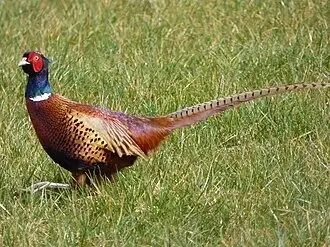
There are many colour forms of the male common pheasant, ranging in colour from nearly white to almost black in some melanistic examples. These are due to captive breeding andhybridisationbetweensubspeciesand with the green pheasant, reinforced by continual releases of stock from varying sources to the wild. For example, the "ring-necked pheasants" common in Europe, North America and Australia do not pertain to any specifictaxon, they rather represent a stereotyped hybrid swarm.[6]Body weight can range from0.5 to 3kg (1 to 7lb), with males averaging1.2kg (2lb 10oz)and females averaging0.9kg (2lb 0oz).[7]Wingspan ranges from56–86cm (22–34in).[8] The adult male common pheasant of thenominate subspeciesPhasianus colchicus colchicusis60–89cm (23+1⁄2–35in)in length with a long brown streaked black tail, accounting for almost50cm (20in)of the total length. The body plumage is barred bright gold or fiery copper-red and chestnut-brownplumagewith iridescent sheen of green and purple; but rump uniform is sometimes blue. The wing coverage is white or cream and black-barred markings are common on the tail.[9]The head is bottle green with a smallcrestand distinctive redwattle.P.c.colchicusand some other races lack a white neck ring.[10]Behind the face are two ear-tufts, that make the pheasant appear more alert.[11] The female (hen) and juveniles aremuch less showy, with a duller mottled brown plumage all over and measuring50–63cm (19+1⁄2–25in)long including a tail of around20cm (8in). Juvenile birds have the appearance of the female with a shorter tail until young males begin to grow characteristic bright feathers on the breast, head and back at about 10 weeks after hatching.[9] Thegreen pheasant(P.versicolor) is very similar, and hybridisation often makes the identity of individual farmed birds difficult to determine. Green pheasant males on average have a shorter tail than the common pheasant and have darker plumage that is uniformly bottle-green on the breast and belly; they always lack a neck ring. Green pheasant females are darker, with many black dots on the breast and belly. In addition, various colourmutationsare commonly encountered, mainlymelanistic(black) and flavistic (isabellineorfawn) specimens. The former are rather commonly released in some areas and are named "tenebrosus pheasant"[citation needed]or simply "melanistic mutant".[12] Taxonomy And Systematics: This species was first scientifically described byCarl Linnaeusin his landmark 175810th edition ofSystema Naturaeunder its modern scientific name. The common pheasant is distinct enough from any other species known to Linnaeus for a laconic[Phasianus] rufus, capîte caeruleo, "a red pheasant with blue head", to serve as entirely sufficient description. The bird had been extensively discussed before Linnaeus establishedbinomial nomenclatureso was already well-known. His sources are theOrnithologiaofUlisse Aldrovandi,[13]Giovanni Pietro Olina'sUccelliera,[14]John Ray'sSynopsis methodica Avium & Piscium,[15]andA Natural History of the BirdsbyEleazar Albin.[16]Therein—essentially the bulk of theornithologytextbooks of his day—the species is simply named "the pheasant" in the books' respective languages. Whereas in most other species, Linnaeus felt it warranted to cite plumage details from his sources, in the common pheasant's case he simply referred to the reason of the bird's fame:principum mensis dicatur.[verification needed]Thetype localityis given simply as "Africa, Asia".[17] However, the bird does not occur in Africa, except perhaps in Linnaeus's time inMediterraneancoastal areas where they might have been introduced during theRoman Empire. The type locality was later fixed to theRioni Riverin westernGeorgia, known asPhasisto theAncient Greeks. These birds, until themodern era, constituted the bulk of the introduced stock in parts of Europe that was not already present; the birds described by Linnaeus's sources, though typically belonging to such early introductions, would certainly have moreallelesin common with thetranscaucasianpopulation than with others. Thescientific nameisLatinfor "pheasant fromColchis",colchicusreferring to the west of modern-dayGeorgia;[18]the Ancient Greek term corresponding to the English "pheasant" isPhasianos ornis(Φασιανὸς ὂρνις), "bird of the river Phasis".[19]Although Linnaeus included manyGalliformesin hisgenusPhasianiussuch as thedomestic chickenand its wild ancestor thered junglefowl(Gallus gallus), only the common and the green pheasant have since been placed in this genus. As the latter was not known to Linnaeus in 1758, the common pheasant is treated as thetype speciesofPhasianus. In the US, common pheasants are widely known as "ring-necked pheasants". One North American writer called them"chinks"or, inMontana,"phezzens".[20]In China, meanwhile, the species is properly calledzhi ji(雉鸡), "pheasant-fowl", essentially implying the same as the English name "common pheasant". As elsewhere,P.colchicusis such a familiar bird in China that it is usually just referred to asshan ji(山雞), "mountain chicken",[21]a Chinese term forpheasantsin general. As of 2005, it had the smallest knowngenomeof all livingamniotes, only 0.97 pg (970 millionbase pairs), roughly one-third of the human genome's size; however, theblack-chinned hummingbirdhas the smallest known amniote genome.[22] Subspecies: There are about 30subspeciesin five[23]to eight[24]groups. These can be identified by the male plumage, namely presence or absence of a white neck-ring and/or a whitesuperciliary stripe, the colour of the uppertail (rump) and wingcoverts, and the colour of crown, chest, upper back, and flank feathers. As noted earlier, introduced populations have mixed theallelesof various races, differing according to the original stock used for introductions and whatnatural selectionaccording toclimateandhabitathas made of that. An investigation into the genetic relationships of subspecies suggested that the common pheasant originated from the forests of southeastern China.[25]Initial divergence is thought to have occurred around 3.4 Mya. The lack of agreement between morphology-based subspecies delimitation and their genetic relationships is thought to be attributed to past isolation followed by more recent population mixing as the pheasant has expanded its range across the Palaearctic.[26] Sometimes this species is split into theCentral Asiancommon and theEast Asianring-necked pheasants, roughly separated by thearidand highmountainousregions ofTurkestan. However, while the western and eastern populations probably were entirely separate during theZyryanka glaciationwhen deserts were more extensive,[27]this separation was not long enough for actualspeciationto occur. The largest variety of colour patterns is found where the western and eastern populations mix, as is to be expected. Females usually cannot be identified even to subspecies group with certainty. Many subspecies are in danger of disappearing due to hybridisation with introduced birds. The last black-necked pheasant (P.c.colchicus) population in Europe survives in Greece in the delta of the riverNestos, where in 2012 the population was estimated 100–250 individuals.[26] The subspecies groups,[24]going from west to east, and some notable subspecies are: Within a maximum clade credibility mDNA gene tree, the most basal group is theP. c. elegans-group of the Eastern Clade, diverging from thegreen pheasantduring theCalabrian, and diversifying inMiddle Pleistocenearound 0.7 million years ago, with the groups of the Western Clade splitting off from those of the Eastern Clade about 0.59 million years ago.[24]While the subspecies of the Western Clade are well geographically separated from each other, the subspecies of the Eastern Clade often showclinalvariation and large areas ofintergradation. For example, clines connectP. c. pallasi-karpowi-torquatus-takatsukasaewithin theP. c. torquatusgroup andP. c. kiangsuensis-alaschanicus-sohokhotensis-strauchiwithin theP. c. strauchi-vlangaliigroup, with the degree of expression of white collar andsuperciliary stripein both cases decreasing from north to south. The isolated formP. c. hagenbeckiis very close toP. c. pallasiin phenotype, and has been traditionally treated within theP. c. torquatusgroup until recently, when it was assigned in one study to theP. c. strauchi / P. c. vlangaliigroup.[24]However, the origin of the corresponding feather samples as listed in GenBank[29]is far away from the known distribution of subspeciesP. c. hagenbecki, and the issue needs further clarification. Nesting: Common pheasants nest solely on the ground in scrapes, lined with some grass and leaves, frequently under dense cover or a hedge. Occasionally they will nest in a haystack, or old nest left by other bird. They roost in sheltered trees at night. The males arepolygynousas is typical for many Phasianidae, and are often accompanied by a harem of several females.[34] Breeding beings in April. Hens scrape a hollow in the ground lined with grass and dead leaves, in which they lay a clutch of eight to fifteen eggs. These are brown-olive in colour. The hen afterwards incubates them twenty-three to twenty-five days.[35]The chicks stay near the hen for several weeks, yet leave the nest when only a few hours old. After hatching they grow quickly, flying after 12–14 days, resembling adults by only 15 weeks of age.[citation needed] They eat a wide variety of animal and vegetable type-food. Vegetable forage includes fruit, seeds, grain, mast, berries and leaves, while animal food includes a wide range ofinvertebrates, such asslugs,earthworms,leatherjackets, ant eggs,wireworms,caterpillars,grasshoppersand other insects.[35][10]Smallvertebrateslike lizards, field voles, small mammals and small birds are occasionally taken.[10] European Native: Southern Caucasian pheasants (P.c.colchicus) were common in Greece during the classical period and it is a widespread myth that the Greeks took pheasants to theBalkanswhen they colonised Colchis in theCaucasus. This colonisation happened during the 6th century BC, but pheasant archaeological remains in the Balkans are much older dating to 6th millennium BC. This fact indicates that probably pheasants reached the area naturally.[36][37]Additionally it seems that they had a continuous range in Turkey from the Sea of Marmara on the edge of the Balkans, across the northern shore of the country till Caucasus.[38]The last remnants of the Balkan population survive in the Kotza-Orman riparian forest of Nestos, inGreecewith an estimated population of 100–200 adult birds.[39]InBulgariathey were lost in the 1970s because they hybridised with introduced eastern subspecies.[40] Besides the Balkans the species lives in Europe in the area north of Caucasus where the local subspeciesP.c.septentrionalissurvives pure around the lower reaches of the Samur River. Reintroduction efforts in the rest of the north Caucasian range may include hybrid birds.[41] As An Introduced Species: Common pheasants can be found across the globe due to their readiness to breed in captivity and the fact that they can naturalise in many climates, but are known to be introduced in Europe (apart from the extreme southeast, where native), North America,JapanandNew Zealand. Pheasants were hunted in their natural range byStone Agehumans just like thegrouseandpartridgesthat inhabited Europe at that time. The common pheasant was originally introduced to Europe during theRomanperiod. Recipes for preparing pheasant meat were discussed byMarcus Gavius Apiciusin the first century AD; pheasant husbandry is also discussed byColumellain the same century and, based on the former's writings, byRutilius Taurus Aemilianus PalladiusinDe Re Rusticain 350 AD.[35] Introductions in theSouthern Hemispherehave mostly failed, except where localGalliformesor theirecologicalequivalents are rare or absent.[citation needed] The bird was naturalised inGreat Britainaround AD 1059, but may have been introduced by theRomano-Britishcenturies earlier.[42]It was the Caucasian subspecies mistakenly known as the 'Old English pheasant' rather than the Chinese ring-necked pheasants (P. c. torquatus) that were then introduced to Britain.[43]However, it becameextinctfrom most of Britain in the early 17th century. There were further re-introductions of 'white neck-ringed' birds in the 18th century. It was rediscovered as a game bird in the 1830s after being ignored for many years in an amalgam of forms. Since then it has been reared extensively bygamekeepersand is shot in season from 1 October to 31 January. Pheasants are moderately adapted to the British climate and breed naturally in small numbers in the wild without human supervision in copses, heaths and commons.[citation needed]Imported stock has originated from a number of other subspecies in addition toP. c. colchicusandP. c. torquatus, including the Prince of Wales pheasant (P. c. principalis), the Mongolian pheasant (P. c. mongolicus), the Satchu pheasant (P. c. satscheuensis), and Pallas's pheasant (P. c. pallasi), alongside the relatedgreen pheasant. Extensive interbreeding has occurred between these stocks, so that most British pheasants are of mixed heritage and display an at least partial neck ring, and the "Old English" type is no longer encountered in its original form. Common British phenotypes include a cream-coloured variant termed the "Bohemian" pheasant and a melanistic form derived from partly green pheasant ancestry.[35][30] The first mentions of pheasants in Scotland occur in the late sixteenth century, although they did not penetrate as far as theScottish Highlandsuntil the nineteenth, when a cock was recorded in theGrampian Mountainsin 1826.[30]By 1950 pheasants bred throughout the British Isles, although they were scarce inIreland. Because around 47,000,000 pheasants are released each year on shooting estates, it is widespread in distribution, although most released birds survive less than a year in the wild.[44]The Bohemian was most likely seen inNorth Norfolk.[45]TheGame & Wildlife Conservation Trustis researching the breeding success of reared pheasants and trying to find ways to improve this breeding success to reduce the demand to release as many reared pheasants and increase the wild population. As the original Caucasian stock all but disappeared during the Early Modern era, most 'dark-winged ringless' birds in the UK are actually descended from 'Chinese ring-necked' and 'green pheasant' hybrids,[46]which were commonly used for shooting estate stocking.[citation needed] Common pheasants were introduced in North America beginning in 1773,[47]with the first large-scale successful introduction occurring in 1881 in theWilliamette ValleyofOregon, followed byWashingtonin 1883 andCaliforniain 1889. Stocking of large pheasant populations in the plains and eastern states occurred in following decades after successful hunting seasons were recorded in the western states.[48]Pheasants have become well established throughout much of theRocky Mountainstates (Colorado,Idaho,Montana,Wyoming, etc.), theMidwest, thePlainsstates, as well asCanadaandMexico.[49][50]In the southwest, they can even be seen south of the Rockies inBosque del ApacheNational Wildlife Refuge161km (100mi)south of Albuquerque, New Mexico.[51][52]The largest populations of pheasants in the United States occur in a continuous belt over theGreat Plains, theCorn Beltand theWheat Belt, with extensions of its range reaching into southernCanadaand the farmland areas ofNew England. Smaller populations occur in valleys and irrigated areas through theIntermountain Westand the coast states, although these are separated by high mountain areas inhospitable to pheasants. Introductions failed in the more humid Southern states and in theAmerican Southwest.[48] Most common pheasants bagged in the United States are wild-born feral pheasants.[citation needed]In some states[53]captive-reared and released birds make up much of the population.[54]Pheasant hunting is very popular in much of the US, especially in the Great Plains states, where a mix of farmland and native grasslands provides ideal habitat. South Dakota alone has an annual harvest of over 1 million birds a year by over 200,000 hunters.[55] Common pheasants have also been introduced toHawaiian Islands,Chile,Uruguay,Peru,Argentina,Brazil,South Africa,New Zealand, andAustralia, including the island state ofTasmaniaand small offshore islands such asRottnest Islandoff Western Australia.[51][52] Negative Impacts On Other Species: There are a number of negative effects of common pheasants on other game birds, includingnest parasitism, disease, aggression, and competition for resources.[56]Nest parasitism, orbrood parasitism, is common in pheasants because of their propensity to nest near other birds and the fact that nesting requirements are similar to those of other prairie birds andwaterfowlthat inhabit the same areas.This phenomenon has been observed ingrey partridges;prairie chickens; several types ofduck, rail,grouse,turkeys, and others.[56]Effects of nest parasitism may include abandonment of nests with a high proportion of foreign eggs, lower hatching rates, and lower numbers of eggs laid by the host species. Pheasant eggs also have a shorter incubation time than many of their nestmates, which may result in the individual watching over the nest to abandon her own eggs after the pheasants hatch, thinking that the remaining eggs are not viable.[56]Pheasants raised in other species' nests often imprint on their caretaker, which may result in them adopting atypical behaviour for their species. This is sometimes the cause of hybridisation of species as pheasants adopt the mating behaviour of their nest's host species.[56] Pheasant farming is a common practice and is frequently doneintensively, with serious adverse impacts on native species.[57]Birds are supplied both tohuntingpreserves/estates and restaurants, with smaller numbers being available for home cooks. Pheasants often compete with other native birds for resources. Studies have shown that they can lead to decreased populations ofbobwhitesandpartridgesdue to habitat and food competition.[58]Insects are a valuable food source for both pheasants and partridges and competition may lead to decreased populations of partridges.[59]Pheasants may also introduce disease, such asblackhead, to native populations. While pheasants tolerate the infection well, other birds such asruffed grouse,chukar, and grey partridge are highly susceptible.[60]Pheasants also have a tendency to harass or kill other birds. One study noted that in pheasant vs. prairie chicken interactions, the pheasants were victorious 78% of the time.[61] A variety of management strategies have been suggested for areas that are home to species that are particularly threatened by pheasants, such as the prairie chickens and grey partridge. These strategies include mowing grass to decrease the nesting cover preferred by pheasants, decreasing pheasant roosting habitat, shooting pheasants in organised hunts, trapping and removing them from areas where there are high concentrations of birds of threatened species, and others.[62] In the United Kingdom, about 50 million pheasants reared in captivity are released each summer, a number which has significantly increased since the 1980s.[63]Most of these birds are shot during the open season (1 October to 1 February), and few survive for a year. The result is a wildly fluctuating population, from 50 million in July to less than 5 million in June.[44] While pheasant populations are not in any danger, they have been decreasing in the United States over the last 30 years, largely in agricultural areas.[64]This is likely due to changes in farming practices, application ofpesticides,habitat fragmentation, and increased predation due to changes in crops grown. Many crops beneficial for pheasants (such asbarley) are not being farmed as much in favour of using the land for more lucrative crops, such as nut trees. Many of these new crops are detrimental to pheasant survival.[64]Pheasants prefer to nest in areas of significantherbaceouscover, such asperennialgrasses, so many agricultural areas are not conducive to nesting anymore.[65]Pheasant hens also experience higher levels ofpredationin areas without patches of grassland.[66] Relationship With Humans: The indigenousPaiwan peopleof Taiwan adorn motifs of the bird (tiativin their language) on beams of their homes.[67]Pheasant feathers are worn by commoners including skilled hunters even as far as elected politicians among Paiwan commoners in modern times, in contrast tomountain hawk-eaglefeathers reserved for hereditary chiefs (mamazangilan).[68] As Gamebirds: Common pheasants are bred to be hunted and are shot in great numbers in Europe, especially the UK, where they are shot on the traditional formal "driven shoot" principles, whereby paying guns have birds driven over them by beaters, and on smaller "rough shoots". The open season in the UK is 1 October – 1 February, under theGame Act 1831(1 & 2 Will. 4. c. 32). Generally they are shot by hunters employinggun dogsto help find, flush and retrieve shot birds.Retrievers,spanielsandpointing breedsare used to hunt pheasants. Thedoggerel"Up gets aguinea, bang goes a penny-halfpenny, and down comes ahalf a crown" reflects the expensive sport of 19th century driven shoots in Britain,[70]when pheasants were often shot for sport, rather than as food. It was a popular royal pastime in Britain to shoot common pheasants.King GeorgeVshot over 1,000 pheasants out of a total bag of 3,937 over a six-day period in December 1913 during a competition with a friend; however, he did not do enough to beat him.[46] Common pheasants are traditionally a target of small gamepoachersin the UK. TheRoald DahlnovelDanny the Champion of the Worldfeatured a poacher (and his son) who lived in the UK and illegally hunted common pheasants. The carcasses were often hung for a time to improve the meat by slight decomposition, as with most other game. Modern cookery generally uses moistroastingand farm-raised female birds.
Life History
Common pheasants are native to Asia and parts of Europe, their original range extending from the easternBlack Seaand theCaspian SeatoManchuria,Siberia,Korea, Mainland China, andTaiwan. The birds are found in woodland, farmland, scrub, and wetlands. In their natural habitat, common pheasants live in grassland near water with smallcopsesof trees, and are tolerant of both dry and humid soils.[30][23]Extensively cleared farmland, however, is marginal habitat that cannot maintain self-sustaining populations for long.[31][32] Common pheasants are gregarious birds and outside the breeding season form loose flocks. However, captive bred common pheasants can show strong sexual segregation, in space and time, with sex differences in the use of feeding stations throughout the day.[33]Wherever they are hunted they are always timid once they associate humans with danger, and will quickly retreat for safety after hearing the arrival of hunting parties in the area.[citation needed] While common pheasants are able short-distance fliers, they prefer to run. If startled however, they can suddenly burst upwards at great speed, with a distinctive "whirring" wing sound and often givingkok kok kokcalls to alertconspecifics. Their flight speed is only43–61km/h (23–33kn)when cruising but when chased they can fly up to90km/h (49kn).
Hunting Season
Dec 1 – Jan 31
Frequently Asked Questions
Regulations for hunting Common pheasant in Oklahoma
Pheasant hunting in Oklahoma runs Dec 1 through Jan 31 in specific counties (Alfalfa, Beaver, Cimarron, Garfield, Grant, Harper, Kay, Major, Noble, Osage, Texas, Woods, Woodward, and portions of others). Daily limit is 2 cocks (4 possession). Shooting hours: official sunrise to official sunset. Evidence of sex (head or one foot) must remain on bird until final destination.
When is Common pheasant hunting season in Oklahoma?
Dec 1 – Jan 31
What is the bag limit for Common pheasant in Oklahoma?
2 cocks per day; 4 cocks in possession after first day
What's another name for Common pheasant?
Common pheasant is also known as Ring-necked pheasant in Oklahoma.
References
| State | Category | Directory | Subcategory | Content | Source |
|---|---|---|---|---|---|
| Oklahoma | Hunting | Regulations | Season Dates | Dec 1 – Jan 31 | Link |
| Oklahoma | Hunting | Regulations | Regulations | Pheasant hunting in Oklahoma runs Dec 1 through Jan 31 in specific counties (Alfalfa, Beaver, Cimarron, Garfield, Grant, | Link |