Also known as: Eastern cottontail, Cottontail
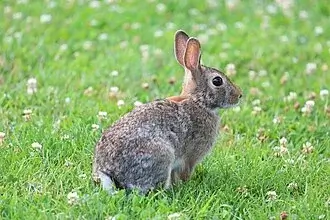
Sylvilagus floridanusis a member of the familyLeporidaewithin the orderLagomorpha. It was first formally described by French naturalistCharles Alexandre Lesueurin 1827.[6]The genusSylvilagusincludes around 15 species of New World cottontail rabbits, which are widespread throughout the Americas. Subspecies: There are at least 17 recognized subspecies ofSylvilagus floridanus, distinguished mainly by geographic distribution and minor morphological differences.[6][7]These subspecies are generally grouped by region: Morphological and genetic variation across populations reflect adaptation to diverse environments, with some populations showing notable differences in size, coloration, and behavior.[6] Evolution And Phylogeny: The eastern cottontail belongs to the Leporidae family, which includes all rabbits and hares. Within this family,Sylvilagusis a New World genus that diverged from Old World rabbits and hares millions of years ago.[10] Molecular and morphological studies have identified several distinct species and subspecies withinSylvilagus, highlighting a complex evolutionary history shaped by geographic isolation and environmental adaptation.[11]Separate populations of the eastern cottontail found in different regions display markedly different genetic compositions, which may factor into their adaptability to diverse habitats.[1] Fossil records and genetic data suggest the eastern cottontail expanded its range following the last glacial period, taking advantage of cleared forest landscapes and open habitats.[12]This species continues to be an important subject in studies of mammalian adaptation and speciation. It The eastern cottontail has a distinctive white spot on its forehead when young and fur that ranges from reddish-brown to grayish-brown, with large hind feet, long ears, and a short, fluffy white tail.[13]Its underside is white, and there is a rusty patch near the tail.[14]It differs from aharein its overall smaller size and brownish-gray coloring around the head and neck, with a lighter-colored body and a white underside on the tail.[15]The species also has large brown eyes and long ears adapted for detecting predators.[5]During winter, the eastern cottontail'spelagebecomes more gray than brown.[16]Kits (young rabbits) develop a similar coloring after a few weeks but are born with a white blaze running down their forehead, which fades as they mature.[15] This rabbit is medium-sized, measuring36–48cm (14–19in)in total length, including a tail that averages5.3cm (2.1in).[17][4] Adults typically weigh between1.8 and 4.4lb (800 and 2,000g), with an average of around2.6lb (1,200g). Females tend to be slightly heavier than males, although the sexes broadly overlap in size.[18][19]The species exhibits slight geographic variation in body size, with individuals generally increasing in mass from southern to northern latitudes, in line withBergmann's rule. For example, adult specimens from theFlorida Museum of Natural Historyhave a mean weight of2.24lb (1.018kg),[20]whereas a study of 346 adults fromMichiganfound an average mass of3.19lb (1.445kg).[21] Range And Habitat: The eastern cottontail inhabits meadows, shrubby areas, and edge habitats throughout the eastern and south-centralUnited States, southernCanada, easternMexico,Central America, and northernmostSouth America. It is also present onMargarita Islandin theCaribbean. The species is especially abundant across the Midwest of North America, and its range expanded northward as forests were cleared by settlers.[16]Originally absent fromNew England, it has since been introduced there, where it now competes with the nativeNew England cottontail(Sylvilagus transitionalis). It has also been introduced to parts ofOregon,Washington, andBritish Columbia.[22]In the 1950s and 1960s, the species was introduced toFranceand northernItaly, where it underwent rapid territorial expansion and population growth.[16] Populations in the mountainous regions of thesouthwestern United Statesand westernMexicoare now considered a separate species, therobust cottontail(S. holzneri).[11] Optimal eastern cottontail habitat includes open grassy areas, clearings, and old fields that support abundant green vegetation, with shrubs or hedgerows providing cover.[23]Critical habitat components include dense, well-distributed escape cover interspersed with open foraging areas such as pastures or grasslands.[24]In the western United States, they occupy diverse habitats such as ponderosa pine, mixed conifer, and pinyon (Pinusspp.)–juniper (Juniperusspp.) woodlands, where woody debris, shrubby understories, and patchy cover are important for survival. Eastern cottontails also thrive in agricultural and suburban environments, especially nearfencerows, forest edges, and thickets. They can be found in swamps and marshes but generally avoid dense forests.[16] Behavior And Ecology: The eastern cottontail is a territorial species that relies on speed and agility to evade predators. When chased, it typically escapes in a zigzag pattern and can reach speeds of up to18mph (29km/h).[16]Cottontails favor habitats where they can feed in the open but quickly retreat to cover when threatened. Preferred environments includeforestedges,swamps, brushythickets,hedgerows, and open fields with nearby shelter. Instead of digging burrows, eastern cottontails rest in aform—a shallow, scratched-out depression in grass or beneath dense vegetation—and may usegroundhog(Marmota monax) burrows during severe weather or heavy snow.[25] Eastern cottontails are mostlycrepuscularandnocturnal, foraging primarily at dawn, dusk, and night. However, they can be seen during the day, particularly in overcast or foggy conditions.[26]They spend much of the daytime resting under vegetative cover and often remain motionless for extended periods to avoid detection.[16]Activity is year-round, as the species does not hibernate.[26] Home Range: Eastern cottontail home ranges are roughly circular in open and uniform habitats. Individuals generally remain within the same range throughout life, although shifts can occur due to weather or vegetation changes.[24]InNew England, home ranges average1.4 acres (0.57 hectares)for males and1.2 acres (0.49 hectares)for females but can vary between0.5 to 40 acres (0.20 to 16.19 hectares)depending on habitat quality and season.[16]Male home ranges expand during the breeding season, with spring ranges in southwestern Wisconsin averaging6.9 acres (2.8 hectares)and peaking at10 acres (4.0 hectares)in early summer before decreasing again in late summer.[27]Daily movements usually cover only 10–20% of their total range.[24] In southeastern Wisconsin, male ranges overlapped by up to 50%, while females overlapped less than 25%. Females defend the immediate area around their nest, whereas males compete aggressively for dominance and access to mates.[27] Cover Requirements: Brush piles, thickets, stone walls, and dense herbaceous growth are crucial for shelter and predator avoidance. Eastern cottontails rarely dig burrows except when constructing nests, preferring abandoned dens of other animals, such as woodchucks.[16]Seasonal cover use changes with plant availability: in winter, when deciduous vegetation is bare, they rely heavily on woody cover.[15]In Florida pine flatwoods, they use low patches ofsaw palmetto(Serenoa repens) as cover.[28] Nests are usually built in grassy fields, hayfields, or weedy areas near brushy cover. In Iowa, nests were most commonly found within70yd (64m)of shrubs in herbaceous vegetation at least4in (10cm)tall.[15]The average nest cavity is5in (13cm)deep,5in (13cm)wide, and7in (18cm)long, and is lined with dry grasses and the mother's fur.[26][29] Mortality: InKansas, the leading cause of mortality among radiotracked eastern cottontails was predation (43%), followed by deaths related to the research process (19%) andtularemia(18%).[32]A significant source of mortality is collisions with vehicles. InMissouri, it has been estimated that approximately ten eastern cottontails are killed annually per mile of road, with the peak of highway mortality occurring in spring (March through May), when roadside vegetation greens up before adjacent fields and attracts rabbits to the roadside.[33] Annual adult survival is estimated to be around 20%. Average lifespan in the wild is about 15 months, though the longest-lived recorded wild individual reached five years. In captivity, eastern cottontails have lived up to nine years.[26] Eastern cottontails host a variety ofectoparasitesand endoparasites, includingfleas,ticks,lice,cestodes,nematodes, andtrematodes. They are also susceptible to parasitism by grayflesh flylarvae,botflylarvae, and diseases such as tularemia, Shope's fibroma virus,torticollis, and cutaneousstreptothricosis.[34]A comprehensive summary of eastern cottontail diseases and parasites is provided by Chapman et al.[35] The eastern cottontail is preyed upon by a wide variety of natural and introduced predators, forming a significant part of the diets of many carnivores and raptors in eastern North America. Common predators include domestic cats (Felis catus) and dogs (Canis lupus familiaris),foxes(VulpesandUrocyonspp.),coyote(C. latrans),bobcat(Lynx rufus),weasels(Mustelaspp.),raccoon(Procyon lotor),mink(Neogale vison),great horned owl(Bubo virginianus),barred owl(Strix varia),hawks(particularlyButeospp.),corvids(Corvusspp.), and varioussnakes.[34] Nestlings are especially vulnerable to predation byraccoons,badgers(Taxidea taxus),skunks(MephitisandSpilogalespp.),crows(Corvus brachyrhynchos), andVirginia opossums(Didelphis virginiana).[33]In centralMissouri, eastern cottontails made up the majority of prey biomass consumed byred-tailed hawks(Buteo jamaicensis) during the nesting season. InPennsylvania, thegreat horned owlis considered the primary predator.[33] In theSouthwest, eastern cottontails comprise between 7% and 25% of the diet of thenorthern goshawk(Accipiter gentilis). InTexas, they are most heavily preyed upon by coyotes in early spring and fall. In southwesternNorth Dakota, eastern and desert cottontails (Sylvilagus auduboni) are a key prey item for bobcats.[36] Juveniles are rarely taken byshort-eared owls(Asio flammeus), and only trace remains of eastern cottontails have been detected in the scat ofblack bears(Ursus americanus).[37]
Life History
Eastern cottontails reach sexual maturity at 2–3 months of age. Breeding season varies by latitude and climate, beginning as early as January in the southern United States and around March in New England, continuing through late summer.[15]Mating is promiscuous, with males competing for access to females.[16] The nest is typically a slanted hole in soft soil lined with fur and grasses, measuring about7.1in ×4.9in ×4.7in (18cm ×12cm ×12cm).[15]Gestation lasts 25–35 days (average 28). Kits are born blind with fine hair and a white blaze on the forehead, which fades as they mature. Their eyes open at 4–7 days, and they begin leaving the nest by 12–16 days. Weaning occurs by 4–5 weeks, and dispersal begins around 7 weeks.[29][26] Females can have 1–7 litters per year (averaging 3–4), with 3–8 kits per litter (average 5). In southern states, breeding is nearly continuous, while northern populations have shorter seasons but larger litters.[26][30] Eastern cottontails feed primarily on a wide variety of plants, with some studies documenting 70–145 plant species in their diet.[31]They prefer tender herbaceous vegetation, such as grasses, clovers (Trifoliumspp.), crabgrasses (Digitariaspp.), and wild rye (Elymusspp.).[4]In Connecticut, their summer diet includes alfalfa, timothy (Phleum pratense), quackgrass (Elytrigia repens), ragweed (Ambrosia psilostachya), goldenrod (Solidagospp.), plantains (Plantagospp.),chickweed(Stellaria media), anddandelion(Taraxacum officinale).[4] During winter or when snow covers vegetation, cottontails browse on twigs, buds, and bark of woody plants such asgray birch(Betula populifolia),red maple(Acer rubrum), andsmooth sumac(Rhus glabra).[31]They are alsocoprophagous, re-ingesting soft fecal pellets to extract additional nutrients.[15][26]
Hunting Season
Oct 1 – Mar 15 (statewide)
Frequently Asked Questions
Regulations for hunting Eastern cottontail in Oklahoma
Rabbit hunting in Oklahoma runs Oct 1 through Mar 15 statewide. Cottontail daily limit is 10 (20 possession). No open season on jackrabbits east of I-35. Shooting hours: 30 minutes before official sunrise to official sunset. Public land seasons may vary.
When is Eastern cottontail hunting season in Oklahoma?
Oct 1 – Mar 15 (statewide)
What is the bag limit for Eastern cottontail in Oklahoma?
Cottontail: 10 per day, 20 possession. Swamp rabbit: 3 per day, 6 possession. Jackrabbit: 3 per day (10 in Cimarron, Texas, Beaver counties)
What's another name for Eastern cottontail?
Eastern cottontail is also known as Eastern cottontail, Cottontail in Oklahoma.
References
| State | Category | Directory | Subcategory | Content | Source |
|---|---|---|---|---|---|
| Oklahoma | Hunting | Regulations | Season Dates | Oct 1 – Mar 15 (statewide) | Link |
| Oklahoma | Hunting | Regulations | Regulations | Rabbit hunting in Oklahoma runs Oct 1 through Mar 15 statewide. Cottontail daily limit is 10 (20 possession). No open se | Link |