Also known as: Mountain lion, Puma, Panther, Catamount
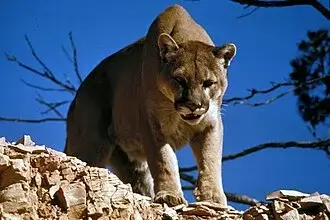
Naming And Etymology: The cougar holds theGuinnessrecord for the animal with the greatest number of names, with over 40 in English alone.[3]The wordcougaris borrowed from thePortugueseçuçuarana, via French, derived from theTupi language. A form in Brazil issuçuarana.[4]In the 17th century,Georg Marcgravenamed itcuguacu ara. Marcgrave's rendering was reproduced in 1648 by his associateWillem Piso.Cuguacu arawas then adopted byJohn Rayin 1693.[5]In 1774,Georges-Louis Leclerc, Comte de Buffonconvertedcuguacu aratocuguar, which was later modified to "cougar" in English.[6][7]Gaelic, or Erse, has similar (likely unrelated) words, includingScottish Gaeliccugarandcugarbhad(a wild or domesticated male cat; also signifying a hero, gallant, or champion).[8]The usual Gaelic forcatis"cat"(withCúorCoinsignifying acanid). The namepumais the mostcommon nameused in the global scientific literature.[9]Pumais the common name used in Latin America and most parts of Europe and is occasionally used in the United States.[10][11][12][13]The first use ofpumain English dates to 1777, introduced from Spanish from theQuechua language.[14] In the United States, the namemountain lionis commonly used, and in Canada, the namecougaris most commonly used.[9]The termmountain lionwas first seen in writing in 1858.[15]Puma concoloris not a true lion of the genusPantheraand cannot roar, nor is its habitat restricted to mountainous regions. The namecatamount,a shortening of name "cat of the mountain", has also been in English use forPuma concolorand other wild cats since at least 1664.[16]Pantheris often used synonymously withcougar,pumaormountain lion.[17]The namepainteris also sometimes used instead ofpanther, mostly in the southern United States.[18] Taxonomy And Evolution: Felis concolorwas thescientific nameproposed byCarl Linnaeusin 1771 for a cat with a long tail from Brazil.[19]It was placed in the genusPumabyWilliam Jardinein 1834.[20]This genus is part of theFelinae.[2]The cougar is most closely related to thejaguarundiand the cheetah.[21][22] Subspecies: Following Linnaeus's first scientific description of the cougar, 32 cougarzoological specimenswere described and proposed assubspeciesuntil the late 1980s.Geneticanalysis of cougarmitochondrial DNAindicates that many of these are too similar to be recognized as distinct at a molecular level but that only sixphylogeographicgroups exist. TheFlorida panthersamples showed a lowmicrosatellitevariation, possibly due toinbreeding.[22]Following this research, the authors ofMammal Species of the Worldrecognized the following six subspecies in 2005:[2] In 2006, the Florida panther was still referred to as a distinct subspeciesP. c. coryiin research works.[23] As of 2017[update], the Cat Classification Taskforce of the Cat Specialist Group recognizes only two subspecies asvalid:[24] Evolution: Lynx CheetahA. jubatus Cougar JaguarundiH. yagouaroundi Felis Otocolobus Prionailurus ThefamilyFelidaeis thought to have originated in Asia about11million years ago; taxonomic research on felids remains partial, and much of what is known about their evolutionary history is based onmitochondrial DNAanalysis.[21]Significantconfidence intervalsexist with suggested dates. In the latestgenomicstudy of the Felidae, the common ancestor of today'sLeopardus,Lynx,Puma,Prionailurus, andFelislineages migrated across theBering land bridgeinto the Americas8to8.5million years ago. The lineages subsequently diverged in that order.[21]North American felids then invaded South America2to4million years agoas part of theGreat American Interchange, following the formation of theIsthmus of Panama.[22] The cheetah lineage is suggested by some studies to have diverged from thePumalineage in the Americas and migrated back to Asia and Africa,[21][22]while other research suggests the cheetah diverged in theOld Worlditself.[26]A high level of genetic similarity has been found among North American cougar populations, suggesting they are all fairly recent descendants of a small ancestral group. Culver et al. propose the original North American cougar population waslocally extinctduring thePleistocene extinctionssome 10,000 years ago, when other large mammals, such asSmilodon, also disappeared. North America was then repopulated bySouth American cougars.[22]Cougars in North America might have survived theLate Pleistocene megafaunal extinctiondue to their greater dietary flexibility as evidenced bydental microweartexture analysis.[27] Acoproliteidentified as from a cougar wasexcavatedin Argentina'sCatamarca Provinceand dated to 17,002–16,573 years old. It containedToxascaris leoninaeggs. This finding indicates that the cougar and the parasite have existed in South America since at least theLate Pleistocene.[28]The oldest fossil record of a cougar (Puma concolor) in South America (Argentina) is a partial skull from the lateCalabrianage.[29] Characteristics: The head of the cougar is round, and the ears are erect. Its powerful forequarters, neck, and jaw serve to grasp and hold large prey. It has four retractile claws on its hind paws and five on its forepaws, of which one is adewclaw. The larger front feet and claws are adaptations for clutching prey.[30] The cougar is slender and agile. It is the fourth largest cat species;[31]adults stand about60 to 90cm (24 to 35in)tall at the shoulders.[32]Adult males are around2.4m (7ft 10in)long from nose to tail tip, and females average2.05m (6ft 9in), with overall ranges between1.50 to 2.75m (4ft 11in to 9ft 0in)nose to tail suggested for the species in general.[33][34]Of this length, the tail typically accounts for63 to 95cm (25 to 37in).[35]Males generally weigh53 to 72kg (117 to 159lb). Females typically weigh between34 and 48kg (75 and 106lb).[35][36]Cougar size is smallest close to theequatorand larger towards thepoles.[37] The largest recorded cougar, shot in 1901, weighed105.2kg (232lb); claims of125.2kg (276lb)and118kg (260lb)have been reported, though they were probably exaggerated.[38]Male cougars in North America average62kg (137lb), while the average female in the same region averages about42kg (93lb).[39]On average, adult male cougars in British Columbia weigh56.7kg (125lb)and adult females45.4kg (100lb), though several male cougars in British Columbia weighed between86.4 and 95.5kg (190 and 211lb).[40] Depending on the locality, cougars can be smaller or bigger than jaguars but are less muscular and not as powerfully built, so on average, their weight is less. Whereas the size of cougars tends to increase as much as distance from the equator increases,[37]which crosses the northern portion of South America, jaguars are generally smaller north of theAmazon Riverin South America and larger south of it. For example, while South American jaguars are comparatively large, and may exceed90kg (200lb),[41]North American jaguars in Mexico'sChamela-Cuixmala Biosphere Reserveweigh approximately50kg (110lb), about the same as female cougars.[42] Cougar coloring is plain tawny, ranging from silvery-grey to reddish with lighter patches on the underbody, including the jaws, chin, and throat. Kittens are spotted and born with blue eyes and rings on their tails;[36]juveniles are pale, and dark spots remain on their flanks.[34]Aleucisticindividual was seen inSerra dos Órgãos National Parkin Rio de Janeiro in 2013 when it was recorded by a camera trap, indicating that pure white individuals do exist within the species, though they are extremely rare.[43][44] The cougar has large paws and proportionally the largest hind legs in Felidae,[36]allowing for great leaping and powerful short sprints. It can leap from the ground up to5.5m (18ft)high into a tree.[45]It is the largest of theFelinaethat is capable ofpurring.[46] Behavior And Ecology: The cougar is akeystone speciesin Western Hemisphere ecosystems as it links numerous species at manytrophic levelsinteracting with 485 other species as food source and prey, carcass remains left behind and competitive effects on otherpredatorsin shared habitat.[55] Hunting And Diet: The cougar is ageneralisthypercarnivore. It prefers large mammals such asmule deer,white-tailed deer,elk,moose,mountain goatandbighorn sheep. It opportunistically takes smaller prey such asrodents,lagomorphs, smaller carnivores, birds, and even domestic animals, including pets.[56]The mean weight of cougar vertebrate prey increases with its body weight and is lower in areas closer to theequator. A survey of North America research found 68% of prey items were ungulates, especially deer. Only the Florida panther showed variation, often preferring feralhogsandarmadillos.[37]Cougars have been known to prey on introducedgemsbokpopulations inNew Mexico. One individual cougar was recorded as hunting 29 gemsbok, which made up 58% of its recorded kills. Most gemsbok kills were neonates, but some adults were also known to have been taken.[57]Elsewhere in the southwestern United States, they have been recorded to also prey onferal horsesin theGreat Basin,[58]as well asferal donkeysin theSonoranandMojave Deserts.[59] Investigations atYellowstone National Parkshowed that elk and mule deer were the cougar's primary prey; the prey base is shared with the park'swolves, with which the cougar competes for resources.[60]A study on winter kills from November to April inAlbertashowed that ungulates accounted for greater than 99% of the cougar diet. Learned, individual prey recognition was observed, as some cougars rarely killed bighorn sheep, while others relied heavily on the species.[61] In the Central and South American cougar range area, the ratio of deer in the diet declines. Small to mid-sized mammals, including large rodents such as thecapybara, are preferred. Ungulates accounted for only 35% of prey items in one survey, about half that of North America. Competition with the larger jaguar in South America has been suggested for the decline in the size of prey items.[37]In Central or North America, the cougar and jaguar share the same prey, depending on its abundance.[62]Other listed prey species of the cougar includemice,porcupines,American beavers,raccoons,hares,guanacoes,peccaries,vicuñas,rheasandwild turkeys.[63]Birds and small reptiles are sometimes preyed upon in the south, but this is rarely recorded in North America.[37]Magellanic penguins(Spheniscus magellanicus) constitute the majority of prey items in cougar diet inPatagonia'sBosques Petrificados de Jaramillo National ParkandMonte León National Park.[64] Although capable of sprinting, the cougar is typically anambush predator. It stalks through brush and trees, across ledges, or other covered spots, before delivering a powerful leap onto the back of its prey and a suffocating neck bite. The cougar can break the neck of some of its smaller prey with a strong bite and momentum bearing the animal to the ground.[30]Kills are generally estimated around one large ungulate every two weeks. The period shrinks for females raising young, and may be as short as one kill every three days when cubs are nearly mature around 15 months.[36]The cat drags a kill to a preferred spot, covers it with brush, and returns to feed over a period of days. The cougar is generally reported to not be ascavenger, but deer carcasses left exposed for study were scavenged by cougars in California, suggesting more opportunistic behavior.[65] The cougar's hunting success rate in centralIdahowas estimated at 82% hunting elk and mule deer in the snow during winter.[66]In centralArgentina, its success rate was estimated at 10% huntingPlains viscachain semi-arid scrub areas.[67] Interactions With Other Predators: Aside from humans, no species preys upon mature cougars in the wild, although conflicts with other predators or scavengers occur. Of the large predators inYellowstone National Park– thegrizzlyandblack bears,gray wolfand cougar – the massive grizzly bear appears dominant, often (though not always) able to drive a gray wolf pack, black bear or cougar off their kills. One study found that grizzlies and American black bears visited 24% of cougar kills in Yellowstone andGlacier National Parks, usurping 10% of carcasses. Bears gained up to 113%, and cougars lost up to 26% of their daily energy requirements from these encounters.[68] InColoradoand California, black bears were found to visit 48% and 77% of kills, respectively. In general, cougars are subordinate to black bears when it comes to kills, and when bears are most active, the cats take prey more frequently and spend less time feeding on each kill. Unlike several subordinate predators from other ecosystems, cougars do not appear to exploit spatial or temporal refuges to avoid competitors.[69][70] The gray wolf and the cougar compete more directly for prey, mostly in winter. Packs of wolves can steal cougars' kills, and there are some documented cases of cougars being killed by them. One report describes a large pack of seven to 11 wolves killing a female cougar and her kittens,[71]while in nearbySun Valley, Idaho, a 2-year-old male cougar was found dead, apparently killed by a wolf pack.[72]Conversely, one-to-one confrontations tend to be dominated by the cat, and there are various documented accounts where wolves have been ambushed and killed,[73][74][75][76]including adult male specimens.[77]Wolves more broadly affect cougar population dynamics and distribution by dominating territory and prey opportunities, and disrupting the feline's behavior. Preliminary research inYellowstone, for instance, has shown displacement of the cougar by wolves.[78] One researcher in Oregon noted: "When there is a pack around, cougars are not comfortable around their kills or raising kittens... A lot of times a big cougar will kill a wolf, but the pack phenomenon changes the table."[79]Both species are capable of killing mid-sized predators, such asbobcats,Canada lynxes,wolverinesandcoyotes, and tend to suppress their numbers.[60]Although cougars can kill coyotes, the latter have been documented attempting to prey on cougar cubs.[80] The cougar and jaguar share overlapping territory in the southern portion of its range.[81]The jaguar tends to take the larger prey where ranges overlap, reducing both the cougar's potential size and the likelihood of direct competition between the two cats.[37]Cougars appear better than jaguars at exploiting a broader prey niche and smaller prey.[82] Social Spacing And Interactions: The cougar is a mostly solitary animal. Only mothers and kittens live in groups, with adults meeting rarely. Subadult cougars of same sexes have been known to temporarily form sibling groups.[83]While generally loners, cougars will reciprocally share kills and seem to organize themselves into small communities defined by the territories of dominant males. Cats within these areas socialize more frequently with each other than with outsiders.[84] In the vicinity of a cattle ranch in northern Mexico, cougars exhibitednocturnalactivity that overlapped foremost with the activity ofcalves.[85]In a nature reserve in central Mexico, the activity of cougars wascrepuscularand nocturnal, overlapping largely with the activity of thenine-banded armadillo(Dasypus novemcinctus).[86]Cougars in the montane Abra-Tanchipa Biosphere Reserve in southeastern Mexico displayed acathemeralactivity pattern.[87]Data from 12 years of camera trapping in the Pacific slope and Talamanca Cordillera of Costa Rica showed cougars as cathemeral.[88]Both cougars and jaguars in theCockscomb Basinof Belize were nocturnal but avoided each other.[89]In a protected cloud forest in the central Andes of Colombia, cougars were active from late afternoon to shortly before sunrise and sometimes during noon and early afternoon.[90]In protected areas of theMadidi-TambopataLandscape in Bolivia and Peru, cougars were active throughout the day but with a tendency to nocturnal activity that overlapped with the activity of main prey species.[91] During an 8-year-long study in a modified landscape in southeastern Brazil, male cougars were primarily nocturnal, but females were active at night and day.[92]Cougars were diurnal in the BrazilianPantanal, but crepuscular and nocturnal in protected areas in theCerrado,Caatingaandecotonebiomes.[93]Cougars in the Atlantic Forest were active throughout the day but displayed peak activity during early mornings in protected areas and crepuscular and nocturnal activity in less protected areas.[94]In central Argentina, cougars were active day and night in protected areas but were active immediately after sunset and before sunrise outside protected areas.[95]Cougars displayed a foremost crepuscular and nocturnal activity pattern in a ranching area in southern Argentina.[54] Home rangesizes and overall cougar abundance depend on terrain, vegetation, and prey abundance.[96]Research suggests a lower limit of25km2(9.7sqmi)and upper limit of1,300km2(500sqmi)of home range for males.[97]Large male home ranges of150 to 1,000km2(58 to 386sqmi)with female ranges half that size.[98]One female adjacent to theSan Andres Mountainswas found with a big range of215km2(83sqmi), necessitated by poor prey abundance.[99]Research has shown cougar abundances from 0.5 animals to as many as seven per100km2(39sqmi).[100] Male home ranges include or overlap with females but, at least where studied, not with those of other males. The home ranges of females overlap slightly. Males create scrapes composed of leaves andduffwith their hind feet, andmarkthem withurineand sometimesfeces.[101]When males encounter each other, they vocalize and may engage in violent conflict if neither backs down.[102] Cougars communicate with various vocalizations. Aggressive sounds include growls, spits, snarls and hisses. During the mating season, estrus females producecaterwaulsor yowls to attract mates, and males respond with similar vocals. Mothers and offspring keep in contact with whistles, chirps, and mews.[56][103] Reproduction And Life Cycle: Females reachsexual maturityat the age of 18 months to three years and are inestrusfor about eight days of a 23-day cycle; thegestation periodis approximately 91 days.[36]Both adult males and females may mate with multiple partners, and a female's litter can have multiple paternities.[56]Copulation is brief but frequent. Chronic stress can result in low reproductive rates in captivity as well as in the field.[104] Gestationis 82–103 days long.[56]Only females are involved in parenting. Litter size is between one and six cubs, typically two. Caves and other alcoves that offer protection are used as litter dens. Born blind, cubs are completely dependent on their mother at first and begin to be weaned at around three months of age. As they grow, they go out on forays with their mother, first visiting kill sites and, after six months, beginning to hunt small prey on their own.[97][56]Kitten survival rates are just over one per litter.[36] Juveniles remain with their mothers for one to two years.[56]When a female reaches estrous again, her offspring mustdisperseor the male will kill them. Males tend to disperse further than females.[105]One study has shown a highmortality rateamong cougars that travel farthest from their maternal range, often due to conflicts with other cougars.[97]In a study area inNew Mexico, males dispersed farther than females, traversed large expanses of non-cougar habitat and were probably most responsible for nuclear gene flow between habitat patches.[106] Life expectancy in the wild is reported at 8 to 13 years and probably averages 8 to 10; a female of at least 18 years was reported killed byhuntersonVancouver Island.[36]Cougars may live as long as 20 years in captivity. Causes of death in the wild include disability and disease, competition with other cougars, starvation, accidents, and, where allowed, hunting. Thefeline immunodeficiency virusis well-adapted to the cougar.[107] Attacks On Humans: Due to theexpanding human population, cougarrangesincreasingly overlap with areas inhabited by humans.[115]Attacks on humans are very rare, as cougar prey recognition is a learned behavior and they do not generally recognize humans as prey.[116]In a 10-year study in New Mexico of wild cougars who were not habituated to humans, the animals did not exhibit threatening behavior to researchers who approached closely (median distance=18.5 m; 61 feet) except in 6% of cases;14⁄16of those were females with cubs.[117]Attacks on people, livestock, and pets may occur when a cougarhabituatesto humans or is in a condition of severe starvation. Attacks are most frequent during late spring and summer when juvenile cougars leave their mothers and search for new territory.[118] Between 1890 and 1990 in North America, there were 53 reported, confirmed attacks on humans, resulting in 48 nonfatal injuries and 10 deaths of humans (the total is greater than 53 because some attacks had more than one victim).[119]By 2004, the count had climbed to 88 attacks and 20 deaths.[120] Within North America, the distribution of attacks is not uniform. The heavily populated state of California saw a dozen attacks from 1986 to 2004 (after just three from 1890 to 1985), including three fatalities.[121]In March 2024, two brothers in California were attacked by a male cougar, with one being fatally wounded; it was the state's first fatal attack in 20 years.[122][123]Washington state was the site of a fatal attack in 2018, its first since 1924.[124]Lightly populated New Mexico reported an attack in 2008, the first there since 1974.[125] As with many predators, a cougar may attack if cornered, if a fleeing human stimulates their instinct to chase, or if a person "plays dead". Standing still may cause the cougar to consider a person easy prey.[126]Exaggerating the threat to the animal through intense eye contact, loud shouting, and any other action to appear larger and more menacing, may make the animal retreat. Fighting back with sticks and rocks, or even bare hands, is often effective in persuading an attacking cougar to disengage.[116][118] When cougars do attack, they usually employ their characteristic neck bite, attempting to position their teeth between thevertebraeand into thespinal cord. Neck, head, and spinal injuries are common and sometimes fatal.[116]Children are at greatest risk of attack and least likely to survive an encounter. Detailed research into attacks before 1991 showed that 64% of all victims – and almost all fatalities – were children. The same study showed the highest proportion of attacks to have occurred inBritish Columbia, particularly onVancouver Island, where cougar populations are especially dense.[119]Preceding attacks on humans, cougars display aberrant behavior, such as activity during daylight hours, a lack of fear of humans, and stalking humans. There have sometimes been incidents of pet cougars mauling people.[127][128] Research on new wildlife collars may reduce human-animal conflicts by predicting when and where predatory animals hunt. This may save the lives of humans, pets, and livestock, as well as the lives of these large predatory mammals that are important to the balance of ecosystems.[129] Cougars in thesouthern coneof South America are reputed to be extremely reluctant to attack people; in legend, they defended people against jaguars.[130]The nineteenth-century naturalistsFélix de Azara[131]andWilliam Henry Hudson[132]thought that attacks on people, even children or sleeping adults, did not happen. Hudson, citing anecdotal evidence from hunters, claimed that pumas were positively inhibited from attacking people, even in self-defense. Attacks on humans, although exceedingly rare, have occurred.[133][134] An early, authenticated, non-fatal case occurred nearLake Viedma, Patagonia, in 1877 when a female mauled the Argentine scientistFrancisco P. Moreno; Moreno afterward showed the scars toTheodore Roosevelt. In this instance, however, Moreno had been wearing aguanaco-hideponchoround his neck and head as protection against the cold;[135]in Patagonia the guanaco is the puma's chief prey animal.[136]Another authenticated case occurred in 1997 inIguazú National Parkin northeastern Argentina, when the 20-month-old son of a ranger was killed by a female puma. Forensic analysis found specimens of the child's hair and clothing fibers in the animal's stomach. Thecoatíis the puma's chief prey in this area. Despite prohibitory signs, coatis are hand-fed by tourists in the park, causing unnatural approximation between cougars and humans. This particular puma had been raised in captivity and released into the wild.[137] On March 13, 2012, Erica Cruz, a 23-year-old shepherdess was found dead in a mountainous area nearRosario de Lerma, Salta Province, in northwestern Argentina.[138]Claw incisions, which severed a jugular vein, indicated that the attacker was a felid; differential diagnosis ruled out other possible perpetrators.[a]There were no bite marks on the victim, who had been herding goats.[139]In 2019 inCórdoba Province, Argentina, an elderly man was badly injured by a cougar after he attempted to defend his dog from it, while in neighboring Chile a 28-year-old woman was attacked and killed inCorral, inLos Ríos Region, on October 20, 2020.[140] Fatal attacks by other carnivores, such as feral dogs, can be misattributed to cougars without appropriate forensic knowledge.[141] Predation On Domestic Animals: During the early years of ranching, cougars were considered on par with wolves in destructiveness. According to figures inTexasin 1990, 86 calves (0.0006% of Texas's 13.4million cattle and calves), 253 mohair goats, 302 mohair kids, 445 sheep (0.02% of Texas's 2million sheep and lambs) and 562 lambs (0.04% of Texas's 1.2million lambs) were confirmed to have been killed by cougars that year.[142][143] Some instances ofsurplus killinghave resulted in the deaths of 20 sheep in one attack.[144]A cougar's killing bite is applied to the back of the neck, head, orthroatand the cat inflicts puncture marks with its claws usually seen on the sides and underside of the prey, sometimes also shredding the prey as it holds on. Coyotes also typically bite the throat, but the work of a cougar is generally clean, while bites inflicted by coyotes and dogs leave ragged edges. The size of the tooth puncture marks also helps distinguish kills made by cougars from those made by smaller predators.[145] Remedial hunting appears to have the paradoxical effect of increased livestock predation and complaints of human-cougar conflicts. In a 2013 study, the most important predictor of cougar problems was the remedial hunting of cougars the previous year. Each additional cougar on the landscape increased predation and human-cougar complaints by 5%, but each animal killed during the previous year increased complaints by 50%. The effect had a dose-response relationship with very heavy (100% removal of adult cougars) remedial hunting, leading to a 150–340% increase in livestock and human conflicts.[146]This effect is attributed to the removal of older cougars that have learned to avoid people and their replacement by younger males that react differently to humans. Remedial hunting enables younger males to enter the former territories of the older animals.[147][148]Predation by cougars on dogs "is widespread, but occurs at low frequencies".[149] In Mythology: The grace and power of the cougar have been widely admired in the cultures of theindigenous peoples of the Americas. TheIncacity ofCuscois reported to have been designed in the shape of a cougar, and the animal also gave its name to both Inca regions and people. TheMochepeople often represented the cougar in their ceramics.[150]The sky and thunder god of the Inca,Viracocha, has been associated with the animal.[151] In North America, mythological descriptions of the cougar have appeared in the stories of theHocąk language("Ho-Chunk" or "Winnebago") ofWisconsinandIllinois[152]and theCheyenne, among others. To theApacheandWalapaiof the Southwestern United States, the wail of the cougar was a harbinger of death.[153]TheAlgonquinsandOjibwebelieve that the cougar lived in the underworld and was wicked, whereas it was a sacred animal among theCherokee.[154]
Habitat & Range
The cougar has the most extensive range of any wild land animal in the Americas, spanning 110 degrees oflatitudefrom the Yukon in Canada to the southern Andes in Chile.[1]The species was extirpated from eastern North America, aside from Florida, but they may be recolonizing their former range and isolated populations have been documented east of their contemporary ranges in both the Midwestern US and Canada.[47] The cougar lives in all forest types, lowland and mountainous deserts, and in open areas with little vegetation up to an elevation of5,800m (19,000ft).[1]In theSanta Ana Mountains, it prefers steep canyons, escarpments, rim rocks and dense brush.[48]In Mexico, it was recorded in theSierra de San Carlos.[49]In theYucatán Peninsula, it inhabitssecondaryand semi-deciduousforests inEl Eden Ecological Reserve.[50]InEl Salvador, it was recorded in the lower montane forest inMontecristo National Parkand in a river basin in theMorazán Departmentabove700m (2,300ft)in 2019.[51]InColombia, it was recorded in apalm oilplantationclose to ariparian forestin theLlanos Basin, and close to water bodies in theMagdalena River Valley.[52][53]In the human-modified landscape of central Argentina, it inhabitsbushlandwith abundant vegetation cover and prey species.[54]
Hunting Season
No open season; protected species
Frequently Asked Questions
Regulations for hunting Cougar in Oklahoma
Mountain lions (cougars) are a protected species in Oklahoma with no open hunting season. Sightings should be reported to ODWC. Depredation permits may be issued for livestock protection. The species is rare in Oklahoma with occasional transient individuals.
When is Cougar hunting season in Oklahoma?
No open season; protected species
What's another name for Cougar?
Cougar is also known as Mountain lion, Puma, Panther, Catamount in Oklahoma.
References
| State | Category | Directory | Subcategory | Content | Source |
|---|---|---|---|---|---|
| Oklahoma | Hunting | Regulations | Season Dates | No open season; protected species | Link |
| Oklahoma | Hunting | Regulations | Regulations | Mountain lions (cougars) are a protected species in Oklahoma with no open hunting season. Sightings should be reported t | Link |