Also known as: Fox squirrel
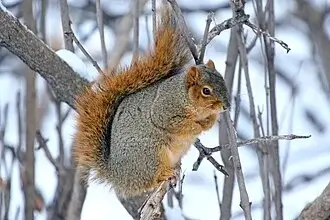
The fox squirrel's total length measures20 to 30in (50.8 to 76.2cm), with a body length of10 to 15in (25.4 to 38.1cm)and a similar tail length. They range in weight from1.0 to 2.5lb (453.6 to 1,134.0g).[7]The length of its hind foot is 5.1 to 8.2 cm.[6]There is nosexual dimorphismin size or appearance. Individuals tend to be smaller in the West. There are three distinct geographicalmorphsin coloration. In most areas, the animal's upper body is brown-grey to brown-yellow with a typically brownish-orange underside, while in eastern regions, such as theAppalachians, there are more strikingly-patterned dark brown and black squirrels with white bands on the face and tail. In the South and parts ofNebraskaandIowaalong the Missouri River,[8]there are populations withuniform black coats. To help with climbing, the squirrels have sharp claws, developedextensorsofdigitsandflexorsof forearms, and abdominalmusculature.[9]Fox squirrels have excellent vision and well-developed senses of hearing and smell. They use scent-marking to communicate with other fox squirrels.[9]"Fox squirrels also have several sets of vibrissae, hairs or whiskers that are used as touch receptors to sense the environment. These are found above and below their eyes, on their chin and nose, and on each forearm."[9]The dental formula ofS. nigeris1.0.1.31.0.1.3× 2 = 20.[6] As An Invasive Species: In Europe,S. nigerhas been included since 2016 in thelist of Invasive Alien Species of Union concern(the Union list).[19]This implies that this species cannot be imported, bred, transported, commercialized, or intentionally released into the environment in the whole of the European Union.[20] Introduced Range: Eastern fox squirrels have been intentionally introduced from portions of their native range to many urban and suburban areas within the western United States, including areas within California, Idaho, Montana, Oregon and Washington. For example, eastern fox squirrels were introduced in California to the city of Fresno from Missouri in 1900 or 1901, to the Veterans Hospital in West Los Angeles in 1904 from some region of the Mississippi Valley, to the area around the San Diego Zoo in 1920, to the campus of the University of California, Berkeley circa 1926, to Mount Diablo in Clayton in 1960, and to Bakersfield from Fresno in 1985.[21] Behavior And Ecology: Fox squirrels are strictlydiurnal, non-territorial, and spend more of their time on the ground than most other tree squirrels. They are still, however, agile climbers. They construct two types of homes called "dreys", depending on the season. Summer dreys are often little more than platforms of sticks high in the branches of trees, while winter dens are usually hollowed out of tree trunks by a succession of occupants over as many as 30 years. Cohabitation of these dens is not uncommon, particularly among breeding pairs. Fox squirrels will form caches by burying food items for later consumption.[6]They like to store foods that are shelled and high in fat, such as acorns and nuts. Shelled foods are favored because they are less likely to spoil than non-shelled foods, and fatty foods are valued for their high energy density.[22][23] Fox squirrels are not particularly gregarious or playful; in fact, they have been described as solitary and asocial creatures, coming together only in breeding season.[24]They have a large vocabulary, consisting most notably of an assortment of clucking and chucking sounds, not unlike some "game" birds, and they warn of approaching threats with distress screams. In the spring and autumn, groups of fox squirrels clucking and chucking together can make a small ruckus. They also make high-pitched whines during mating. When threatening another fox squirrel, they will stand upright with their tail over their back and flick it.[9]Fox squirrels are impressive jumpers, easily spanning 15 feet in horizontal leaps and free-falling 20 feet or more to a soft landing on a tree limb or tree trunk. Mortality: In captivity, fox squirrels have been known to live about 18 years, but in the wild, most fox squirrels die before they become adults. Their maximum life expectancy is typically 12.6 years for females and 8.6 years for males. Because of overhunting and the destruction of mature forests, many subspecies of fox squirrel areendangered.[9]Another major cause of fox squirrel population decline is mange mites (Cnemidoptesspp.) along with severe winter weather.[25] Relatively few natural predators can regularly capture adult fox squirrels. Of these predators, most only take fox squirrels opportunistically. Predators includebobcats(Lynx rufus),Canada lynx(L. canadensis),red foxes(Vulpes vulpes),gray foxes(Urocyon cinereoargenteus),red-tailed hawks(Buteo jamaicensis),red-shouldered hawks(B. lineatus),great horned owls(Bubo virginianus),barred owls(Strix varia), andcoyotes(Canis latrans). Former predators extirpated from most of the fox squirrel's range includecougars(Puma concolor) andwolves(Canis lupus).[7][16][25]Nestlings and young fox squirrels are particularly vulnerable to climbing predators such asraccoons(Procyon lotor),opossums(Didelphis virginiana),rat snakes(Pantherophisspp.), andpine snakes(Pituophis melanoleucus). In those states where fox squirrels are not protected, they are considered a game animal. Fox squirrels were an important source of meat for European settlers in the 17th and 18th centuries. They are still hunted over most of their range.[7] In Florida, fox squirrels may be eaten by some growth stage of invasive snakes such asBurmese pythons,reticulated pythons,Central African rock pythons,Southern African rock pythons,boa constrictors,yellow anacondas,Bolivian anacondas,dark-spotted anacondas, andgreen anacondas.[27] Vocalization: The most common vocalization for fox squirrels is a series of barks. Tooth chatters and breathy barks are indications of stress. Grunts and squeals are given by restrained animals and during male-male chase.[9] Disease: The Eastern Fox squirrel (S. niger) carried diseases that have spread all over the earth. A case study in Wisconsin was performed, where a group of critters including squirrels were found dead due to having a case of the West Nile Virus. It was said that squirrels like S. niger were used to find the spread: "Tree squirrels are useful in WNV surveillance and provide localized evidence of WNV transmission to mammals”.[28]
Habitat & Range
The fox squirrel's natural range extends through most of the easternUnited States, north into the southern prairie provinces ofCanada, west to theDakotas,Colorado, andTexas, and south to the northern parts ofCoahuila,Nuevo León(as far south as the Valle de las Salinas) andTamaulipas. It is absent (except for vagrants) inNew England,New Jersey, most ofNew York, northern and easternPennsylvania,Ontario,Quebec, and theAtlantic provincesof Canada. It has been introduced to both northern and southernCalifornia,[10]Oregon,[11]Idaho,Montana,Washington, andNew Mexico,[12]as well as Ontario andBritish Columbiain Canada. While very versatile in their habitat choices, fox squirrels are most often found in forest patches of 40 hectares or less with an open understory, or in urban neighborhoods with trees. They thrive amongoak,hickory,walnut,pecanandpinetrees, storing their nuts for winter. Western range extensions inGreat Plainsregions such asKansasare associated with riverine corridors ofcottonwood. Somesubspeciesnative to several eastern U.S. states are theDelmarva Peninsula fox squirrel(S. n. cinereus),[7]and thesouthern fox squirrel(S. n. niger).[13] Fox squirrels are most abundant in open forest stands with little understory vegetation; they are not found in stands with dense undergrowth. Ideal habitat is small stands of large trees interspersed withagricultural land.[14]The size and spacing ofpinesandoaksare among the important features of fox squirrel habitat. The actual species of pines and oaks themselves may not always be a major consideration in defining fox squirrel habitat.[7]Fox squirrels are often observed foraging on the ground several hundred meters from the nearestwoodlot. Fox squirrels also commonly occupy forest edge habitat.[15] Fox squirrels have two types of shelters: leaf nests (dreys) and tree dens. They may have twotree cavityhomes or a tree cavity and a leaf nest. Tree dens are preferred over leaf nests during the winter and for raising young. When den trees are scarce, leaf nests are used year-round.[16][17]Leaf nests are built during the summer months in forks of deciduous trees about 30 feet (9 m) above the ground. Fox squirrels use natural cavities and crotches (forked branches of a tree) as tree dens.[16]Den trees in Ohio had an averagediameter at breast height(d.b.h.) of21 inches (53cm)and were an average of58.6 yards (53.6m)from the nearest woodland border. About 88% of den trees in eastern Texas had an average d.b.h. (diameter at breast height) of12 inches (30cm)or more.[14]Dens are usually6 inches (15cm)wide and14–16 inches (36–41cm)inches deep. Den openings are generally circular and about2.9 to 3.7 inches (7.4 to 9.4cm). Fox squirrels may make their own den in a hollow tree by cutting through the interior; however, they generally use natural cavities or cavities created bynorthern flickers(Colaptes auratus) orred-headed woodpeckers(Melanerpes erythrocephalus).Crownests have also been used by fox squirrels.[17] Fox squirrels use leaf nests or tree cavities for shelter and litter rearing.[14]Forest stands dominated by mature to over-mature trees provide cavities and a sufficient number of sites for leaf nests to meet the cover requirements. Overstory trees with an average d.b.h. of15 inches (38cm)or more generally provide adequate cover and reproductive habitat. Optimum tree canopy closure for fox squirrels is from 20% to 60%. Optimum conditions of understory closure occur when the shrub-crown closure is 30% or less.[14] Fox squirrels are tolerant of human proximity, and even thrive in crowded urban and suburban environments. They exploit human habitations for sources of food and nesting sites, being as happy nesting in an attic as they are in a hollow tree.[18]
Life History
Food habits of fox squirrels depend largely on geographic location.[25]In general, fox squirrel foods includemast, treebuds,insects,tubers,bulbs,roots,bird eggs,pine nutsand spring-fruiting trees, andfungi. Agricultural crops such ascorn,soybeans,oats,wheat, and fruit are also eaten.[7][14][17][25]Mast eaten by fox squirrels commonly includes turkey oak (Quercus laevis), southern red oak (Quercus falcata), blackjack oak (Quercus marilandica), bluejack oak (Quercus incana), post oak (Quercus stellata), and live oak (Quercus virginiana).[7] In Illinois, fox squirrels rely heavily onhickoriesfrom late August through September. Pecans, black walnuts (Juglans nigra), osage orange (Maclura pomifera) fruits, and corn are also important fall foods. In early spring, elm buds and seeds are the most important food. In May and June, mulberries (Morusspp.) are heavily used. By early summer, corn in the milk stage becomes a primary food.[25] During the winter in Kansas, osage orange is a staple item supplemented with seeds of the Kentucky coffee tree (Gymnocladus dioicus) and honey locust (Gleditsia triacanthos), corn, wheat,eastern cottonwood(Populus deltoidesvar.deltoides) bark, ash seeds, and eastern red cedar (Juniperus virginiana) berries. In the spring, fox squirrels feed primarily on buds of elm, maple, and oaks but also on newly sprouting leaves and insect larvae.[25] Fox squirrels in Ohio prefer hickory nuts, acorns, corn, and black walnuts. The squirrels are absent where two or more of these mast trees are missing. Fox squirrels also eatbuckeyes, seeds and buds of maple and elm, hazelnuts (Corylusspp.),blackberries(Rubusspp.), and tree bark. In March, they feed mainly on buds and seeds of elm, maple, and willow. In Ohio, eastern fox squirrels have the following order of food preference: white oak (Quercus alba) acorns, black oak (Quercus velutina) acorns, red oak (Quercus rubra) acorns, walnuts, and corn.[25] In eastern Texas, fox squirrels prefer the acorns of bluejack oak, pecans, southern red oak (Q. falcata), and overcup oak (Q. lyrata). The least preferred foods are acorns of swamp chestnut oak (Q. michauxii) and overcup oak. In California, fox squirrels feed on English walnuts (J. regia), oranges, avocados, strawberries, and tomatoes. In midwinter, they feed on eucalyptus seeds.[25] In Michigan, fox squirrels feed on a variety of foods throughout the year. Spring foods are mainly tree buds and flowers, insects, bird eggs, and seeds of red maple (Acer rubrum), silver maple (Acer saccharinum), and elms. Summer foods include a variety of berries, plum and cherry pits, fruits of basswood (Tilia americana), fruits of box elder (Acer negundo), black oak acorns, hickory nuts, seeds of sugar (Acer saccharum) and black maple (Acer nigrum), grains, insects, and unripe corn. Autumn foods consist mainly of acorns, hickory nuts, beechnuts, walnuts, butternuts (Juglans cinerea), and hazelnuts. Caches of acorns and hickory nuts are heavily used in winter.[25] Female fox squirrels come into estrus in mid-December or early January, then again in June. They normally produce two litters a year; however, yearling females may only produce one. Females become sexually mature at 10 to 11 months of age and usually produce their first litter when they are 1 year old.[25]Females may bear young at 8 months of age, yet most reproduce after 16 months of age. The reproductive longevity of the squirrel may be over 12 years.[9] Gestationoccurs over a period of 44 to 45 days. The earliest litters appear in late January; most births occur in mid-March and July. The average litter size is three, but can vary according to season and food conditions.[25] Tree cavities, usually those formed bywoodpeckers, are remodeled into winter dens and often serve as nurseries for late winter litters. If existing trees lack cavities, leaf nests known asdreysare built by cutting twigs with leaves and weaving them into warm, waterproof shelters. Similar leafy platforms are built for summer litters and are often called "cooling beds."[26] Fox squirrels, like other tree squirrels, develop slowly compared to others. At birth, the young are blind, without fur, and helpless. Their eyes open at 4 to 5 weeks and their ears open at 6 weeks. Fox squirrels are weaned between 12 and 14 weeks, but may not be self-supporting until 16 weeks.[17][25]Juveniles usually disperse in September or October, but may den either together or with their mother during their first winter.[16]
Hunting Season
May 15 – Feb 28 (statewide)
Frequently Asked Questions
Regulations for hunting Fox squirrel in Oklahoma
Fox squirrels may be hunted under the same regulations as other squirrel species in Oklahoma. Season runs May 15 through Feb 28. Daily limit is 25 fox and gray squirrels combined. Shooting hours: 30 minutes before official sunrise to official sunset.
When is Fox squirrel hunting season in Oklahoma?
May 15 – Feb 28 (statewide)
What is the bag limit for Fox squirrel in Oklahoma?
25 per day (fox and gray squirrels combined); 50 in possession after first day
References
| State | Category | Directory | Subcategory | Content | Source |
|---|---|---|---|---|---|
| Oklahoma | Hunting | Regulations | Season Dates | May 15 – Feb 28 (statewide) | Link |
| Oklahoma | Hunting | Regulations | Regulations | Fox squirrels may be hunted under the same regulations as other squirrel species in Oklahoma. Season runs May 15 through | Link |