Also known as: Pinnated grouse, Prairie grouse
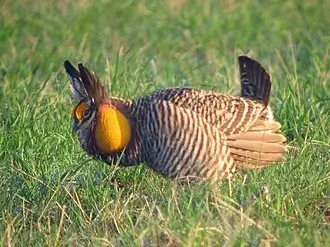
The greater prairie-chicken wasformally describedin 1758 by the Swedish naturalistCarl Linnaeusin thetenth editionof hisSystema Naturaeunder thebinomial nameTetrao cupido.[6][7]Linnaeus based his account on the "Le Cocq de bois d'Amerique" that had been described and illustrated by the English naturalistMark Catesbyin his bookThe Natural History of Carolina, Florida and the Bahama Islands. Catesby had seen greater prairie-chickens in 1743 at the home of theEarl of Wilmingtonin the then village ofChiswick,7mi (11km)west of London. The Earl believed that that his birds had come from North America but did not know from where.[8]Linnaeus specified thetype localityasVirginiabut this has been changed toPennsylvaniaby theAmerican Ornithologists' Union.[9]The specific epithetcupidowas chosen as the erectile neck feathers were thought to resemble the wings ofCupid.[10]The greater prairie-chicken is now placed together with thesharp-tailed grouseand thelesser prairie-chickenin the genusTympanuchusthat was introduced in 1841 by the German zoologistConstantin Gloger.[11] Threesubspeciesare recognised:[11][12] Adults of both sexes are medium to large chicken-like birds, stocky with round wings. They have short tails which are typically rounded. Adult males have orange comb-like feathers over their eyes and dark, elongated head feathers that can be raised or lain along neck. They also possess a circular, un-feathered neck patch which can be inflated while displaying; this, like their comb feathers, is also orange. As with many other bird species, the adult females have shorter head feathers and also lack the male's yellow comb and orange neck patch. Adults are about43cm (17in)long, and weigh between700–1,200g (25–42oz).[13]The greater prairie-chicken has a wingspan range of69.5–72.5cm (27.4–28.5in).[14] Conservation Of Subspecies: The Attwater's prairie chicken is one of the most endangered endemic species of the United States, its biggest threats are habitat loss caused byindustrialisationand natural disasters such asHurricane Harvey.[3]Captive-breeding programmes have been established at theFossil Rim Wildlife Center,Abilene Zoo,Caldwell Zoo,Houston Zoo, andNASA.[29] There were many conservation efforts to save the heath hen. The biggest threats towards the subspecies were overhunting due to perceived overabundance, predation frominvasive speciessuch asferal cats, and natural disasters. As early as 1791, bills were passed to protect the species but were poorly enforced.[30]By 1870, the heath hen was extirpated from mainland North America, leaving arelict populationof 300 individuals onMartha's Vineyard. In 1908 the "Heath Hen Reserve" (Now theManuel F. Correllus State Forest) was established as a last ditch effort to save the remaining birds. By late 1928, only one male individual remained, Booming Ben, theendlingof the subspecies.[31]Booming Ben was last seen in March 1932, with his disappearance marking the extinction of his subspecies. There is an ongoing project to potentiallyrevivethe heath hen throughgenome editingand reintroduce it to Martha's Vineyard. The project is carried out by American non-profit,Revive & Restore.[32] Sexual Behavior: Greater prairie-chickens do notmigrate. They are territorial birds and often defend theirbooming grounds. These booming grounds are the area in which they perform their displays in hopes of attracting females. Their displays consist of inflating air sacs located on the side of their neck and snapping their tails. These booming grounds usually have very short or no vegetation. The male prairie-chickens stay on this ground displaying for almost two months. The breeding season usually begins in the United States starting in late March and throughout April. During this time the males establish booming sites where they display for the females. The one or two most dominant males can obtain 90% of mating opportunities.[citation needed]Due to their now small populations andhabitat fragmentationthe greater prairie-chickens often undergo inbreeding causing observableinbreeding depression: with fewer offspring and a decreased survival rate within these limited offspring further aiding their population decrease. After mating has taken place, the females move about one mile from the booming grounds and begin to build theirnests. Hens lay between 5 and 17eggsper clutch and the eggs take between 23 and 24 days to hatch. There are between five and 10 young per brood.[36]The young are raised by the female andfledgein one to four weeks, are completely independent by the tenth to twelfth week, and reach sexual maturity by age one (Ammann, 1957). A study of female greater prairie-chickens in Kansas found that their survival rates were 1.6 to 2.0 times higher during the non-breeding season compared to the breeding season; this was due to heavy predation during nesting and brood-rearing.[37]One problem facing prairie-chickens is competition with thering-necked pheasants. Pheasants lay their eggs in prairie-chicken nests. The pheasant eggs hatch first; this causes the prairie-chickens to leave the nest thinking that the young have hatched. In reality, prairie-chicken eggs do not hatch and the young usually die due to lack ofincubation.
Habitat & Range
The greater prairie-chicken prefers undisturbedprairieand was originally found intallgrass prairies. It can tolerate agricultural land mixed with prairie, but sparser population density is found in areas that are more agricultural. Its diet consists primarily of seeds andfruit, but during the summer it also eats green plants andinsectssuch as grasshoppers, crickets, and beetles.[15]This species was once widespread all across theoak savannaand tall grass prairieecosystem.
Hunting Season
No open season currently; check with ODWC for any limited draw opportunities
Frequently Asked Questions
Regulations for hunting Greater prairie-chicken in Oklahoma
Greater prairie-chicken populations in Oklahoma have declined significantly and there is currently no open hunting season. The species is managed under ODWC's Prairie Chicken Management Plan. Hunters should check with ODWC for any limited permit opportunities.
When is Greater prairie-chicken hunting season in Oklahoma?
No open season currently; check with ODWC for any limited draw opportunities
What's another name for Greater prairie-chicken?
Greater prairie-chicken is also known as Pinnated grouse, Prairie grouse in Oklahoma.
References
| State | Category | Directory | Subcategory | Content | Source |
|---|---|---|---|---|---|
| Oklahoma | Hunting | Regulations | Season Dates | No open season currently; check with ODWC for any limited draw opportunities | Link |
| Oklahoma | Hunting | Regulations | Regulations | Greater prairie-chicken populations in Oklahoma have declined significantly and there is currently no open hunting seaso | Link |