Also known as: Woodchuck, Whistlepig
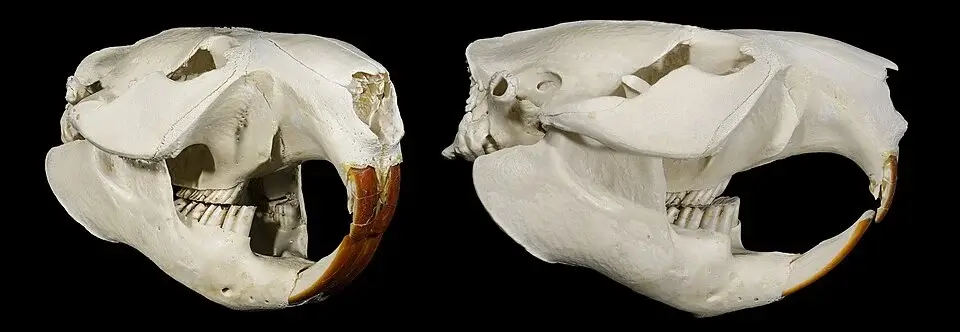
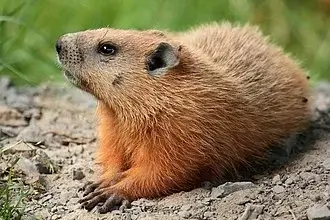
The groundhog is the largestsciuridin its geographical range, excluding its presence inBritish Columbiawhere its range may be comparable to that of its somewhat larger cousin, thehoary marmot. Adults may measure from41.8 to 68.5cm (16+7⁄16to26+15⁄16in)in total length, including a tail of9.5 to 18.7cm (3+3⁄4to7+3⁄8in).[7][21][22]Weights of adult groundhogs typically fall between2 and 6.3kg (4lb 7oz and 13lb 14oz).[22][23][24] Male groundhogs are slightly larger than females on average and, like all marmots, they are considerably heavier during autumn (when engaged inautumn hyperphagia) than when they emerge from hibernation in spring. Adult males average year-around weight3.83kg (8lb 7oz), with spring to fall average weights of3.1 to 5.07kg (6lb 13oz to 11lb 3oz)while females average3.53kg (7lb 13oz), with spring to fall averages of3.08 to 4.8kg (6lb 13oz to 10lb 9oz).[7][25]Seasonal weight changes reflectcircannualdeposition and use of fat. Groundhogs attain progressively higher weights each year for the first two or three years, after which weight plateaus.[7] Groundhogs have fourincisors, which grow1.5 millimetres (1⁄16in)per week. Constant usage wears them down by about that much each week.[26]Unlike the incisors of many other rodents, the incisors of groundhogs are white to ivory-white.[27][18]:20Groundhogs are well-adapted for digging, with powerful, short legs and broad, long claws. The groundhog's tail is shorter than that of other Sciuridae—only about one-fourth of body length. Burrows: Groundhogs are excellent burrowers, using burrows for sleeping, rearing young, andhibernating. Groundhog burrows usually have two to five entrances, providing groundhogs their primary means of escape from predators. The volume of earth removed from groundhog burrows in one study averaged6 cubic feet (0.17m3)per den. The longest burrow measured24 feet (7.3m)in addition to two short side galleries.[18]:108–109 Though groundhogs are the most solitary of the marmots, several individuals may occupy the same burrow. Burrows can pose a serious threat to agricultural and residential development by damaging farm machinery and even undermining building foundations.[33]In a June 7, 2009, Humane Society of the United States article, "How to Humanely Chuck a Woodchuck Out of Your Yard" by John Griffin, director of Humane Wildlife Services, stated you would have to have a lot of woodchucks working over a lot of years to create tunnel systems that would pose any risk to a structure.[citation needed] The burrow is used for safety, retreat in bad weather, hibernating, sleeping, mating, and nursery. In addition to the nest, there is an excrement chamber. The hibernation or nest chamber is lined with dead leaves and dried grasses.[42]The nest chamber may be about twenty inches to three feet (51–91cm) below ground surface. It is about16 inches (41cm)wide and14 inches (36cm)high. There are typically two burrow openings or holes. One is the main entrance, the other a spy hole. Description of the length of the burrow often includes side galleries. Excluding side galleries, Schoonmaker reports the longest was24 feet (7.3m), and the average length of eleven dens was14 feet (4.3m).[18]:104–105W. H. Fisher investigated nine burrows, finding the deepest point49 inches (120cm)down. The longest, including side galleries, was47ft 11.5in (14.62m).[14]:306Numbers of burrows per individual groundhog decrease withurbanization.[43][failed verification] Bachman mentioned when young groundhogs are a few months old, they prepare for separation, digging a number of holes in the area of their early home. Some of these holes were only a few feet deep and never occupied, but the numerous burrows gave the impression that groundhogs live in communities.[14]:318 Abandoned groundhog burrows benefit many other species by providing shelter. They are used bycottontail rabbits,raccoons,foxes,river otters,eastern chipmunks, and a wide variety of small mammals, snakes, and birds.[44] Hibernation: Groundhogs are one of the few species that enter into truehibernation, and often build a separate "winter burrow" for this purpose. This burrow is usually in a wooded or brushy area and is dug below thefrost lineand remains at a stable temperature well above freezing during the winter months. In most areas, groundhogs hibernate from October to March or April, but in more temperate areas, they may hibernate as little as three months.[45]Groundhogs hibernate longer in northern latitudes than southern latitudes.[46][47]To survive the winter, they are at their maximum weight shortly before entering hibernation.[48]When the groundhog enters hibernation, there is a drop in body temperature to as low as35 degrees Fahrenheit (2°C), heart rate falls to 4–10 beats per minute and breathing rate falls to one breath every six minutes.[49]During hibernation, they experience periods of torpor and arousal.[50]Hibernating woodchucks lose as much as half their body weight by February.[51]They emerge from hibernation with some remaining body fat to live on until the warmer spring weather produces abundant plant materials for food.[48]Males emerge from hibernation before females.[52][18]:50Groundhogs are mostlydiurnaland are often active early in the morning or late afternoon.[53] Health And Mortality: In the wild, groundhogs can live up to six years with two or three being the average life expectancy. In captivity, groundhogs reportedly live up to 14 years. Human development often leaves vacant space nearsecondary forests, which are indigenous to groundhogs, which ensures that groundhogs in well-developed areas are nearly free of predators other thanhumans(through various forms of pest control orvehicular incursion) or mid-to-large sizeddogs.[55] Occasionally, woodchucks may suffer fromparasitism, and a woodchuck may die from infestation or from bacteria transmitted byvectors.[56]In areas of intensive agriculture and the dairying regions of the state of Wisconsin, particularly in southern areas, the woodchuck had been almost extirpated by 1950.[57]:124Jackson (1961) suggested that exaggerated reports of damage done by the woodchuck led to excessive culling, substantially reducing its numbers in the state. In some areas woodchucks are importantgame animalsand are killed regularly for sport, food, or fur. In Kentucky, an estimated 267,500 specimens were taken annually from 1964 to 1971.[58]Woodchucks had protected status in the state of Wisconsin[59]until 2017.[60]Woodchuck numbers appear to have decreased in Illinois.[61] Natural Predators: Wild predators of adult groundhogs in most of eastern North America includecoyotes,badgers,[62]bobcats, andfoxes(largelyred fox). Many of these predators are successful stealth stalkers that catch groundhogs by surprise before they can escape to their burrows; badgers likely hunt them by digging them out from their burrows. Coyotes in particular are sizable enough to overpower any groundhog with the latter being the third most significant prey species per a statewide study inPennsylvania.[63][64][65][66][67][68] Large predators such as thegray wolfandeastern cougarare likelyextirpatedin the east but still may hunt groundhogs on occasion inCanada.[69][70]Golden eaglescan also prey on adult groundhogs, but seldom occur in the same range or in the same habitats as this marmot. Likewise,great horned owlscan reportedly, per Bent (1938), prey upon groundhogs but rarely do so, given the temporal differences in their behaviors.[71][72] Young groundhogs (usually those less than a couple months in age) may also be taken by theAmerican mink, and perhaps other smallmustelids,cats,timber rattlesnakes, andhawks.Red-tailed hawkscan take groundhogs at least of up to the size of yearling juveniles andnorthern goshawkscan take them up to perhaps young adulthood in the spring.[7][22][73][74][75] Beyond their large size, groundhogs have several successfulanti-predatorbehaviors, such as concealing their burrows under trees in the winter months[76]and scaling trees to escape a threat.[58] Relationship With Humans: Both their diet and their habit of burrowing make groundhogs a serious source of nuisance around farms and gardens. They will eat many commonly grown vegetables, and extensive burrowing can undermine building foundations.[33] Very often, the dens of groundhogs provide homes for other animals, includingskunks,red foxes, andcottontail rabbits. Foxes and skunks feed uponfield mice,grasshoppers,beetles, and other creatures that destroy farm crops. In aiding these animals, the groundhog can also indirectly help the farmer. In addition to providing homes for itself and other animals, the groundhog aids in soil improvement by bringingsubsoilto the surface. The groundhog is also a valuablegame animaland is considered a difficult sport when hunted in a fair manner.[18]:129–131In some parts of the U.S., they have historically been eaten, and in some places are still considered a delicacy.[77][78] A report in 1883 by the New Hampshire Legislative Woodchuck Committee describes the groundhog's objectionable character:[14]:328[79] The woodchuck, despite its deformities both of mind and body, possesses some of the amenities of a higher civilization. It cleans its face after the manner of the squirrels, and licks its fur after the manner of a cat. Your committee is too wise, however, to be deceived by this purely superficial observation of better habits. Contemporaneous with the ark, the woodchuck has not made any material progress in social science, and it is now too late to reform the wayward sinner. The average age of the woodchuck is too long to please your committee.... The woodchuck is not only a nuisance, but also a bore. It burrows beneath the soil, and then chuckles to see a mowing machine, man and all, slump into one of these holes and disappear.... Groundhogs may be raised in captivity, but their aggressive nature can pose problems. Doug Schwartz, a zookeeper and groundhog trainer at theStaten Island Zoo, has been quoted as saying "They're known for their aggression, so you're starting from a hard place. His natural impulse is tokill 'em all and let God sort 'em out. You have to work to produce the sweet and cuddly."[80]Groundhogs cared for inwildlife rehabilitationthat survive but cannot be returned to the wild may remain with their caregivers and become educational ambassadors.[81][82][83] In the United States and Canada, the yearlyGroundhog Daycelebration on February 2 has given the groundhog recognition and popularity. The most popularly known of these groundhogs arePunxsutawney Phil,Buckeye Chuck,Wiarton Willie,Shubenacadie Sam, Jimmy the Groundhog,Dunkirk Dave, andStaten Island Chuckkept as part of Groundhog Day festivities inPunxsutawney, Pennsylvania;Marion, Ohio;Wiarton, Ontario;Shubenacadie, Nova Scotia;Sun Prairie, Wisconsin;Dunkirk, New York; andStaten Islandrespectively. The 1993 comedy filmGroundhog Dayreferences several events related to Groundhog Day, and portrays both Punxsutawney Phil himself, and the annual Groundhog Day ceremony. FamousSoutherngroundhogs includeGeneral Beauregard Lee, based atDauset Trails Nature CenteroutsideAtlanta, Georgia.[84] Groundhogs are used in medical research onhepatitis B–inducedliver cancer. A percentage of the woodchuck population is infected with thewoodchuck hepatitis virus(WHV), which is similar to human hepatitisB virus. Humans cannot contract hepatitis from woodchucks with WHV, but the virus and its effects on the liver make the woodchuck the best available animal for the study of viral hepatitis in humans. The only other animal model for hepatitisB virus studies is thechimpanzee, an endangered species.[85]Woodchucks are also used in biomedical research investigatingmetabolic function,obesity,energy balance, theendocrine system,reproduction,neurology,cardiovascular disease,cerebrovascular disease, andneoplastic disease.[86]Researching the hibernation patterns of groundhogs may lead to benefits for humans, including the ability to lower a patient's heart rate during complicated surgical procedures.[87] Groundhog burrows have revealed at least twoarchaeological sites, theUfferman Sitein the U.S. state ofOhio[88]andMeadowcroft RockshelterinPennsylvania. Archaeologists have neverexcavatedthe Ufferman Site, but the activities of local groundhogs have revealed numerousartifacts. They favor the loose soil of theeskerwhere the site lies, and their burrow digging has brought many objects to the surface: human and animal bones, pottery, and bits of stone.[88]Woodchuck remains were found in the Indian mounds atAztalan, Jefferson County, Wisconsin.[57]:124 Robert Frost's poem "A Drumlin Woodchuck" uses the imagery of a groundhog dug into a small ridge as ametaphorfor his emotionalreticence.[89]
Habitat & Range
The groundhog dwells in lowland habitats, unlike other marmots that live in rocky and mountainous areas.Marmota monaxhas a wide geographic range. The groundhog prefers open country and the edges of woodland, being rarely found far from a burrow entrance.[28]It can typically be found in small woodlots, low-elevation forests, fields and pastures, and hedgerows. It constructs dens in well-drained soil, and most groundhogs have summer and winter dens. Human activity has increased food access and abundance, allowingM. monaxto thrive.[29]
Life History
W.J. Schoonmaker reports that groundhogs may hide when they see, smell, or hear an observer.[18]:41–43Marmot researcher Ken Armitage states that the social biology of the groundhog is poorly studied.[30]Despite their heavy-bodied appearance, groundhogs are accomplished swimmers and occasionally climb trees when escaping predators or when they want to survey their surroundings.[31]They prefer to retreat to their burrows when threatened; if the burrow is invaded, the groundhog tenaciously defends itself with its two largeincisorsand front claws. Groundhogs are generallyagonisticand territorial toward each other and may skirmish to establish dominance.[32][18]:93Outside their burrow, individuals are alert when not actively feeding. It is common to see one or more nearly motionless individuals standing erect on their hind feet watching for danger. When alarmed, they use a high-pitched whistle to warn the rest of the colony, hence the name "whistle-pig".[33][34]Groundhogs may squeal when fighting, seriously injured, or caught by a predator.[34]Other vocalizations include low barks and a sound produced by grinding their teeth.[34]David P. Barashwrote that he witnessed only two occasions of upright play-fighting among woodchucks and that the upright posture of play-fighting involves sustained physical contact between individuals that may require a degree of social tolerance virtually unknown inM. monax. Alternatively, upright play-fighting may be a part of the woodchuck's behavioral repertoire that rarely is shown because of physical spacing and/or low social tolerance.[35]:97 Mostlyherbivorous, groundhogs eat primarily wild grasses and other vegetation, including berries, bark, leaves, and agricultural crops, when available.[32][36]In early spring,dandelionandcoltsfootare important groundhog food items. Some additional foods includesheep sorrel,timothy-grass,buttercup,persicaria,agrimony, red and blackraspberries,mulberries,buckwheat,plantain,wild lettuce,alfalfa, and all varieties ofclover. Groundhogs also occasionally eat small animals, such asgrubs,grasshoppers,snails, and even bird eggs and baby birds, but are not asomnivorousas many otherSciuridae.[36][37] An adult groundhog can eat more than1lb (0.45kg)of vegetation daily.[38]In early June, woodchucks'metabolismslows, and while their food intake decreases, their weight increases by as much as 100% as they produce fat deposits to sustain them during hibernation and late winter.[39]Instead of storing food, groundhogs stuff themselves to survive the winter without eating.[40]Thought not to drink water, groundhogs are reported to obtain needed liquids from the juices of edible plants, aided by their sprinkling with rain or dew.[18]:85[41][14]:308 Groundhogs are considered the mostsolitaryof themarmot species. They live in aggregations, and their social organization also varies acrosspopulations. Groundhogs do not form stable, long-term pair bonds, and duringmating seasonmale-female interactions are limited tocopulation. Groundhogs inOhio, however, have been observed to have different social organization than groundhogs elsewhere, with adult males and females associating with each other throughout the year and often from year to year.[6][7]Usually groundhogsbreedin their second year, but a small proportion may breed in their first. Thebreeding seasonextends from early March to mid- or late April, after hibernation. Woodchucks arepolygynous[29]but only alpine and woodchuck marmot females have been shown to mate with multiple males.[6]A mated pair remains in the same den throughout the 31- to 32-daygestation period.[54]As birth of the young approaches in April or May, the male leaves the den. One litter is produced annually. Female woodchucks give birth to one to nine offspring, with most litters ranging between 3 and 5 pups.[29]Groundhog mothers introduce their young to the wild once their fur is grown in and they can see. At this time, if at all, the father groundhog comes back to the family.[14]:316By the end of August, the family breaks up; or at least, the larger number scatter, to burrow on their own.[14]:318
Hunting Season
Year-round (not a regulated game species)
Frequently Asked Questions
Regulations for hunting Groundhog in Oklahoma
Groundhogs (woodchucks) are not a regulated game species in Oklahoma and may be taken year-round. They are considered a nuisance species and may be controlled without a hunting license when causing damage.
When is Groundhog hunting season in Oklahoma?
Year-round (not a regulated game species)
What's another name for Groundhog?
Groundhog is also known as Woodchuck, Whistlepig in Oklahoma.
References
| State | Category | Directory | Subcategory | Content | Source |
|---|---|---|---|---|---|
| Oklahoma | Hunting | Regulations | Season Dates | Year-round (not a regulated game species) | Link |
| Oklahoma | Hunting | Regulations | Regulations | Groundhogs (woodchucks) are not a regulated game species in Oklahoma and may be taken year-round. They are considered a | Link |