Also known as: Greenhead, Mallard duck
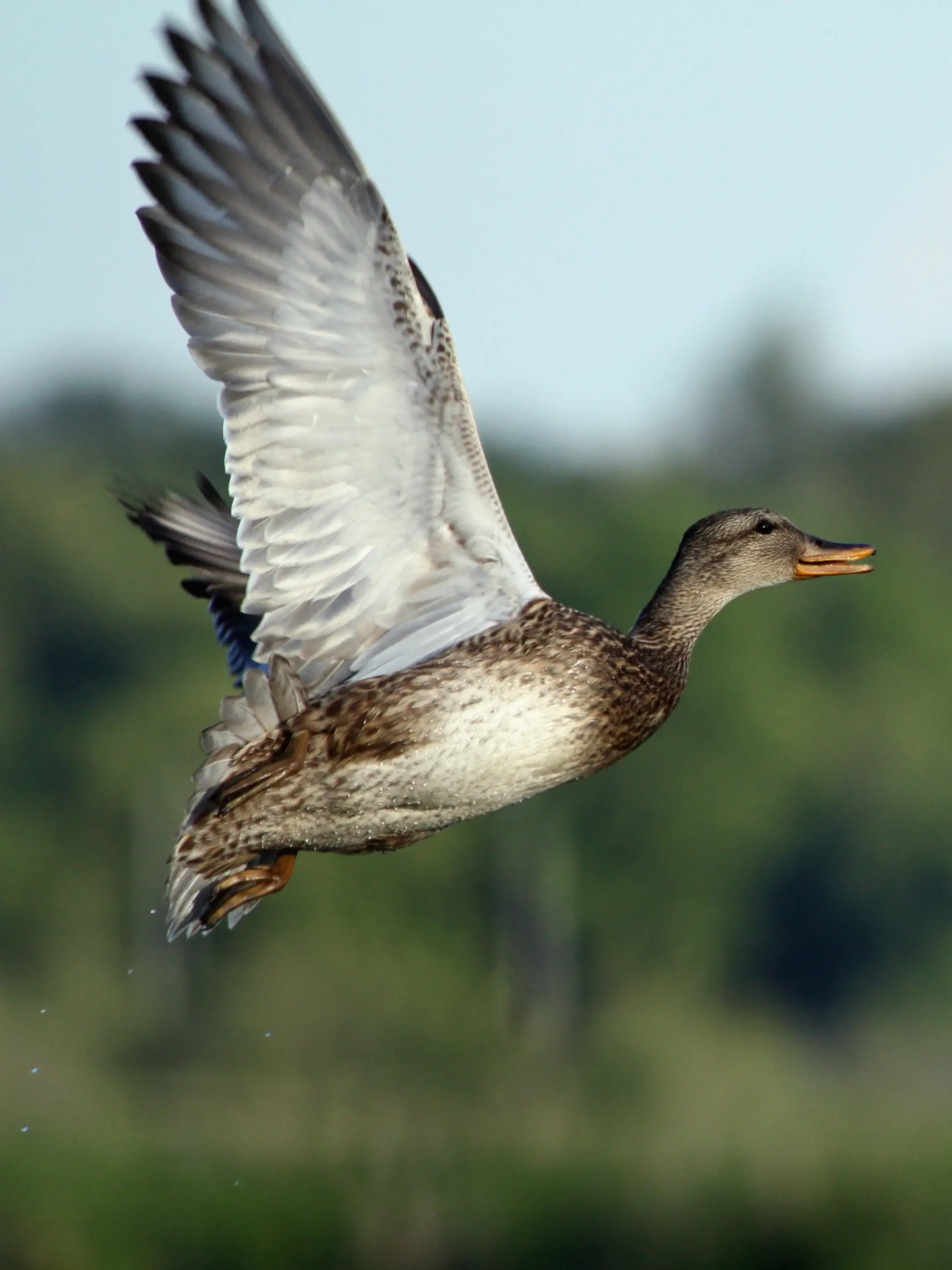
Mallard: Familiar by many when noticing the male’s gleaming, iridescent-green head is the mallard duck. With their long and hefty bodies, wide bills, and tail that rides out of the water’s surface, they are an ideal definition of a “dabbling duck”—tipping their bodies forward in the water to reach submerged underwater plants, almost never diving. Male mallards have a dark, iconic green head, black tail-curl and bright yellow bill. They have a soft, gray body with a brown breast and darker rear. Both females and juveniles are mottled brown with an orange-brown bill, and all mallards feature a white-bordered blue "speculum" patch on their wings. At the end of the breeding season, they shed their flight feathers and molt into an “eclipse” plumage that makes them a bit harder to identify. Both female and male adults average in length of 20-26 inches, weight of 35-46 ounces, and a wingspan of 32-37 inches. Oklahoma is part of the wintering range for this duck species as well as other waterfowl from November to January though is considered a suitable location for mallards year-round. Mallards thrive in numerous wetland habitats, natural or artificial, but have a liking for freshwater areas during all seasons. From ponds and marshes to roadside ditches and grain fields, these ducks call these places home throughout their 5-10 year—17-27 year even—lifespan. Female ducks typically lay around nine eggs per clutch with the nest success rate being less than 20%. Hens often attempt to renest if their initial nest fails due to predation or other factors. A social duck, mallards are adaptable to urban areas and flock with other groups of mallards and other dabbling duck species. A majority of the pairs form before the start of breeding season during the fall time or early winter. Mallard courtship behaviors vary in displays, including rhythmic head-bobbing, grunt-whistling and males pulling their wings and tails up to show off their purple-blue secondaries while compressing their body. Up and ready to leave the nest within 13-16 hours after being newly hatched are the fuzzy, down-covered ducklings. Mallards have a wide range of food they eat such as aquatic invertebrates and vegetation and vary diets during different times of the year. This change in nutritional needs can lead the ducks to seeking out specific habitats to find the most suitable food source. Feeding on plants during the winter serve as a great source of carbohydrates, whereas eating invertebrates is preferred during the nesting/rearing stage. Mallards may be found mostly eating or resting in about every wetland. It is a spectacle to observe their courtship behaviors by finding a group of them actively moving about. At up to 55 mph, this fast flier can be spotted overhead as they migrate. Look for them while fishing at a lake, strolling through city parks, or even relaxing in your own backyard at times! Familiar by many when noticing the male’s gleaming, iridescent-green head is the mallard duck. With their long and hefty bodies, wide bills, and tail that rides out of the water’s surface, they are an ideal definition of a “dabbling duck”—tipping their bodies forward in the water to reach submerged underwater plants, almost never diving. Male mallards have a dark, iconic green head, black tail-curl and bright yellow bill. They have a soft, gray body with a brown breast and darker rear. Both females and juveniles are mottled brown with an orange-brown bill, and all mallards feature a white-bordered blue "speculum" patch on their wings. At the end of the breeding season, they shed their flight feathers and molt into an “eclipse” plumage that makes them a bit harder to identify. Both female and male adults average in length of 20-26 inches, weight of 35-46 ounces, and a wingspan of 32-37 inches. Oklahoma is part of the wintering range for this duck species as well as other waterfowl from November to January though is considered a suitable location for mallards year-round. Mallards thrive in numerous wetland habitats, natural or artificial, but have a liking for freshwater areas during all seasons. From ponds and marshes to roadside ditches and grain fields, these ducks call these places home throughout their 5-10 year—17-27 year even—lifespan. Female ducks typically lay around nine eggs per clutch with the nest success rate being less than 20%. Hens often attempt to renest if their initial nest fails due to predation or other factors. A social duck, mallards are adaptable to urban areas and flock with other groups of mallards and other dabbling duck species. A majority of the pairs form before the start of breeding season during the fall time or early winter. Mallard courtship behaviors vary in displays, including rhythmic head-bobbing, grunt-whistling and males pulling their wings and tails up to show off their purple-blue secondaries while compressing their body. Up and ready to leave the nest within 13-16 hours after being newly hatched are the fuzzy, down-covered ducklings. Mallards have a wide range of food they eat such as aquatic invertebrates and vegetation and vary diets during different times of the year. This change in nutritional needs can lead the ducks to seeking out specific habitats to find the most suitable food source. Feeding on plants during the winter serve as a great source of carbohydrates, whereas eating invertebrates is preferred during the nesting/rearing stage. Mallards may be found mostly eating or resting in about every wetland. It is a spectacle to observe their courtship behaviors by finding a group of them actively moving about. At up to 55 mph, this fast flier can be spotted overhead as they migrate. Look for them while fishing at a lake, strolling through city parks, or even relaxing in your own backyard at times! Familiar by many when noticing the male’s gleaming, iridescent-green head is the mallard duck. With their long and hefty bodies, wide bills, and tail that rides out of the water’s surface, they are an ideal definition of a “dabbling duck”—tipping their bodies forward in the water to reach submerged underwater plants, almost never diving. Male mallards have a dark, iconic green head, black tail-curl and bright yellow bill. They have a soft, gray body with a brown breast and darker rear. Both females and juveniles are mottled brown with an orange-brown bill, and all mallards feature a white-bordered blue "speculum" patch on their wings. At the end of the breeding season, they shed their flight feathers and molt into an “eclipse” plumage that makes them a bit harder to identify. Both female and male adults average in length of 20-26 inches, weight of 35-46 ounces, and a wingspan of 32-37 inches. Oklahoma is part of the wintering range for this duck species as well as other waterfowl from November to January though is considered a suitable location for mallards year-round. Mallards thrive in numerous wetland habitats, natural or artificial, but have a liking for freshwater areas during all seasons. From ponds and marshes to roadside ditches and grain fields, these ducks call these places home throughout their 5-10 year—17-27 year even—lifespan. Female ducks typically lay around nine eggs per clutch with the nest success rate being less than 20%. Hens often attempt to renest if their initial nest fails due to predation or other factors. A social duck, mallards are adaptable to urban areas and flock with other groups of mallards and other dabbling duck species. A majority of the pairs form before the start of breeding season during the fall time or early winter. Mallard courtship behaviors vary in displays, including rhythmic head-bobbing, grunt-whistling and males pulling their wings and tails up to show off their purple-blue secondaries while compressing their body. Up and ready to leave the nest within 13-16 hours after being newly hatched are the fuzzy, down-covered ducklings. Mallards have a wide range of food they eat such as aquatic invertebrates and vegetation and vary diets during different times of the year. This change in nutritional needs can lead the ducks to seeking out specific habitats to find the most suitable food source. Feeding on plants during the winter serve as a great source of carbohydrates, whereas eating invertebrates is preferred during the nesting/rearing stage. Mallards may be found mostly eating or resting in about every wetland. It is a spectacle to observe their courtship behaviors by finding a group of them actively moving about. At up to 55 mph, this fast flier can be spotted overhead as they migrate. Look for them while fishing at a lake, strolling through city parks, or even relaxing in your own backyard at times! Familiar by many when noticing the male’s gleaming, iridescent-green head is the mallard duck. With their long and hefty bodies, wide bills, and tail that rides out of the water’s surface, they are an ideal definition of a “dabbling duck”—tipping their bodies forward in the water to reach submerged underwater plants, almost never diving. Male mallards have a dark, iconic green head, black tail-curl and bright yellow bill. They have a soft, gray body with a brown breast and darker rear. Both females and juveniles are mottled brown with an orange-brown bill, and all mallards feature a white-bordered blue "speculum" patch on their wings. At the end of the breeding season, they shed their flight feathers and molt into an “eclipse” plumage that makes them a bit harder to identify. Both female and male adults average in length of 20-26 inches, weight of 35-46 ounces, and a wingspan of 32-37 inches. Oklahoma is part of the wintering range for this duck species as well as other waterfowl from November to January though is considered a suitable location for mallards year-round. Mallards thrive in numerous wetland habitats, natural or artificial, but have a liking for freshwater areas during all seasons. From ponds and marshes to roadside ditches and grain fields, these ducks call these places home throughout their 5-10 year—17-27 year even—lifespan. Female ducks typically lay around nine eggs per clutch with the nest success rate being less than 20%. Hens often attempt to renest if their initial nest fails due to predation or other factors. A social duck, mallards are adaptable to urban areas and flock with other groups of mallards and other dabbling duck species. A majority of the pairs form before the start of breeding season during the fall time or early winter. Mallard courtship behaviors vary in displays, including rhythmic head-bobbing, grunt-whistling and males pulling their wings and tails up to show off their purple-blue secondaries while compressing their body. Up and ready to leave the nest within 13-16 hours after being newly hatched are the fuzzy, down-covered ducklings. Mallards have a wide range of food they eat such as aquatic invertebrates and vegetation and vary diets during different times of the year. This change in nutritional needs can lead the ducks to seeking out specific habitats to find the most suitable food source. Feeding on plants during the winter serve as a great source of carbohydrates, whereas eating invertebrates is preferred during the nesting/rearing stage. Mallards may be found mostly eating or resting in about every wetland. It is a spectacle to observe their courtship behaviors by finding a group of them actively moving about. At up to 55 mph, this fast flier can be spotted overhead as they migrate. Look for them while fishing at a lake, strolling through city parks, or even relaxing in your own backyard at times! Familiar by many when noticing the male’s gleaming, iridescent-green head is the mallard duck. With their long and hefty bodies, wide bills, and tail that rides out of the water’s surface, they are an ideal definition of a “dabbling duck”—tipping their bodies forward in the water to reach submerged underwater plants, almost never diving. Male mallards have a dark, iconic green head, black tail-curl and bright yellow bill. They have a soft, gray body with a brown breast and darker rear. Both females and juveniles are mottled brown with an orange-brown bill, and all mallards feature a white-bordered blue "speculum" patch on their wings. At the end of the breeding season, they shed their flight feathers and molt into an “eclipse” plumage that makes them a bit harder to identify. Both female and male adults average in length of 20-26 inches, weight of 35-46 ounces, and a wingspan of 32-37 inches. Oklahoma is part of the wintering range for this duck species as well as other waterfowl from November to January though is considered a suitable location for mallards year-round. Mallards thrive in numerous wetland habitats, natural or artificial, but have a liking for freshwater areas during all seasons. From ponds and marshes to roadside ditches and grain fields, these ducks call these places home throughout their 5-10 year—17-27 year even—lifespan. Female ducks typically lay around nine eggs per clutch with the nest success rate being less than 20%. Hens often attempt to renest if their initial nest fails due to predation or other factors. A social duck, mallards are adaptable to urban areas and flock with other groups of mallards and other dabbling duck species. A majority of the pairs form before the start of breeding season during the fall time or early winter. Mallard courtship behaviors vary in displays, including rhythmic head-bobbing, grunt-whistling and males pulling their wings and tails up to show off their purple-blue secondaries while compressing their body. Up and ready to leave the nest within 13-16 hours after being newly hatched are the fuzzy, down-covered ducklings. Mallards have a wide range of food they eat such as aquatic invertebrates and vegetation and vary diets during different times of the year. This change in nutritional needs can lead the ducks to seeking out specific habitats to find the most suitable food source. Feeding on plants during the winter serve as a great source of carbohydrates, whereas eating invertebrates is preferred during the nesting/rearing stage. Mallards may be found mostly eating or resting in about every wetland. It is a spectacle to observe their courtship behaviors by finding a group of them actively moving about. At up to 55 mph, this fast flier can be spotted overhead as they migrate. Look for them while fishing at a lake, strolling through city parks, or even relaxing in your own backyard at times! Familiar by many when noticing the male’s gleaming, iridescent-green head is the mallard duck. With their long and hefty bodies, wide bills, and tail that rides out of the water’s surface, they are an ideal definition of a “dabbling duck”—tipping their bodies forward in the water to reach submerged underwater plants, almost never diving. Male mallards have a dark, iconic green head, black tail-curl and bright yellow bill. They have a soft, gray body with a brown breast and darker rear. Both females and juveniles are mottled brown with an orange-brown bill, and all mallards feature a white-bordered blue "speculum" patch on their wings. At the end of the breeding season, they shed their flight feathers and molt into an “eclipse” plumage that makes them a bit harder to identify. Familiar by many when noticing the male’s gleaming, iridescent-green head is the mallard duck. With their long and hefty bodies, wide bills, and tail that rides out of the water’s surface, they are an ideal definition of a “dabbling duck”—tipping their bodies forward in the water to reach submerged underwater plants, almost never diving. Male mallards have a dark, iconic green head, black tail-curl and bright yellow bill. They have a soft, gray body with a brown breast and darker rear. Both females and juveniles are mottled brown with an orange-brown bill, and all mallards feature a white-bordered blue "speculum" patch on their wings. At the end of the breeding season, they shed their flight feathers and molt into an “eclipse” plumage that makes them a bit harder to identify. Familiar by many when noticing the male’s gleaming, iridescent-green head is the mallard duck. With their long and hefty bodies, wide bills, and tail that rides out of the water’s surface, they are an ideal definition of a “dabbling duck”—tipping their bodies forward in the water to reach submerged underwater plants, almost never diving. Male mallards have a dark, iconic green head, black tail-curl and bright yellow bill. They have a soft, gray body with a brown breast and darker rear. Both females and juveniles are mottled brown with an orange-brown bill, and all mallards feature a white-bordered blue "speculum" patch on their wings. At the end of the breeding season, they shed their flight feathers and molt into an “eclipse” plumage that makes them a bit harder to identify. Familiar by many when noticing the male’s gleaming, iridescent-green head is the mallard duck. With their long and hefty bodies, wide bills, and tail that rides out of the water’s surface, they are an ideal definition of a “dabbling duck”—tipping their bodies forward in the water to reach submerged underwater plants, almost never diving. Male mallards have a dark, iconic green head, black tail-curl and bright yellow bill. They have a soft, gray body with a brown breast and darker rear. Both females and juveniles are mottled brown with an orange-brown bill, and all mallards feature a white-bordered blue "speculum" patch on their wings. At the end of the breeding season, they shed their flight feathers and molt into an “eclipse” plumage that makes them a bit harder to identify. Both female and male adults average in length of 20-26 inches, weight of 35-46 ounces, and a wingspan of 32-37 inches. Size: Both female and male adults average in length of 20-26 inches, weight of 35-46 ounces, and a wingspan of 32-37 inches. Both female and male adults average in length of 20-26 inches, weight of 35-46 ounces, and a wingspan of 32-37 inches. Both female and male adults average in length of 20-26 inches, weight of 35-46 ounces, and a wingspan of 32-37 inches. Oklahoma is part of the wintering range for this duck species as well as other waterfowl from November to January though is considered a suitable location for mallards year-round. Mallards thrive in numerous wetland habitats, natural or artificial, but have a liking for freshwater areas during all seasons. From ponds and marshes to roadside ditches and grain fields, these ducks call these places home throughout their 5-10 year—17-27 year even—lifespan. Female ducks typically lay around nine eggs per clutch with the nest success rate being less than 20%. Hens often attempt to renest if their initial nest fails due to predation or other factors. Mallards may be found mostly eating or resting in about every wetland. It is a spectacle to observe their courtship behaviors by finding a group of them actively moving about. At up to 55 mph, this fast flier can be spotted overhead as they migrate. Look for them while fishing at a lake, strolling through city parks, or even relaxing in your own backyard at times! Mallards may be found mostly eating or resting in about every wetland. It is a spectacle to observe their courtship behaviors by finding a group of them actively moving about. At up to 55 mph, this fast flier can be spotted overhead as they migrate. Look for them while fishing at a lake, strolling through city parks, or even relaxing in your own backyard at times! Mallards may be found mostly eating or resting in about every wetland. It is a spectacle to observe their courtship behaviors by finding a group of them actively moving about. At up to 55 mph, this fast flier can be spotted overhead as they migrate. Look for them while fishing at a lake, strolling through city parks, or even relaxing in your own backyard at times!
Habitat & Range
Oklahoma is part of the wintering range for this duck species as well as other waterfowl from November to January though is considered a suitable location for mallards year-round. Mallards thrive in numerous wetland habitats, natural or artificial, but have a liking for freshwater areas during all seasons. From ponds and marshes to roadside ditches and grain fields, these ducks call these places home throughout their 5-10 year—17-27 year even—lifespan. Female ducks typically lay around nine eggs per clutch with the nest success rate being less than 20%. Hens often attempt to renest if their initial nest fails due to predation or other factors. Oklahoma is part of the wintering range for this duck species as well as other waterfowl from November to January though is considered a suitable location for mallards year-round. Mallards thrive in numerous wetland habitats, natural or artificial, but have a liking for freshwater areas during all seasons. From ponds and marshes to roadside ditches and grain fields, these ducks call these places home throughout their 5-10 year—17-27 year even—lifespan. Female ducks typically lay around nine eggs per clutch with the nest success rate being less than 20%. Hens often attempt to renest if their initial nest fails due to predation or other factors. Oklahoma is part of the wintering range for this duck species as well as other waterfowl from November to January though is considered a suitable location for mallards year-round. Mallards thrive in numerous wetland habitats, natural or artificial, but have a liking for freshwater areas during all seasons. From ponds and marshes to roadside ditches and grain fields, these ducks call these places home throughout their 5-10 year—17-27 year even—lifespan. Female ducks typically lay around nine eggs per clutch with the nest success rate being less than 20%. Hens often attempt to renest if their initial nest fails due to predation or other factors. A social duck, mallards are adaptable to urban areas and flock with other groups of mallards and other dabbling duck species. A majority of the pairs form before the start of breeding season during the fall time or early winter. Mallard courtship behaviors vary in displays, including rhythmic head-bobbing, grunt-whistling and males pulling their wings and tails up to show off their purple-blue secondaries while compressing their body. Up and ready to leave the nest within 13-16 hours after being newly hatched are the fuzzy, down-covered ducklings. Mallards have a wide range of food they eat such as aquatic invertebrates and vegetation and vary diets during different times of the year. This change in nutritional needs can lead the ducks to seeking out specific habitats to find the most suitable food source. Feeding on plants during the winter serve as a great source of carbohydrates, whereas eating invertebrates is preferred during the nesting/rearing stage.
Life History
A social duck, mallards are adaptable to urban areas and flock with other groups of mallards and other dabbling duck species. A majority of the pairs form before the start of breeding season during the fall time or early winter. Mallard courtship behaviors vary in displays, including rhythmic head-bobbing, grunt-whistling and males pulling their wings and tails up to show off their purple-blue secondaries while compressing their body. Up and ready to leave the nest within 13-16 hours after being newly hatched are the fuzzy, down-covered ducklings. Mallards have a wide range of food they eat such as aquatic invertebrates and vegetation and vary diets during different times of the year. This change in nutritional needs can lead the ducks to seeking out specific habitats to find the most suitable food source. Feeding on plants during the winter serve as a great source of carbohydrates, whereas eating invertebrates is preferred during the nesting/rearing stage. A social duck, mallards are adaptable to urban areas and flock with other groups of mallards and other dabbling duck species. A majority of the pairs form before the start of breeding season during the fall time or early winter. Mallard courtship behaviors vary in displays, including rhythmic head-bobbing, grunt-whistling and males pulling their wings and tails up to show off their purple-blue secondaries while compressing their body. Up and ready to leave the nest within 13-16 hours after being newly hatched are the fuzzy, down-covered ducklings. Mallards have a wide range of food they eat such as aquatic invertebrates and vegetation and vary diets during different times of the year. This change in nutritional needs can lead the ducks to seeking out specific habitats to find the most suitable food source. Feeding on plants during the winter serve as a great source of carbohydrates, whereas eating invertebrates is preferred during the nesting/rearing stage. A social duck, mallards are adaptable to urban areas and flock with other groups of mallards and other dabbling duck species. A majority of the pairs form before the start of breeding season during the fall time or early winter. Mallard courtship behaviors vary in displays, including rhythmic head-bobbing, grunt-whistling and males pulling their wings and tails up to show off their purple-blue secondaries while compressing their body. Up and ready to leave the nest within 13-16 hours after being newly hatched are the fuzzy, down-covered ducklings. Mallards have a wide range of food they eat such as aquatic invertebrates and vegetation and vary diets during different times of the year. This change in nutritional needs can lead the ducks to seeking out specific habitats to find the most suitable food source. Feeding on plants during the winter serve as a great source of carbohydrates, whereas eating invertebrates is preferred during the nesting/rearing stage. Mallards may be found mostly eating or resting in about every wetland. It is a spectacle to observe their courtship behaviors by finding a group of them actively moving about. At up to 55 mph, this fast flier can be spotted overhead as they migrate. Look for them while fishing at a lake, strolling through city parks, or even relaxing in your own backyard at times!
Hunting Season
Zones 1 & 2: Nov 8–30, Dec 6 – Jan 25. Panhandle: Oct 4 – Jan 7
Frequently Asked Questions
Regulations for hunting Mallard in Oklahoma
Mallard hunting follows Oklahoma's duck season framework. Daily limit is 6 ducks total, with species-specific sub-limits: mallards max 5 (max 2 hens). Shooting hours: 30 minutes before official sunrise to official sunset. Federal duck stamp and HIP permit required. Nontoxic shot mandatory.
What is the best place to hunt mallards in Oklahoma?
Oklahoma offers excellent mallard hunting in the eastern wetlands, central reservoirs, and playa lakes of the Panhandle. Key areas include the Red Slough WMA, Optima Lake, and various public waterfowl areas across the state.
When is Mallard hunting season in Oklahoma?
Zones 1 & 2: Nov 8–30, Dec 6 – Jan 25. Panhandle: Oct 4 – Jan 7
What is the bag limit for Mallard in Oklahoma?
6 ducks total; mallard max 5 (no more than 2 hens); wood duck max 3; pintail max 3; redhead max 2; canvasback max 2; scaup max 1
What's another name for Mallard?
Mallard is also known as Greenhead, Mallard duck in Oklahoma.
References
| State | Category | Directory | Subcategory | Content | Source |
|---|---|---|---|---|---|
| Oklahoma | Hunting | Regulations | Season Dates | Zones 1 & 2: Nov 8–30, Dec 6 – Jan 25. Panhandle: Oct 4 – Jan 7 | Link |
| Oklahoma | Hunting | Regulations | Regulations | Mallard hunting follows Oklahoma's duck season framework. Daily limit is 6 ducks total, with species-specific sub-limits | Link |