Also known as: Black-tailed deer
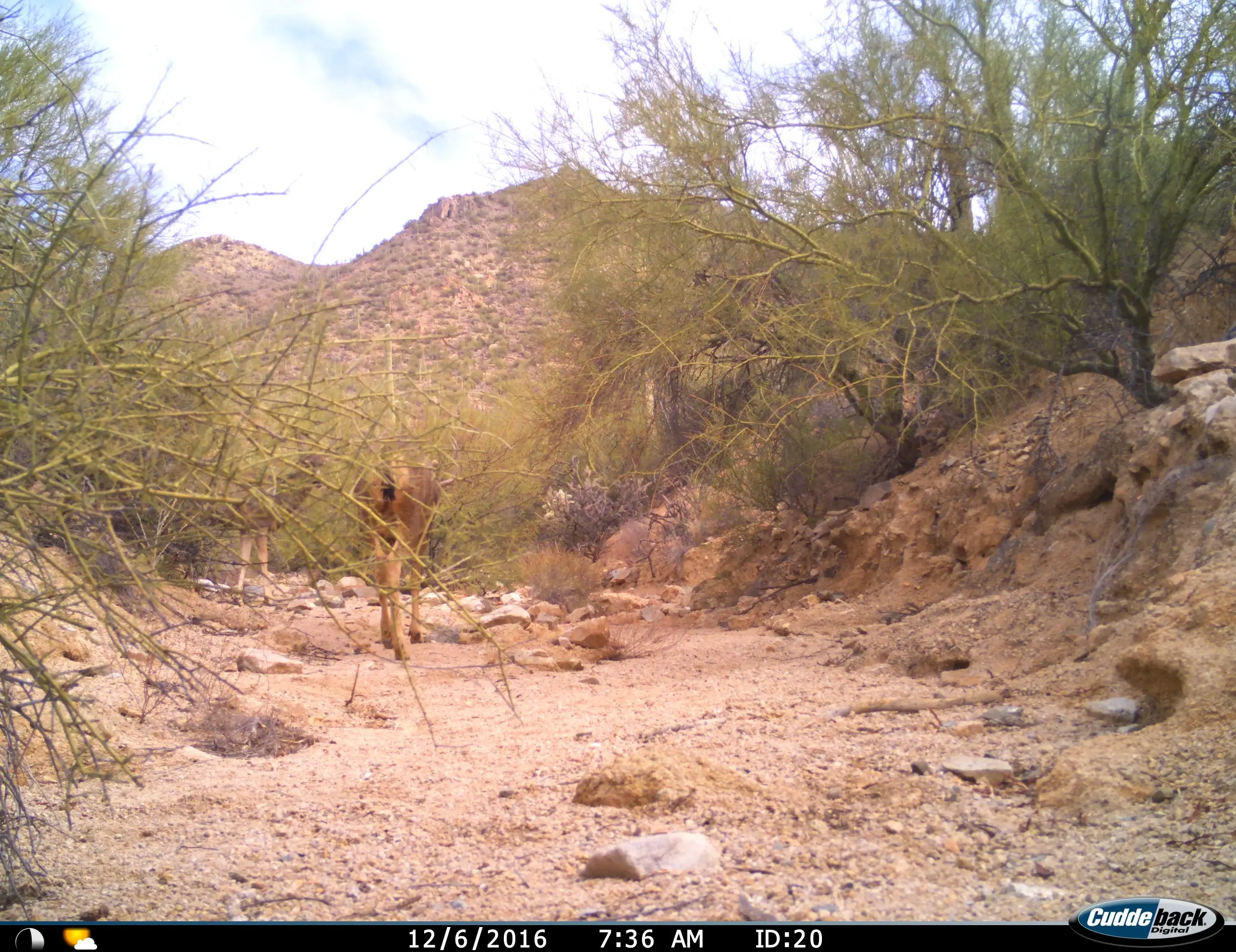
Mule Deer: In the Oklahoma panhandle, among rocky mesas and scrubby junipers, lives the mule deer. This close relative of the whitetail deer is unfamiliar to most Oklahomans, but in the western part of the United States, it is a familiar sight. To anyone accustomed to the graceful stride of the whitetail, a fleeing mule deer must seem quite extraordinary. It bounces up and down as if on powerful springs. This is because the bounding muley strikes downward and backward with all four legs at once, thrusting itself high into the air with each leap. Perhaps landing on all four feet is safer than a gallop on the rocky slopes the mule deer calls home, and the height of its leap allows it to see over the surrounding brush. Large ears make the muley's name a good fit. They are at least twenty-five percent larger than the whitetails. The head of a mature buck carries a second clue to his identity. His upright antlers present a distinct contrast to the whitetail's forward-curving tines. A whitetail's antler consists of a main beam with a series of single points projecting from the beam. The mule deer's antlers are dichotomous: that is, the main beam divides into two branches like a tree, and each branch then divides again. The points often reach impressive lengths. The less fortunate observer who glimpses only the rear view of a fast-disappearing mule deer should still be able to call them by name. The large white "flag" of the whitetail is its alone. The mule deer's tail is narrow, short, and black-tipped, a mere wisp compared to the whitetail's. A mule deer's habits change with the season of the year, according to the kinds of plants that are available. In early spring the deer feast on the new growth of succulent grasses. This is the only time of year when grasses are a significant part of their diet, and even then only for a short period. As summer approaches, a greater variety of plants becomes available, and deer turn primarily to forbs (or weeds) and the foliage of shrubs. After fall frosts, many of the forbs are no longer available, and the deer depend more and more on evergreens and the woody annual growth of shrubs. Winter is the critical period, especially when snow covers the ground. There is less food available then than at any other time, and the nutritional value of the food is much lower. This is why there should never be more deer on an area than the winter range can support. Like its food habits, the activities of the mule deer are governed by the seasons. Mature bucks lead a solitary life during most of the year, except in early fall when small bachelor parties become commonplace. Later, with the onset of cold weather, the bucks become restless and begin to seek the company of does. This signifies the onset of rut and the start of the mating season. The mating season lasts about two months. After mating, the bucks again are solitary, and the family groups return to an orderly existence. In mid-winter, the bucks begin to shed their antlers. With their antlers, they also shed much of their vigor and aggressiveness. They become tolerant of other deer and join mixed groups, partly because of the shortage of winter food. As early spring vegetation appears and the days grow warmer, the deer begin to scatter and move to higher terrain. A doe heavy with fawn may remain alone in the wintering area, especially if it is well watered. Fawns are dropped in late May and early June, seven months after mating. Twins are most common on good range, but young does usually have only one. A doe with a young fawn is especially alert to danger and will put up a strong defense against an enemy. She leaves her fawns hidden separately in foliage while she feeds at some distance, returning at irregular intervals for nursing. If they have wandered, they return in answer to her soft call. The spotted coat which the fawn wears for the first eight to ten weeks of life helps to break up the outline of his body, making him nearly invisible to predators. After a few weeks, the fawn begins eating green food. It is weaned when about four months old. Both whitetail and mule deer do not commonly occupy the same range. The mule deer range is limited to the far western part of the state. Deer Hunting Resources In the Oklahoma panhandle, among rocky mesas and scrubby junipers, lives the mule deer. This close relative of the whitetail deer is unfamiliar to most Oklahomans, but in the western part of the United States, it is a familiar sight. To anyone accustomed to the graceful stride of the whitetail, a fleeing mule deer must seem quite extraordinary. It bounces up and down as if on powerful springs. This is because the bounding muley strikes downward and backward with all four legs at once, thrusting itself high into the air with each leap. Perhaps landing on all four feet is safer than a gallop on the rocky slopes the mule deer calls home, and the height of its leap allows it to see over the surrounding brush. Large ears make the muley's name a good fit. They are at least twenty-five percent larger than the whitetails. The head of a mature buck carries a second clue to his identity. His upright antlers present a distinct contrast to the whitetail's forward-curving tines. A whitetail's antler consists of a main beam with a series of single points projecting from the beam. The mule deer's antlers are dichotomous: that is, the main beam divides into two branches like a tree, and each branch then divides again. The points often reach impressive lengths. The less fortunate observer who glimpses only the rear view of a fast-disappearing mule deer should still be able to call them by name. The large white "flag" of the whitetail is its alone. The mule deer's tail is narrow, short, and black-tipped, a mere wisp compared to the whitetail's. A mule deer's habits change with the season of the year, according to the kinds of plants that are available. In early spring the deer feast on the new growth of succulent grasses. This is the only time of year when grasses are a significant part of their diet, and even then only for a short period. As summer approaches, a greater variety of plants becomes available, and deer turn primarily to forbs (or weeds) and the foliage of shrubs. After fall frosts, many of the forbs are no longer available, and the deer depend more and more on evergreens and the woody annual growth of shrubs. Winter is the critical period, especially when snow covers the ground. There is less food available then than at any other time, and the nutritional value of the food is much lower. This is why there should never be more deer on an area than the winter range can support. Like its food habits, the activities of the mule deer are governed by the seasons. Mature bucks lead a solitary life during most of the year, except in early fall when small bachelor parties become commonplace. Later, with the onset of cold weather, the bucks become restless and begin to seek the company of does. This signifies the onset of rut and the start of the mating season. The mating season lasts about two months. After mating, the bucks again are solitary, and the family groups return to an orderly existence. In mid-winter, the bucks begin to shed their antlers. With their antlers, they also shed much of their vigor and aggressiveness. They become tolerant of other deer and join mixed groups, partly because of the shortage of winter food. As early spring vegetation appears and the days grow warmer, the deer begin to scatter and move to higher terrain. A doe heavy with fawn may remain alone in the wintering area, especially if it is well watered. Fawns are dropped in late May and early June, seven months after mating. Twins are most common on good range, but young does usually have only one. A doe with a young fawn is especially alert to danger and will put up a strong defense against an enemy. She leaves her fawns hidden separately in foliage while she feeds at some distance, returning at irregular intervals for nursing. If they have wandered, they return in answer to her soft call. The spotted coat which the fawn wears for the first eight to ten weeks of life helps to break up the outline of his body, making him nearly invisible to predators. After a few weeks, the fawn begins eating green food. It is weaned when about four months old. Both whitetail and mule deer do not commonly occupy the same range. The mule deer range is limited to the far western part of the state. Deer Hunting Resources In the Oklahoma panhandle, among rocky mesas and scrubby junipers, lives the mule deer. This close relative of the whitetail deer is unfamiliar to most Oklahomans, but in the western part of the United States, it is a familiar sight. To anyone accustomed to the graceful stride of the whitetail, a fleeing mule deer must seem quite extraordinary. It bounces up and down as if on powerful springs. This is because the bounding muley strikes downward and backward with all four legs at once, thrusting itself high into the air with each leap. Perhaps landing on all four feet is safer than a gallop on the rocky slopes the mule deer calls home, and the height of its leap allows it to see over the surrounding brush. Large ears make the muley's name a good fit. They are at least twenty-five percent larger than the whitetails. The head of a mature buck carries a second clue to his identity. His upright antlers present a distinct contrast to the whitetail's forward-curving tines. A whitetail's antler consists of a main beam with a series of single points projecting from the beam. The mule deer's antlers are dichotomous: that is, the main beam divides into two branches like a tree, and each branch then divides again. The points often reach impressive lengths. The less fortunate observer who glimpses only the rear view of a fast-disappearing mule deer should still be able to call them by name. The large white "flag" of the whitetail is its alone. The mule deer's tail is narrow, short, and black-tipped, a mere wisp compared to the whitetail's. A mule deer's habits change with the season of the year, according to the kinds of plants that are available. In early spring the deer feast on the new growth of succulent grasses. This is the only time of year when grasses are a significant part of their diet, and even then only for a short period. As summer approaches, a greater variety of plants becomes available, and deer turn primarily to forbs (or weeds) and the foliage of shrubs. After fall frosts, many of the forbs are no longer available, and the deer depend more and more on evergreens and the woody annual growth of shrubs. Winter is the critical period, especially when snow covers the ground. There is less food available then than at any other time, and the nutritional value of the food is much lower. This is why there should never be more deer on an area than the winter range can support. Like its food habits, the activities of the mule deer are governed by the seasons. Mature bucks lead a solitary life during most of the year, except in early fall when small bachelor parties become commonplace. Later, with the onset of cold weather, the bucks become restless and begin to seek the company of does. This signifies the onset of rut and the start of the mating season. The mating season lasts about two months. After mating, the bucks again are solitary, and the family groups return to an orderly existence. In mid-winter, the bucks begin to shed their antlers. With their antlers, they also shed much of their vigor and aggressiveness. They become tolerant of other deer and join mixed groups, partly because of the shortage of winter food. As early spring vegetation appears and the days grow warmer, the deer begin to scatter and move to higher terrain. A doe heavy with fawn may remain alone in the wintering area, especially if it is well watered. Fawns are dropped in late May and early June, seven months after mating. Twins are most common on good range, but young does usually have only one. A doe with a young fawn is especially alert to danger and will put up a strong defense against an enemy. She leaves her fawns hidden separately in foliage while she feeds at some distance, returning at irregular intervals for nursing. If they have wandered, they return in answer to her soft call. The spotted coat which the fawn wears for the first eight to ten weeks of life helps to break up the outline of his body, making him nearly invisible to predators. After a few weeks, the fawn begins eating green food. It is weaned when about four months old. Both whitetail and mule deer do not commonly occupy the same range. The mule deer range is limited to the far western part of the state. Deer Hunting Resources In the Oklahoma panhandle, among rocky mesas and scrubby junipers, lives the mule deer. This close relative of the whitetail deer is unfamiliar to most Oklahomans, but in the western part of the United States, it is a familiar sight. To anyone accustomed to the graceful stride of the whitetail, a fleeing mule deer must seem quite extraordinary. It bounces up and down as if on powerful springs. This is because the bounding muley strikes downward and backward with all four legs at once, thrusting itself high into the air with each leap. Perhaps landing on all four feet is safer than a gallop on the rocky slopes the mule deer calls home, and the height of its leap allows it to see over the surrounding brush. Large ears make the muley's name a good fit. They are at least twenty-five percent larger than the whitetails. The head of a mature buck carries a second clue to his identity. His upright antlers present a distinct contrast to the whitetail's forward-curving tines. A whitetail's antler consists of a main beam with a series of single points projecting from the beam. The mule deer's antlers are dichotomous: that is, the main beam divides into two branches like a tree, and each branch then divides again. The points often reach impressive lengths. The less fortunate observer who glimpses only the rear view of a fast-disappearing mule deer should still be able to call them by name. The large white "flag" of the whitetail is its alone. The mule deer's tail is narrow, short, and black-tipped, a mere wisp compared to the whitetail's. A mule deer's habits change with the season of the year, according to the kinds of plants that are available. In early spring the deer feast on the new growth of succulent grasses. This is the only time of year when grasses are a significant part of their diet, and even then only for a short period. As summer approaches, a greater variety of plants becomes available, and deer turn primarily to forbs (or weeds) and the foliage of shrubs. After fall frosts, many of the forbs are no longer available, and the deer depend more and more on evergreens and the woody annual growth of shrubs. Winter is the critical period, especially when snow covers the ground. There is less food available then than at any other time, and the nutritional value of the food is much lower. This is why there should never be more deer on an area than the winter range can support. Like its food habits, the activities of the mule deer are governed by the seasons. Mature bucks lead a solitary life during most of the year, except in early fall when small bachelor parties become commonplace. Later, with the onset of cold weather, the bucks become restless and begin to seek the company of does. This signifies the onset of rut and the start of the mating season. The mating season lasts about two months. After mating, the bucks again are solitary, and the family groups return to an orderly existence. In mid-winter, the bucks begin to shed their antlers. With their antlers, they also shed much of their vigor and aggressiveness. They become tolerant of other deer and join mixed groups, partly because of the shortage of winter food. As early spring vegetation appears and the days grow warmer, the deer begin to scatter and move to higher terrain. A doe heavy with fawn may remain alone in the wintering area, especially if it is well watered. Fawns are dropped in late May and early June, seven months after mating. Twins are most common on good range, but young does usually have only one. A doe with a young fawn is especially alert to danger and will put up a strong defense against an enemy. She leaves her fawns hidden separately in foliage while she feeds at some distance, returning at irregular intervals for nursing. If they have wandered, they return in answer to her soft call. The spotted coat which the fawn wears for the first eight to ten weeks of life helps to break up the outline of his body, making him nearly invisible to predators. After a few weeks, the fawn begins eating green food. It is weaned when about four months old. Both whitetail and mule deer do not commonly occupy the same range. The mule deer range is limited to the far western part of the state. Deer Hunting Resources In the Oklahoma panhandle, among rocky mesas and scrubby junipers, lives the mule deer. This close relative of the whitetail deer is unfamiliar to most Oklahomans, but in the western part of the United States, it is a familiar sight. To anyone accustomed to the graceful stride of the whitetail, a fleeing mule deer must seem quite extraordinary. It bounces up and down as if on powerful springs. This is because the bounding muley strikes downward and backward with all four legs at once, thrusting itself high into the air with each leap. Perhaps landing on all four feet is safer than a gallop on the rocky slopes the mule deer calls home, and the height of its leap allows it to see over the surrounding brush. Large ears make the muley's name a good fit. They are at least twenty-five percent larger than the whitetails. The head of a mature buck carries a second clue to his identity. His upright antlers present a distinct contrast to the whitetail's forward-curving tines. A whitetail's antler consists of a main beam with a series of single points projecting from the beam. The mule deer's antlers are dichotomous: that is, the main beam divides into two branches like a tree, and each branch then divides again. The points often reach impressive lengths. The less fortunate observer who glimpses only the rear view of a fast-disappearing mule deer should still be able to call them by name. The large white "flag" of the whitetail is its alone. The mule deer's tail is narrow, short, and black-tipped, a mere wisp compared to the whitetail's. A mule deer's habits change with the season of the year, according to the kinds of plants that are available. In early spring the deer feast on the new growth of succulent grasses. This is the only time of year when grasses are a significant part of their diet, and even then only for a short period. As summer approaches, a greater variety of plants becomes available, and deer turn primarily to forbs (or weeds) and the foliage of shrubs. After fall frosts, many of the forbs are no longer available, and the deer depend more and more on evergreens and the woody annual growth of shrubs. Winter is the critical period, especially when snow covers the ground. There is less food available then than at any other time, and the nutritional value of the food is much lower. This is why there should never be more deer on an area than the winter range can support. Like its food habits, the activities of the mule deer are governed by the seasons. Mature bucks lead a solitary life during most of the year, except in early fall when small bachelor parties become commonplace. Later, with the onset of cold weather, the bucks become restless and begin to seek the company of does. This signifies the onset of rut and the start of the mating season. The mating season lasts about two months. After mating, the bucks again are solitary, and the family groups return to an orderly existence. In mid-winter, the bucks begin to shed their antlers. With their antlers, they also shed much of their vigor and aggressiveness. They become tolerant of other deer and join mixed groups, partly because of the shortage of winter food. As early spring vegetation appears and the days grow warmer, the deer begin to scatter and move to higher terrain. A doe heavy with fawn may remain alone in the wintering area, especially if it is well watered. Fawns are dropped in late May and early June, seven months after mating. Twins are most common on good range, but young does usually have only one. A doe with a young fawn is especially alert to danger and will put up a strong defense against an enemy. She leaves her fawns hidden separately in foliage while she feeds at some distance, returning at irregular intervals for nursing. If they have wandered, they return in answer to her soft call. The spotted coat which the fawn wears for the first eight to ten weeks of life helps to break up the outline of his body, making him nearly invisible to predators. After a few weeks, the fawn begins eating green food. It is weaned when about four months old. Both whitetail and mule deer do not commonly occupy the same range. The mule deer range is limited to the far western part of the state. Deer Hunting Resources In the Oklahoma panhandle, among rocky mesas and scrubby junipers, lives the mule deer. This close relative of the whitetail deer is unfamiliar to most Oklahomans, but in the western part of the United States, it is a familiar sight. To anyone accustomed to the graceful stride of the whitetail, a fleeing mule deer must seem quite extraordinary. It bounces up and down as if on powerful springs. This is because the bounding muley strikes downward and backward with all four legs at once, thrusting itself high into the air with each leap. Perhaps landing on all four feet is safer than a gallop on the rocky slopes the mule deer calls home, and the height of its leap allows it to see over the surrounding brush. Large ears make the muley's name a good fit. They are at least twenty-five percent larger than the whitetails. The head of a mature buck carries a second clue to his identity. His upright antlers present a distinct contrast to the whitetail's forward-curving tines. A whitetail's antler consists of a main beam with a series of single points projecting from the beam. The mule deer's antlers are dichotomous: that is, the main beam divides into two branches like a tree, and each branch then divides again. The points often reach impressive lengths. The less fortunate observer who glimpses only the rear view of a fast-disappearing mule deer should still be able to call them by name. The large white "flag" of the whitetail is its alone. The mule deer's tail is narrow, short, and black-tipped, a mere wisp compared to the whitetail's. In the Oklahoma panhandle, among rocky mesas and scrubby junipers, lives the mule deer. This close relative of the whitetail deer is unfamiliar to most Oklahomans, but in the western part of the United States, it is a familiar sight. To anyone accustomed to the graceful stride of the whitetail, a fleeing mule deer must seem quite extraordinary. It bounces up and down as if on powerful springs. This is because the bounding muley strikes downward and backward with all four legs at once, thrusting itself high into the air with each leap. Perhaps landing on all four feet is safer than a gallop on the rocky slopes the mule deer calls home, and the height of its leap allows it to see over the surrounding brush. Large ears make the muley's name a good fit. They are at least twenty-five percent larger than the whitetails. The head of a mature buck carries a second clue to his identity. His upright antlers present a distinct contrast to the whitetail's forward-curving tines. A whitetail's antler consists of a main beam with a series of single points projecting from the beam. The mule deer's antlers are dichotomous: that is, the main beam divides into two branches like a tree, and each branch then divides again. The points often reach impressive lengths. The less fortunate observer who glimpses only the rear view of a fast-disappearing mule deer should still be able to call them by name. The large white "flag" of the whitetail is its alone. The mule deer's tail is narrow, short, and black-tipped, a mere wisp compared to the whitetail's. In the Oklahoma panhandle, among rocky mesas and scrubby junipers, lives the mule deer. This close relative of the whitetail deer is unfamiliar to most Oklahomans, but in the western part of the United States, it is a familiar sight. To anyone accustomed to the graceful stride of the whitetail, a fleeing mule deer must seem quite extraordinary. It bounces up and down as if on powerful springs. This is because the bounding muley strikes downward and backward with all four legs at once, thrusting itself high into the air with each leap. Perhaps landing on all four feet is safer than a gallop on the rocky slopes the mule deer calls home, and the height of its leap allows it to see over the surrounding brush. Large ears make the muley's name a good fit. They are at least twenty-five percent larger than the whitetails. The head of a mature buck carries a second clue to his identity. His upright antlers present a distinct contrast to the whitetail's forward-curving tines. A whitetail's antler consists of a main beam with a series of single points projecting from the beam. The mule deer's antlers are dichotomous: that is, the main beam divides into two branches like a tree, and each branch then divides again. The points often reach impressive lengths. The less fortunate observer who glimpses only the rear view of a fast-disappearing mule deer should still be able to call them by name. The large white "flag" of the whitetail is its alone. The mule deer's tail is narrow, short, and black-tipped, a mere wisp compared to the whitetail's. In the Oklahoma panhandle, among rocky mesas and scrubby junipers, lives the mule deer. This close relative of the whitetail deer is unfamiliar to most Oklahomans, but in the western part of the United States, it is a familiar sight. To anyone accustomed to the graceful stride of the whitetail, a fleeing mule deer must seem quite extraordinary. It bounces up and down as if on powerful springs. This is because the bounding muley strikes downward and backward with all four legs at once, thrusting itself high into the air with each leap. Perhaps landing on all four feet is safer than a gallop on the rocky slopes the mule deer calls home, and the height of its leap allows it to see over the surrounding brush. Large ears make the muley's name a good fit. They are at least twenty-five percent larger than the whitetails. The head of a mature buck carries a second clue to his identity. His upright antlers present a distinct contrast to the whitetail's forward-curving tines. A whitetail's antler consists of a main beam with a series of single points projecting from the beam. The mule deer's antlers are dichotomous: that is, the main beam divides into two branches like a tree, and each branch then divides again. The points often reach impressive lengths. The less fortunate observer who glimpses only the rear view of a fast-disappearing mule deer should still be able to call them by name. The large white "flag" of the whitetail is its alone. The mule deer's tail is narrow, short, and black-tipped, a mere wisp compared to the whitetail's. A mule deer's habits change with the season of the year, according to the kinds of plants that are available. In early spring the deer feast on the new growth of succulent grasses. This is the only time of year when grasses are a significant part of their diet, and even then only for a short period. As summer approaches, a greater variety of plants becomes available, and deer turn primarily to forbs (or weeds) and the foliage of shrubs. After fall frosts, many of the forbs are no longer available, and the deer depend more and more on evergreens and the woody annual growth of shrubs. Winter is the critical period, especially when snow covers the ground. There is less food available then than at any other time, and the nutritional value of the food is much lower. This is why there should never be more deer on an area than the winter range can support. Both whitetail and mule deer do not commonly occupy the same range. The mule deer range is limited to the far western part of the state. Deer Hunting Resources Both whitetail and mule deer do not commonly occupy the same range. The mule deer range is limited to the far western part of the state. Deer Hunting Resources Both whitetail and mule deer do not commonly occupy the same range. The mule deer range is limited to the far western part of the state. Deer Hunting Resources
Habitat & Range
A mule deer's habits change with the season of the year, according to the kinds of plants that are available. In early spring the deer feast on the new growth of succulent grasses. This is the only time of year when grasses are a significant part of their diet, and even then only for a short period. As summer approaches, a greater variety of plants becomes available, and deer turn primarily to forbs (or weeds) and the foliage of shrubs. After fall frosts, many of the forbs are no longer available, and the deer depend more and more on evergreens and the woody annual growth of shrubs. Winter is the critical period, especially when snow covers the ground. There is less food available then than at any other time, and the nutritional value of the food is much lower. This is why there should never be more deer on an area than the winter range can support. A mule deer's habits change with the season of the year, according to the kinds of plants that are available. In early spring the deer feast on the new growth of succulent grasses. This is the only time of year when grasses are a significant part of their diet, and even then only for a short period. As summer approaches, a greater variety of plants becomes available, and deer turn primarily to forbs (or weeds) and the foliage of shrubs. After fall frosts, many of the forbs are no longer available, and the deer depend more and more on evergreens and the woody annual growth of shrubs. Winter is the critical period, especially when snow covers the ground. There is less food available then than at any other time, and the nutritional value of the food is much lower. This is why there should never be more deer on an area than the winter range can support. A mule deer's habits change with the season of the year, according to the kinds of plants that are available. In early spring the deer feast on the new growth of succulent grasses. This is the only time of year when grasses are a significant part of their diet, and even then only for a short period. As summer approaches, a greater variety of plants becomes available, and deer turn primarily to forbs (or weeds) and the foliage of shrubs. After fall frosts, many of the forbs are no longer available, and the deer depend more and more on evergreens and the woody annual growth of shrubs. Winter is the critical period, especially when snow covers the ground. There is less food available then than at any other time, and the nutritional value of the food is much lower. This is why there should never be more deer on an area than the winter range can support. Like its food habits, the activities of the mule deer are governed by the seasons. Mature bucks lead a solitary life during most of the year, except in early fall when small bachelor parties become commonplace. Later, with the onset of cold weather, the bucks become restless and begin to seek the company of does. This signifies the onset of rut and the start of the mating season. The mating season lasts about two months. After mating, the bucks again are solitary, and the family groups return to an orderly existence. In mid-winter, the bucks begin to shed their antlers. With their antlers, they also shed much of their vigor and aggressiveness. They become tolerant of other deer and join mixed groups, partly because of the shortage of winter food. As early spring vegetation appears and the days grow warmer, the deer begin to scatter and move to higher terrain. A doe heavy with fawn may remain alone in the wintering area, especially if it is well watered. Fawns are dropped in late May and early June, seven months after mating. Twins are most common on good range, but young does usually have only one. A doe with a young fawn is especially alert to danger and will put up a strong defense against an enemy. She leaves her fawns hidden separately in foliage while she feeds at some distance, returning at irregular intervals for nursing. If they have wandered, they return in answer to her soft call. The spotted coat which the fawn wears for the first eight to ten weeks of life helps to break up the outline of his body, making him nearly invisible to predators. After a few weeks, the fawn begins eating green food. It is weaned when about four months old.
Life History
Like its food habits, the activities of the mule deer are governed by the seasons. Mature bucks lead a solitary life during most of the year, except in early fall when small bachelor parties become commonplace. Later, with the onset of cold weather, the bucks become restless and begin to seek the company of does. This signifies the onset of rut and the start of the mating season. The mating season lasts about two months. After mating, the bucks again are solitary, and the family groups return to an orderly existence. In mid-winter, the bucks begin to shed their antlers. With their antlers, they also shed much of their vigor and aggressiveness. They become tolerant of other deer and join mixed groups, partly because of the shortage of winter food. As early spring vegetation appears and the days grow warmer, the deer begin to scatter and move to higher terrain. A doe heavy with fawn may remain alone in the wintering area, especially if it is well watered. Fawns are dropped in late May and early June, seven months after mating. Twins are most common on good range, but young does usually have only one. A doe with a young fawn is especially alert to danger and will put up a strong defense against an enemy. She leaves her fawns hidden separately in foliage while she feeds at some distance, returning at irregular intervals for nursing. If they have wandered, they return in answer to her soft call. The spotted coat which the fawn wears for the first eight to ten weeks of life helps to break up the outline of his body, making him nearly invisible to predators. After a few weeks, the fawn begins eating green food. It is weaned when about four months old. Like its food habits, the activities of the mule deer are governed by the seasons. Mature bucks lead a solitary life during most of the year, except in early fall when small bachelor parties become commonplace. Later, with the onset of cold weather, the bucks become restless and begin to seek the company of does. This signifies the onset of rut and the start of the mating season. The mating season lasts about two months. After mating, the bucks again are solitary, and the family groups return to an orderly existence. In mid-winter, the bucks begin to shed their antlers. With their antlers, they also shed much of their vigor and aggressiveness. They become tolerant of other deer and join mixed groups, partly because of the shortage of winter food. As early spring vegetation appears and the days grow warmer, the deer begin to scatter and move to higher terrain. A doe heavy with fawn may remain alone in the wintering area, especially if it is well watered. Fawns are dropped in late May and early June, seven months after mating. Twins are most common on good range, but young does usually have only one. A doe with a young fawn is especially alert to danger and will put up a strong defense against an enemy. She leaves her fawns hidden separately in foliage while she feeds at some distance, returning at irregular intervals for nursing. If they have wandered, they return in answer to her soft call. The spotted coat which the fawn wears for the first eight to ten weeks of life helps to break up the outline of his body, making him nearly invisible to predators. After a few weeks, the fawn begins eating green food. It is weaned when about four months old. Like its food habits, the activities of the mule deer are governed by the seasons. Mature bucks lead a solitary life during most of the year, except in early fall when small bachelor parties become commonplace. Later, with the onset of cold weather, the bucks become restless and begin to seek the company of does. This signifies the onset of rut and the start of the mating season. The mating season lasts about two months. After mating, the bucks again are solitary, and the family groups return to an orderly existence. In mid-winter, the bucks begin to shed their antlers. With their antlers, they also shed much of their vigor and aggressiveness. They become tolerant of other deer and join mixed groups, partly because of the shortage of winter food. As early spring vegetation appears and the days grow warmer, the deer begin to scatter and move to higher terrain. A doe heavy with fawn may remain alone in the wintering area, especially if it is well watered. Fawns are dropped in late May and early June, seven months after mating. Twins are most common on good range, but young does usually have only one. A doe with a young fawn is especially alert to danger and will put up a strong defense against an enemy. She leaves her fawns hidden separately in foliage while she feeds at some distance, returning at irregular intervals for nursing. If they have wandered, they return in answer to her soft call. The spotted coat which the fawn wears for the first eight to ten weeks of life helps to break up the outline of his body, making him nearly invisible to predators. After a few weeks, the fawn begins eating green food. It is weaned when about four months old. Both whitetail and mule deer do not commonly occupy the same range. The mule deer range is limited to the far western part of the state. Deer Hunting Resources
Hunting Season
Same as white-tailed deer seasons: Archery Oct 1 – Jan 15; Youth Gun Oct 16–18; Muzzleloader Oct 24 – Nov 1; Gun Nov 21 – Dec 6
Frequently Asked Questions
Regulations for hunting Mule Deer in Oklahoma
Mule deer in Oklahoma are restricted to the Panhandle region. They follow the same season framework as white-tailed deer, but antlerless mule deer harvest is strictly prohibited in all zones. Combined limit is 6 deer total (max 2 antlered). Archery: Oct 1 – Jan 15; Youth Gun: Oct 16–18; Muzzleloader: Oct 24 – Nov 1; Gun: Nov 21 – Dec 6. Hunters must check zone-specific regulations.
When is Mule Deer hunting season in Oklahoma?
Same as white-tailed deer seasons: Archery Oct 1 – Jan 15; Youth Gun Oct 16–18; Muzzleloader Oct 24 – Nov 1; Gun Nov 21 – Dec 6
What is the bag limit for Mule Deer in Oklahoma?
6 deer total, no more than 2 antlered; antlerless mule deer harvest prohibited in all zones
What's another name for Mule Deer?
Mule Deer is also known as Black-tailed deer in Oklahoma.
References
| State | Category | Directory | Subcategory | Content | Source |
|---|---|---|---|---|---|
| Oklahoma | Hunting | Regulations | Season Dates | Same as white-tailed deer seasons: Archery Oct 1 – Jan 15; Youth Gun Oct 16–18; Muzzleloader Oct 24 – Nov 1; Gun Nov 21 | Link |
| Oklahoma | Hunting | Regulations | Regulations | Mule deer in Oklahoma are restricted to the Panhandle region. They follow the same season framework as white-tailed deer | Link |