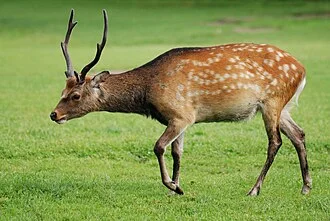
Also known as: Japanese deer, Spotted deer
The sika deer is a member of thegenusCervus, a group of deer also known as the "true" deer, within the larger deerfamily,Cervidae. Formerly, sika were grouped together in this genus with nine other diverse species; these animals have since been found to be genetically different, and reclassified elsewhere under different genera. Currently, deer species within the genusCervusare the sika, thered deer(C. elaphus) of Eurasia and North Africa (introduced in Argentina, Australia, New Zealand), and thewapiti, or elk (C. canadensis), of North America, Siberia, and north-central Asia.[3] DNAevidence indicates that the species formerly placed underCervusare not as closely related as once thought, resulting in the creation of several new genera. The ancestor of allCervusspecies probably originated inCentral Asiaand possibly resembled the sika deer.[4]Members of this genus can crossbreed and producehybridsin areas where they coexist. This includes sika and wapiti; in theScottish Highlands, the interbreeding of nativeScottish red deerwith introduced sika has been deemed a serious threat to the gene pool of the Scottish deer.[5]By comparison, though, an invasive sika deer in the United States cannot reproduce with a North Americanwhite-tailed,mule, orblack-tailed deer, all of which are placed in a separate genus,Odocoileus. Subspecies: Seriousgenetic pollutionhas occurred in manypopulations, especially in China, so the status of manysubspeciesremains unclear.[1]The status ofC. n. hortulorumis particularly uncertain and might in fact be of mixed origin, hence it is not listed here. The sika deer is one of the few deer species that does not lose its spots upon reaching maturity. Spot patterns vary with region. The mainland subspecies have larger and more obvious spots, in contrast to theTaiwaneseand Japanese subspecies, whose spots are nearly invisible. Many introduced populations are from Japan, so they also lack significant spots. The color of thepelageranges from mahogany to black, and white individuals are also known. During winter, the coat becomes darker and shaggier and the spots less prominent, and a mane forms on the back of the males' necks.[9]They are medium-sizedherbivores, though they show notable size variation across their several subspecies and considerablesexual dimorphism, with males invariably much larger than females. They can vary from50 to 110cm (20 to 45in)tall at the shoulder and from95 to 180cm (35 to 70in)in head-and-body length. The tail measures about7.5–13cm (3–5in)long. The largest subspecies is theManchurian sika deer(C. n. mantchuricus), in which males commonly weigh about68–109kg (150–240lb)and females weigh45–50kg (100–110lb), with large stags scaling up to160kg (350lb), althoughYezo sika deerbulls weighing up to170 or 200kg (370 or 440lb)have been recorded.[10][11]On the other end of the size spectrum, in the Japanese sika deer (C. n. nippon), males weigh40–70kg (90–150lb)and females weigh30–40kg (70–90lb).[12][13]All sikas are compact and dainty-legged, with short, trim, wedge-shaped heads and a boisterous disposition. When alarmed, they often display a distinctive flaredrump, much like the Americanelk. Sika stags have stout, uprightantlerswith an extra buttress up from the browtineand a very thick wall. A forward-facing intermediate tine breaks the line to the top, which is usually forked. Occasionally, sika antlers develop some palmation (flat areas). Females carry a pair of distinctive black bumps on the forehead.Antlerscan range from28 to 45cm (11 to17+1⁄2in)to more than80cm (30in), depending on the subspecies. Stags also have distinctive manes during their mating period (rut). These deer have well-developed metatarsal and preorbitalglands. The volatile components of these glands were examined from a free-ranging female. The metatarsal gland contained 35 compounds: long-chaincarboxylic acids, straight-chainaldehydes, long-chain alcohols, aketone, and cholesterol.[14]The components of thepreorbital glandwere C14 through C18 straight and branched-chain fatty acids.[15] Population: Sika deer inhabit temperate and subtropical woodlands, often inareas suitable for farmingand other human exploitation. Their range encompasses some of the most densely populated areas in the world, where forests were cleared hundreds of years ago. Their population status varies significantly in different countries. Although the species as a whole is thriving, it is endangered and extinct in many areas. Japan has by far the largest native sika population in the world. The population was estimated to be between 170,000 and 330,000 individuals in 1993,[23]mainly due to recent conservation efforts and the extinction of its main predator, theJapanese wolf(Canis lupus hodophilax), over a century ago. Without its main predator, the population of sika exploded and it is now overpopulated in many areas, posing a threat to both forests and farmlands. Efforts are now being made to control its population instead of conserving it. None of its subspecies isendangeredexcept theKerama deer(C. n. keramae) on the tinyKerama Islands.[2]In 2015,Japanese Ministry of the Environmentestimated the population at 3,080,000 in Japan, includingHokkaido.[24] China used to have the largest population of sika, but thousands of years of hunting and habitat loss have reduced the population to less than 1,000.[1]Of the five subspecies in China, theNorth China sika deer(C. n. mandarinus) is believed to be extinct in the wild since the 1930s; theShanxi sika deer(C. n. grassianus) has not been seen in the wild since the 1980s and is also believed to be extinct in the wild. The status ofManchurian sika deerin China is unclear, though it is also believed to be extinct, and the sightings there are actually feral populations. TheSouth China sika deer(C. n. kopschi) andSichuan sika deer(C. n. sichuanicus) are the only subspecies known to remain in the wild in China. The former exists in fragmented populations of around 300 in southeast China, while the latter is found in a single population of over 400. The feral population is likely to be much higher than the wild, though most of them are descended from domesticated sikas of mixed subspecies. All of the subspecies are present in captivity, but a lack of suitable habitats and government efforts prevent their reintroduction. TheFormosan sika deer(C. n. taioanus) has been extinct in the wild for almost two decades before individuals from zoos were introduced toKenting National Park; the population now numbers 200. Reintroduction programs are also under way inVietnam, where theVietnamese sika deer(C. n. pseudaxis) isextinctor nearly so. Russiahas a relatively large and stable population of 8,500–9,000 individuals of the Manchurian subspecies,[1]but this is limited to a small area inPrimorsky Krai. Small populations might exist inNorth Korea, but the political situation makes investigation impossible. The original stock of sika deer inSouth Koreais extinct, with only captive stock raised for medicine from other parts of the deer's habitat. But in June 2020, an unmanned camera located a doe and fawn which might hold proof for Korea's last native sika deer, although the claim is contested.[25] Introduced Populations: Sika deer have been introduced into a number of other countries, includingEstonia,Latvia,Lithuania,Austria,Belgium,Denmark,France,Germany,Ireland,Netherlands,Norway,Switzerland,Russia,Romania,New Zealand,Australia, thePhilippines(Jolo Island),Poland,Sweden,Finland,Canada, theUnited Kingdom, and theUnited States(inDelaware,Maryland,[26]Oklahoma,Nebraska,[26]Pennsylvania,Wisconsin,Virginia,Indiana,Michigan,[26]Minnesota,Maine,New York,[27][28]Texas,[26]andWyoming). In many cases, they were originally introduced asornamental animalsin parklands, but have established themselves in the wild. OnSpieden Islandin theSan Juan Islandsof Washington, they were introduced as a game animal.[29] In the UK and Ireland, several distinct feral populations now exist, in addition to about 1000 individuals in deer parks.[30]Some of these are in isolated areas, for example on the island ofLundy,[31]but others are contiguous with populations of the nativered deer.[30]Since the two species sometimeshybridize, a serious conservation concern exists.[32]In the United Kingdom, Sika deer are most common inScotland, with scattered smaller populations inEngland- particularlyCumbria,Lancashire,Dorsetand in theNew Forest- andNorthern Ireland. The introduced populations of the United Kingdom are exclusively of the nominate subspeciesC. n. nippon.[33] In research which rated the negative impact of introduced mammals in Europe, the sika deer was found to be among the most damaging to the environment and economy, along with thebrown ratandmuskrat.[34]TheEuropean Unionhas included it in thelist of invasive alien species of Union concernand hence it cannot be imported, bred, transported, commercialized, or intentionally released into the environment in any of its member states.[35][36] In the 1900s,King Edward VIIpresented a pair of sika deer toJohn, the second Baron Montagu of Beaulieu. This pair escaped intoSowleyWood and were the basis of the sika to be found in theNew Foresttoday.[37]They were so prolific, culling had to be introduced in the 1930s to control their numbers.[38] Hunting: Across its original range and in many areas to which it has been introduced, the sika is regarded as a particularly prized and elusivesportsman's quarry. In Britain, Ireland, and mainland Europe, sika display very different survival strategies and escape tactics from theindigenousdeer. They have a marked tendency to use concealment in circumstances when red deer, for example, would flee, and have been seen to squat and lie belly-flat when danger threatens. In theBritish Isles, sika are widely regarded as a serious threat to new and established woodlands, and public and private forestry bodies adopt policies of rigorous year-round culling.[39] The main predators of sika deer includetigers,wolves,[16]leopards, andbrown bears.Lynxandgolden eaglestarget fawns. Velvet Antler: Velvet antler(dried precalcifiedantlers) is a popular ingredient intraditional Chinese medicine, and sika deer were domesticated bydeer farmsin China long ago for the antler trade, along with several other species.[40]InTaiwan, bothFormosan sika deerand Formosansambar deer(Cervus unicolor swinhoei) have been farmed for velvet antlers.Japanis the only country inEast Asiawhere sika deer were not farmed for velvet antlers. Other deer raised for the antler trade wereThorold's deer(Cervus albirostris),central Asian red deer(Cervus hanglu), andAmerican elk(Cervus canadensis). Cultural Significance: InShinto, theShikaDeer is considered a kind of messenger between mortals and thekami.[41]
Habitat & Range
Sika deer are found in thetemperateandsubtropicalforests ofeastern Asia, preferring areas with dense understory and occasional clearings and where snowfall does not exceed10–20cm (4–8in),[20]though in theirnative range, they have been known to frequent areas with a maximum snow depth up to 50cm (19.6in).[21]They tend to forage in patchy clearings of forests.[citation needed]Introduced populations are found in areas with similar habitats to their native ranges, including Western and Central Europe, Eastern United States, andNew Zealand.[22]
Life History
Sika deer can be active throughout the day, though in areas with heavy human disturbance, they tend to benocturnal.Seasonal migrationis known to occur in mountainous areas, such as Japan, with winter ranges being up to700m (2,300ft)lower in elevation than summer ranges. Lifestyles vary between individuals, with some occurring alone, while others are found in single-sex groups. Largeherdsgather in autumn and winter. Males spend most years alone, occasionally forming herds together. Females with fawns only form herds during birthing season.[16]The sika deer is a highly vocal species, with over 10 individual sounds, ranging from soft whistles to loud screams. Sika males are territorial and keepharemsof females during their rut, which peaks from early September through November,[17]but may last well into the winter.Territorysize varies withhabitattype and size of the buck; strong, prime bucks may hold up to2ha (5 acres). Territories are marked by a series of shallow pits or "scrapes", which is digging holes (up to 1.6 m in wide and 0.3 m in deep) with forefeet or antlers,[16]into which the males urinate and from which emanates a strong,muskyodor. Fights between rival males for territorial disputes, which occur by using hooves and antlers,[16]are sometimes fierce and long and may even be fatal. Thegestation periodlasts for seven months. Hinds (does) give birth to a single fawn, weighing4.5 to 7.0kg (10 to 15lb), which is nursed for up to 10 months.[16]The mother hides her fawn in thick undergrowth immediately after giving birth, and the fawn stays very quiet and still while it waits until the mother returns to nurse it. The fawn becomes independent 10 to 12 months after birth,[17][16]and attains sexual maturity at 16 to 18 months in both sexes. The average lifespan is 15 to 18 years in captivity, although one case is recorded as living 25 years and 5 months.[16] The sika deer may interbreed with thered deer, the closest relative; hybrid descendants may have adaptive advantages over purebred relatives.[16] InNara Prefecture, Japan, the deer are also known as "bowing deer", as they have learned to bow their heads before being fed specialshikasenbei(鹿せんべい, called "deer cookies"). Deer also bow their head to signal that they are about toheadbutt, so when a human "bows" to a deer, the deer may take it as a challenge, and will assume the same stance before charging and attempting to headbutt the person. Deer headbutt both for play and to assert dominance, as do goats. Sika deer are found throughout thecity of Naraand its many parks likeNara Parkand temples likeTōdai-ji, as they are considered to be the messengers of theShintogods.[18][19]
Hunting Season
Same as deer seasons: Archery Oct 1 – Jan 15; Youth Gun Oct 16–18; Muzzleloader Oct 24 – Nov 1; Gun Nov 21 – Dec 6
Frequently Asked Questions
Regulations for hunting Sika deer in Oklahoma
Sika deer are an introduced species in Oklahoma and are managed under the same deer season framework. Combined season limit of 6 deer (max 2 antlered) includes all deer species. Check zone-specific regulations for sika deer hunting opportunities.
When is Sika deer hunting season in Oklahoma?
Same as deer seasons: Archery Oct 1 – Jan 15; Youth Gun Oct 16–18; Muzzleloader Oct 24 – Nov 1; Gun Nov 21 – Dec 6
What is the bag limit for Sika deer in Oklahoma?
6 deer total, no more than 2 antlered (counted within combined deer limit)
What's another name for Sika deer?
Sika deer is also known as Japanese deer, Spotted deer in Oklahoma.
References
| State | Category | Directory | Subcategory | Content | Source |
|---|---|---|---|---|---|
| Oklahoma | Hunting | Regulations | Season Dates | Same as deer seasons: Archery Oct 1 – Jan 15; Youth Gun Oct 16–18; Muzzleloader Oct 24 – Nov 1; Gun Nov 21 – Dec 6 | Link |
| Oklahoma | Hunting | Regulations | Regulations | Sika deer are an introduced species in Oklahoma and are managed under the same deer season framework. Combined season li | Link |