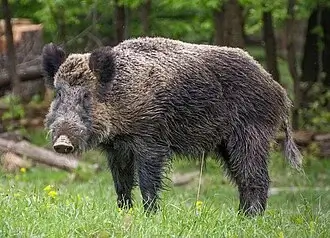
Also known as: Feral hog, Feral swine, Wild pig, Eurasian boar
Terminology: As true wild boars became extinct inGreat Britainbefore the development ofModern English, the same terms are often used for both true wild boar and pigs, especially large or semi-wild ones. TheEnglishboarstems from theOld Englishbār, which is thought to be derived from theWest Germanicbair, of unknown origin.[13]Boaris sometimes used specifically to refer to males, and may also be used to refer to male domesticated pigs, especially breeding males that have not been castrated.[14][15] Sow, the traditional name for a female, again comes from Old English and Germanic; it stems fromProto-Indo-European, and is related to theLatinsusandAncient Greekhus, and more closely to theNew High GermanSau. The young may be calledpigletsorboarlets.[16] The animals' specific namescrofaisLatinfor 'sow'.[17] Hunting: In hunting terminology, boars are given different designations according to their age:[18] Taxonomy And Evolution: MtDNAstudies indicate that the wild boar originated from islands in Southeast Asia such asIndonesiaand thePhilippines, and subsequently spread onto mainland Eurasia and North Africa.[8]The earliest fossil finds of the species come from both Europe and Asia, and date back to theEarly Pleistocene.[19]By the lateVillafranchian,S. scrofalargely displaced the relatedS. strozzii, a large, possibly swamp-adapted suid ancestral to the modernS. verrucosusthroughout the Eurasian mainland, restricting it to insular Asia.[9]Its closest wild relative is thebearded pigofMalaccaand surrounding islands.[4] Subspecies: As of 2005[update], 16 subspecies are recognised, which are divided into four regional groupings:[2] sahariensis(Heim de Balzac, 1937) sardous(Ströbel, 1882) mediterraneus(Ulmansky, 1911)reiseri(Bolkay, 1925) nipponicus(Heude, 1899) Domestication: With the exception of domestic pigs inTimorandPapua New Guinea(which appear to be ofSulawesi warty pigstock), the wild boar is the ancestor of mostpig breeds.[22][43]Archaeological evidence suggests that pigs weredomesticatedfrom wild boar as early as 13,000–12,700BCE in theNear Eastin theTigrisBasin,[44]being managed in the wild in a way similar to the way they are managed by some modern New Guineans.[45]Remains of pigs have been dated to earlier than 11,400BCE inCyprus. Those animals must have been introduced from the mainland, which suggests domestication in the adjacent mainland by then.[46]There was also a separate domestication in China, which took place about 8,000 years ago.[47][48] DNAevidence from sub-fossil remains of teeth and jawbones of Neolithic pigs shows that the first domestic pigs in Europe had been brought from the Near East. This stimulated the domestication of local European wild boars, resulting in a third domestication event with the Near Eastern genes dying out in European pig stock. Modern domesticated pigs have involved complex exchanges, with European domesticated lines being exported in turn to the ancient Near East.[49][50]Historical records indicate that Asian pigs were introduced into Europe during the 18th and early 19th centuries.[47]Domestic pigs tend to have much more developed hindquarters than their wild boar ancestors, to the point where 70% of their body weight is concentrated in the posterior, which is the opposite of wild boar, where most of the muscles are concentrated on the head and shoulders.[51] Synonymous Species: The Heude's pig (Sus bucculentus), also known as the Indochinese warty pig or Vietnam warty pig, was an alleged pig species found inLaosandVietnam. It was virtually unknown and was fearedextinct, until the discovery of a skull from a recently killed individual in theAnnamite Range, Laos, in 1995.[52]Subsequent studies indicated thatSus bucculentuswas not a valid taxon.[53][54][55]As of 2022 the Mammal Diversity Database included it inSus scrofa.[6] The wild boar is a bulky, massively built suid with short and relatively thin legs. The trunk is short and robust, while the hindquarters are comparatively underdeveloped. The region behind the shoulder blades rises into a hump and the neck is short and thick to the point of being nearly immobile. The animal's head is very large, taking up to one-third of the body's entire length.[4]The structure of the head is well suited for digging. The head acts as a plough, while the powerful neck muscles allow the animal to upturn considerable amounts of soil:[56]it is capable of digging8–10cm (3–4in)into frozen ground and can upturn rocks weighing40–50kg (88–110lb).[11]The eyes are small and deep-set and the ears long and broad. The species has well developedcanine teeth, which protrude from the mouths of adult males. The medial hooves are larger and more elongated than the lateral ones and are capable of quick movements.[4]The animal can run at a maximum speed of 40km/h (25mph) and jump at a height of140–150cm (55–59in).[11] Sexual dimorphismis very pronounced in the species, with males being typically 5–10% larger and 20–30% heavier than females. Males also sport a mane running down the back, which is particularly apparent during autumn and winter.[57]The canine teeth are also much more prominent in males and grow throughout life. The upper canines are relatively short and grow sideways early in life, though they gradually curve upwards. The lower canines are much sharper and longer, with the exposed parts measuring10–12cm (3.9–4.7in)in length. In the breeding period, males develop a coating ofsubcutaneous tissue, which may be2–3cm (0.79–1.18in)thick, extending from the shoulder blades to the rump, thus protecting vital organs during fights. Males sport a roughly chicken egg–sized sac of unclear function near the opening of the penis that collects urine and emits a sharp odour.[4] Adult size and weight is largely determined by environmental factors; boars living in arid areas with little productivity tend to attain smaller sizes than their counterparts inhabiting areas with abundant food and water. In most ofEurope, males average75–100kg (165–220lb)in weight,75–80cm (30–31in)in shoulder height and150cm (59in)in body length, whereas females average60–80kg (130–180lb)in weight,70cm (28in)in shoulder height and140cm (55in)in body length. In Europe'sMediterranean regions, males may reach average weights as low as50kg (110lb)and females45kg (99lb), with shoulder heights of63–65cm (25–26in). In the more productive areas ofEastern Europe, males average110–130kg (240–290lb)in weight,95cm (37in)in shoulder height and160cm (63in)in body length, while females weigh95kg (209lb), reach85–90cm (33–35in)in shoulder height, and reach145cm (57in)in body length. InWesternandCentral Europe, the largest males weigh200kg (440lb)and females120kg (260lb). In Northeastern Asia, large males can reachbrown bear-like sizes, weighing270kg (600lb)and measuring110–118cm (43–46in)in shoulder height. Some adult males inPrimorsky KraiandManchuriahave been recorded to weigh300–350kg (660–770lb)and measure125cm (49in)in shoulder height. Adults of this size are generally immune from wolf predation.[58]Such giants are rare in modern times, as past overhunting has prevented animals from attaining their full growth.[4] The winter coat consists of long, coarse bristles underlaid with short brown downy fur. The length of these bristles varies along the body, with the shortest being around the face and limbs and the longest running along the back. These back bristles form the aforementioned mane prominent in males and stand erect when the animal is agitated. Colour is highly variable; specimens aroundLake Balkhashare very lightly coloured, and can even be white, while some boars fromBelarusand Ussuriland can be black. Some subspecies sport a light-coloured patch running backward from the corners of the mouth. Coat colour also varies with age, with piglets having light brown or rusty-brown fur with pale bands extending from the flanks and back.[4] The wild boar produces a number of different sounds which are divided into three categories: Its sense ofsmellis very well developed to the point that the animal is used for drug detection in Germany.[60]Itshearingis also acute, though itseyesightis comparatively weak,[4]lackingcolor vision[60]and being unable to recognise a standing human10–15 metres (33–49ft)away.[11] Pigs are one of four known mammalian taxa which possess mutations in thenicotinic acetylcholine receptorthat protect against snake venom.Mongooses,honey badgers,hedgehogs, and pigs all have modifications to the receptor pocket which prevents thesnake venomα-neurotoxinfrom binding. These represent four separate, independent mutations.[61] Social Behaviour And Life Cycle: Boars are typically social animals, living infemale-dominatedsounders consisting of barren sows and mothers with young led by an old matriarch. Male boars leave their sounder at the age of 8–15 months, while females either remain with their mothers or establish new territories nearby. Subadult males may live in loosely knit groups, while adult and elderly males tend to be solitary outside the breeding season.[10][a] Thebreedingperiod in most areas lasts from November to January, though most mating only lasts a month and a half. Prior to mating, the males develop their subcutaneous armour in preparation for confronting rivals. Thetesticlesdouble in size and the glands secrete a foamy yellowish liquid. Once ready to reproduce, males travel long distances in search of a sounder of sows, eating little on the way. Once a sounder has been located, the male drives off all young animals and persistently chases the sows. At this point, the male fiercely fights potential rivals.[4]A single male can mate with 5–10 sows.[11]By the end of the rut, males are often badly mauled and have lost 20% of their body weight,[4]with bite-induced injuries to the penis being common.[63]Thegestation periodvaries according to the age of the expecting mother. For first-time breeders, it lasts 114–130 days, while it lasts 133–140 days in older sows. Farrowing occurs between March and May, with litter sizes depending on the age and nutrition of the mother. The average litter consists of 4–6 piglets, with the maximum being 10–12.[4][b]The piglets arewhelpedin a nest constructed from twigs, grasses and leaves. Should the mother die prematurely, the piglets are adopted by the other sows in the sounder.[65] Newborn piglets weigh around 600–1,000 grams, lacking underfur and bearing a single milk incisor and canine on each half of the jaw.[4]There is intense competition between the piglets over the most milk-rich nipples, as the best-fed young grow faster and have stronger constitutions.[65]The piglets do not leave the lair for their first week of life. Should the mother be absent, the piglets lie closely pressed to each other. By two weeks of age, the piglets begin accompanying their mother on her journeys. Should danger be detected, the piglets take cover or stand immobile, relying on their camouflage to keep them hidden. The neonatal coat fades after three months, with adult colouration being attained at eight months. Although thelactationperiod lasts 2.5–3.5 months, the piglets begin displaying adult feeding behaviours at the age of 2–3 weeks. Thepermanent dentitionis fully formed by 1–2 years. With the exception of the canines in males, the teeth stop growing during the middle of the fourth year. The canines in old males continue to grow throughout their lives, curving strongly as they age. Sows attainsexual maturityat the age of one year, with males attaining it a year later. However,estrususually first occurs after two years in sows, while males begin participating in the rut after 4–5 years, as they are not permitted to mate by the older males.[4]The maximum lifespan in the wild is 10–14 years, though few specimens survive past 4–5 years.[66]Boars in captivity have lived for 20 years.[11] Habitat And Sheltering: The wild boar inhabits a diverse array ofhabitatsfrom borealtaigastodeserts.[4]In mountainous regions, it can even occupyalpinezones, occurring up to1,900m (6,200ft)in theCarpathians,2,600m (8,500ft)in theCaucasusand up to3,600–4,000m (11,800–13,100ft)in the mountains inCentral AsiaandKazakhstan.[4]In order to survive in a given area, wild boars require a habitat fulfilling three conditions: heavily brushed areas providing shelter from predators, water for drinking and bathing purposes and an absence of regular snowfall.[67] The main habitats favored by boars inEuropearedeciduousandmixed forests, with the most favorable areas consisting of forest composed ofoakandbeechenclosingmarshesandmeadows. In theBiałowieża Forest, the animal's primary habitat consists of well-developedbroad-leavedand mixed forests, along with marshy mixed forests, withconiferousforests and undergrowths being of secondary importance. Forests made up entirely of oak groves and beeches are used only during the fruit-bearing season. This is in contrast to the Caucasian andTranscaucasianmountain areas, where boars will occupy such fruit-bearing forests year-round. In the mountainous areas of theRussian Far East, the species inhabitsnutpinegroves, hilly mixed forests whereMongolian oakandKorean pineare present, swampy mixed taiga and coastal oak forests. InTransbaikalia, boars are restricted to river valleys with nut pine and shrubs. Boars are regularly encountered inpistachiogroves in winter in some areas ofTajikistanandTurkmenistan, while in spring they migrate to open deserts; boar have also colonized deserts in several areas they have been introduced to.[4][67][68] On the islands ofKomodoandRinca, the boar mostly inhabits savanna or open monsoon forests, avoiding heavily forested areas unless pursued by humans.[12]Wild boar are known to be competent swimmers, capable of covering long distances. In 2013, one boar was reported to have completed the11-kilometre (7mi)swim fromFrancetoAlderneyin theChannel Islands. Due to concerns about disease, it was shot and incinerated.[69] Wild boar rest in shelters, which contain insulating material likesprucebranches and dryhay. These resting places are occupied by whole families (though males lie separately) and are often located in the vicinity of streams, in swamp forests and in tall grass or shrub thickets. Boars never defecate in their shelters and will cover themselves with soil and pine needles when irritated by insects.[11] Predators: Piglets are vulnerable to attack from medium-sized felids likeEurasian lynx(Lynx lynx),jungle cats(Felis chaus), andsnow leopards(Panthera uncia), as well as other carnivorans likebrown bears(Ursus arctos) andyellow-throated martens(Martes flavigula).[4] Thewolf(Canis lupus) is the main predator of wild boar throughout most of its range. A single wolf can kill around 50 to 80 boars of differing ages in one year.[4]In Italy[76]and Belarus'Belovezhskaya Pushcha National Park, boars are the wolf's primary prey, despite an abundance of alternative, less powerful ungulates.[76]Wolves are particularly threatening during the winter, when deep snow impedes the boars' movements. In the Baltic regions, heavy snowfall can allow wolves to eliminate boars from an area almost completely. Wolves primarily target piglets and subadults and only rarely attack adult sows. Adult males are usually avoided entirely.[4]Dholes(Cuon alpinus) may also prey on boars, to the point of keeping their numbers down in northwestern Bhutan, despite there being many morecattlein the area.[77] Leopards(Panthera pardus) are predators of wild boar in the Caucasus (particularly Transcaucasia), the Russian Far East, India, China[78]and Iran. In most areas, boars constitute only a small part of the leopard's diet. However, in Iran's Sarigol National Park, boars are the second most frequently targeted prey species aftermouflon(Ovis gmelini), though adult individuals are generally avoided, as they are above the leopard's preferred weight range of10–40kg (22–88lb).[79]This dependence on wild boar is largely due in part to the local leopard subspecies' large size.[80] Boars of all ages were once the primary prey of thetiger(Panthera tigris) in Transcaucasia, Kazakhstan, Middle Asia and the Far East up until the late 19th century. In modern times, tiger numbers are too low to have a limiting effect on boar populations. A single tiger can systematically destroy an entire sounder by preying on its members one by one, before moving on to another sounder. Tigers have been noted to chase boars for longer distances than with other prey. In two rare cases, boars were reported to gore a small tiger and a tigress to death in self-defense.[81]A "large male tiger" died of wounds inflicted by an old wild boar it had killed in "a battle royal" between the two animals.[82]:500 In theAmur region, wild boars are one of the two most important prey species forSiberian tigers, alongside theManchurian wapiti(Cervus canadensis xanthopygus), with the two species collectively comprising roughly 80% of the felid's prey.[83]InSikhote Alin, a tiger can kill 30–34 boars a year.[11]Studies of tigers in India indicate that boars are usually secondary in preference to variouscervidsandbovids,[citation needed]though when boars are targeted, healthy adults are caught more frequently than young and sick specimens.[84] On the islands ofKomodo,RincaandFlores, the boar's main predator is theKomodo dragon(Varanus komodoensis).[12] Reconstructed Range: The species originally occurred inNorth Africaand much ofEurasia; from theBritish IslestoKoreaand theSunda Islands. The northern limit of its range extended from southernScandinaviato southernSiberiaandJapan. Within this range, it was only absent in extremely dry deserts andalpinezones. It was once found in North Africa along theNilevalley up toKhartoumand north of theSahara. The species occurs on a fewIonianandAegean Islands, sometimes swimming between islands.[85]The reconstructed northern boundary of the animal's Asian range ran fromLake Ladoga(at 60°N) through the area ofNovgorodandMoscowinto the southernUrals, where it reached 52°N. From there, the boundary passedIshimand farther east theIrtyshat 56°N. In the easternBaraba steppe(nearNovosibirsk) the boundary turned steep south, encircled theAltai Mountainsand went again eastward including theTannu-Ola MountainsandLake Baikal. From here, the boundary went slightly north of theAmur Rivereastward to its lower reaches at theSea of Okhotsk. OnSakhalin, there are onlyfossilreports of wild boar. The southern boundaries in Europe and Asia were almost invariably identical to the seashores of these continents. It is absent in the dry regions ofMongoliafrom 44 to 46°N southward, in China westward ofSichuanand in India north of theHimalayas. It is absent in the higher elevations of thePamirand theTian Shan, though they do occur in theTarim Basinand on the lower slopes of the Tian Shan.[4] Present Range: In recent centuries, the range of wild boar has changed dramatically, largely due to hunting by humans and more recently because of captive wild boar escaping into the wild. Prior to the 20th century, boar populations had declined in numerous areas, with British populations probably becoming extinct during the 13th century.[86]In the warm period after the ice age, wild boar lived in the southern parts ofSwedenandNorwayand north of Lake Ladoga inKarelia.[87]It was previously thought that the species did not live inFinlandduring prehistory because no prehistoric wild boar bones had been found within the borders of the country.[88][89]It was not until 2013, when a wild boar bone was found inAskola, that the species was found to have lived in Finland more than 8,000 years ago. It is believed, however, that man prevented its establishment by hunting.[90][91]InDenmark, the last boar was shot at the beginning of the 19th century, and by 1900 they were absent in Tunisia and Sudan and large areas of Germany, Austria and Italy. In Russia, they were extirpated in wide areas by the 1930s.[4]The last boar inEgyptreportedly died on 20 December 1912 in theGiza Zoo, with wild populations having disappeared by 1894–1902.Prince Kamal el Dine Husseinattempted to repopulateWadi El Natrunwith boars of Hungarian stock, but they were quickly exterminated by poachers.[92] A revival of boar populations began in the middle of the 20th century. By 1950, wild boar had once again reached their original northern boundary in many parts of their Asiatic range. By 1960, they reachedLeningradand Moscow and by 1975, they were to be found inArkhangelskandAstrakhan. In the 1970s they again occurred in Denmark and Sweden, where captive animals escaped and now survive in the wild. Boars have since spread into Norway and by the 2020s have established breeding populations in the southeast of the country[93]. In England, wild boar populations re-established themselves in the 1990s, after escaping from specialist farms that had imported European stock.[86] Status In Great Britain: By the 11th century, wild boars were apparently already becoming rare in Britain. A 1087 forestry law enacted byWilliam the Conquerorpunished through blinding the unlawful killing of a boar.Charles Iattempted to reintroduce the species into theNew Forest, but this population was exterminated in the 17th century during theEnglish Civil War. Between their medieval extinction and the 1980s, when wild boar farming began, only a handful of captive wild boar, imported from the continent, were present in Britain. Occasional escapes of wild boar from wildlife parks have occurred as early as the 1970s, but since the early 1990s significant populations have re-established themselves after escapes from farms, the number of which has increased as the demand for meat from the species has grown. A 1998MAFF(nowDEFRA) study on wild boar living wild in Britain confirmed the presence of two populations of wild boar living in Britain; one inKent/East Sussexand another inDorset.[86] Another DEFRA report, in February 2008,[94]confirmed the existence of these two sites as 'established breeding areas' and identified a third inGloucestershire/Herefordshire; in theForest of Dean/Ross on Wyearea. A 'new breeding population' was also identified inDevon. There is another significant population inDumfriesandGalloway. Populations estimates were as follows: Population estimates for the Forest of Dean are disputed as, at the time that the DEFRA population estimate was 100, a photo of a boar sounder in the forest near Staunton with over 33 animals visible was published and at about the same time over 30 boar were seen in a field near the original escape location of Weston under Penyard many kilometres or miles away. In early 2010 the Forestry Commission embarked on a cull,[95]with the aim of reducing the boar population from an estimated 150 animals to 100. By August it was stated that efforts were being made to reduce the population from 200 to 90, but that only 25 had been killed.[96]The failure to meet cull targets was confirmed in February 2011.[97] Wild boars have crossed theRiver WyeintoMonmouthshire, Wales. Iolo Williams, the BBC Wales wildlife expert, attempted to film Welsh boar in late 2012.[98]Many other sightings, across the UK, have also been reported.[99]The effects of wild boar on the U.K.'s woodlands were discussed with Ralph Harmer of theForestry Commissionon theBBC Radio'sFarming Todayradio programme in 2011. The programme prompted activist writerGeorge Monbiotto propose a thorough population study, followed by the introduction of permit-controlledculling.[100] In Scotland, wild boar are professionally referred to as 'feral pigs' as the genetics of the established feral populations may come from a mix of both wild boar and domestic pigs.[101]They are now known to be present inDumfries and Gallowayand a number of sites in theHighlands, mainly centred around theLoch Nessarea.[102]They can be killed there legally without a license and are culled by land managers as wild populations appear occasionally.[103]As of 2024[update], an agency that advises the Scottish government estimates that Scotland is home to a few thousand wild boars. Locals around Loch Ness that were interviewed byThe New York Timesbelieved that the boars were becoming an increasingly worse problem, and farmers noted that they had killed and eaten several lambs.[104] Introduction To North America: Wild boars are aninvasive speciesin the Americas, having been introduced by European explorers and settlers in the 16th century to serve as a source of food. Wild boars now cause problems including out-competing native species for food, destroying the nests of ground-nesting species, killing fawns and young domestic livestock, destroying agricultural crops, eating tree seeds and seedlings, destroying native vegetation and wetlands through wallowing, damaging water quality, coming into violent conflict with humans and pets and carrying pig and human diseases includingbrucellosis,trichinosisandpseudorabies. In some jurisdictions, it is illegal to import, breed, release, possess, sell, distribute, trade, transport, hunt, or trap Eurasian boars. Hunting and trapping is done systematically, to increase the chance of eradication and to remove the incentive to illegally release boars, which have mostly been spread deliberately by sport hunters.[105] While domestic pigs, both captive and feral (popularly termed "razorbacks"), have been in North America since the earliest days ofEuropean colonization, pure wild boars were not introduced into the New World until the 19th century. The suids were released into the wild by wealthy landowners as big game animals. The initial introductions took place in fenced enclosures, though several escapes occurred, with the escapees sometimes intermixing with already established feral pig populations. The first of these introductions occurred inNew Hampshirein 1890. Thirteen wild boars from Germany were purchased byAustin CorbinfromCarl Hagenbeckand released intoa9,500-hectare (23,000-acre)game preserveinSullivan County. Several of these boars escaped, though they were quickly hunted down by locals. Two further introductions were made from the original stocking, with several escapes taking place due to breaches in the game preserve's fencing. These escapees have ranged widely, with some specimens having been observed crossing intoVermont.[106] In 1902, 15–20 wild boar from Germany were released into a3,200-hectare (7,900-acre)estate inHamilton County, New York. Several specimens escaped six years later, dispersing into theWilliam C. Whitney Wilderness Area, with their descendants surviving for at least 20 years.[106] The most extensive boar introduction in the US took place in westernNorth Carolinain 1912, when 13 boars of undetermined European origin were released into two fenced enclosures in a game preserve inHooper Bald, Graham County. Most of the specimens remained in the preserve for the next decade, until a large-scale hunt caused the remaining animals to break through their confines and escape. Some of the boars migrated toTennessee, where they intermixed with both free-ranging and feral pigs in the area. In 1924, a dozen Hooper Bald wild pigs were shipped toCaliforniaand released in a property betweenCarmel Valleyand theLos Padres National Forest. These hybrid boar were later used as breeding stock on various private and public lands throughout the state, as well as in other states likeFlorida,Georgia,South Carolina,West VirginiaandMississippi.[106] Several wild boars fromLeon Springsand theSan Antonio,Saint LouisandSan Diego Zooswere released in the Powder Horn Ranch inCalhoun County, Texas, in 1939. These specimens escaped and established themselves in surrounding ranchlands and coastal areas, with some crossing theEspiritu Santo Bayand colonizingMatagorda Island. Descendants of the Powder Horn Ranch boars were later released ontoSan José Islandand the coast ofChalmette, Louisiana.[106] Wild boar of unknown origin were stocked in a ranch in theEdwards Plateauin the 1940s, only to escape during a storm and hybridize with local feral pig populations, later spreading into neighboring counties.[106] Starting in the mid-1980s, several boars purchased from the San Diego Zoo andTierpark Berlinwere released into the United States. A decade later, more specimens from farms inCanadaand Białowieża Forest were let loose. In recent years, wild pig populations have been reported in 44 states within the US, most of which are likely wild boar–feral hog hybrids. Pure wild boar populations may still be present, but are extremely localized.[106] Introduction And Lack Of Control In South America: InSouth America, the European boar is believed to have been introduced for the first time inArgentinaandUruguayaround the 20th century for breeding purposes.[107]InBrazil, the creation of wild boar and hybrids started on a large scale in the mid-1990s. With the invasion of wild boar that crossed the border and enteredRio Grande do Sularound 1989, and the escape and intentional release by several Brazilian breeders in the late 1990s – in response to aIBAMAdecision against the import and breeding of wild boar in 1998 – numerousferalspecies formed a growing population, which progressively advances in Brazilian territory.[108][109] As a form of control for the wild boar population, hunting and killing are allowed forCollectors, Shooters and Hunters(CACs)[110]duly registered by the environmental control agency,IBAMA, which, on the other hand, seeks to encourage the preservation of similar species of nativepeccaries, such as the"queixada"and the"caititu".[111][112][113] Wild boars negatively impact other habitats through the destruction of the environment, or homes of wildlife. When wild boars invade new areas, they adapt to the new area by trampling and rooting, as well as displacing many saplings/nutrients. This causes a decrease in growing of many plants and trees. Water is also affected negatively by wild boars. When wild boars are active in streams, or small pools of water, it causes increased turbidity (excessive silt and particle suspension).[114]In some cases, the fecal coliform concentration increases to dangerous levels because of wild boars. Aquatic wildlife is affected, more prominently fish, and amphibians. Wild boars have caused a great decrease in over 300 animal or plant species, 250 being endangered or threatened.[115] The boars cause many habitats to become less diverse because of their feeding behaviors and predation. Wild boars will dig up eggs of species and eat them, as well as killing other wildlife for food. When these boars compete with other species for resources, they usually come out successful.[116]A study published in the Journal of Experimental Marine Biology and Ecology was conducted on the results of Feral Swine control. Only two years after the control started, the amount of turtle nests jumped from 57 to 143, and the turtle nest predation percent dropped from 74 to 15.[117]They kill and eat deers, lizards, birds, snakes, and more. These boars are called "opportunist omnivores", which means they eat almost anything. This means they can survive almost anywhere. A big surplus of food and the ability to adapt to any new place causes lots of breeding. All of these factors make it difficult to get rid of wild boars.[118] Diseases And Parasites: Wild boars are known to host at least 20 different parasitic worm species, with maximum infections occurring in summer. Young animals are vulnerable tohelminthslikeMetastrongylus, which are consumed by boars through earthworms and cause death by parasitising the lungs. Wild boar also carry parasites known to infect humans, includingGastrodiscoides,Trichinella spiralis,Taenia solium,Balantidium coliandToxoplasma gondii.[119]Wild boar in southern regions are frequently infested withticks(Dermacentor,Rhipicephalus, andHyalomma) andhog lice. The species also suffers from blood-suckingflies, which it escapes by bathing frequently or hiding in dense shrubs.[4] Swine plaguespreads very quickly in wild boar, withepizooticsbeing recorded in Germany, Poland, Hungary, Belarus, the Caucasus, the Far East, Kazakhstan and other regions.Foot-and-mouth diseasecan also take on epidemic proportions in boar populations. The species occasionally, but rarely contractsPasteurellosis,hemorrhagic sepsis,tularemia, andanthrax. Wild boar may on occasion contract swineerysipelasthrough rodents or hog lice and ticks.[4] In Culture: The wild boar features prominently in the cultures ofIndo-Europeanpeople, many of which saw the animal as embodying warrior virtues.[123]Cultures throughout Europe and Asia Minor saw the killing of a boar as proof of one's valor and strength.Neolithichunter gatherersdepicted reliefs of ferocious wild boars on their temple pillars atGöbekli Tepesome 11,600 years ago.[124][125]Virtually all heroes inGreek mythologyfight or kill a boar at one point. ThedemigodHerakles'third labourinvolves the capture of theErymanthian Boar,Theseusslays the wild sowPhaea, and a disguisedOdysseusis recognised by his handmaidenEurycleiaby the scars inflicted on him by a boar during a hunt in his youth.[126]To the mythicalHyperboreans, the boar represented spiritual authority.[120]Several Greek myths use the boar as a symbol of darkness, death and winter.[127]One example is the story of the youthfulAdonis, who is killed by a boar and is permitted byZeusto depart fromHadesonly during the spring and summer period. This theme also occurs inIrishandEgyptian mythology, where the animal is explicitly linked to the month of October, therefore autumn. This association likely arose from aspects of the boar's actual nature. Its dark colour was linked to the night, while its solitary habits, proclivity to consume crops and nocturnal nature were associated with evil.[128]Thefoundation mythofEphesushas the city being built over the site where Prince Androklos ofAthenskilled a boar.[129]Boars were frequently depicted on Greek funerary monuments alongsidelions, representing gallant losers who have finally met their match, as opposed to victorious hunters as lions are. The theme of the doomed, yet valorous boar warrior also occurred inHittiteculture, where it was traditional to sacrifice a boar alongside a dog and a prisoner of war after a military defeat.[126] The boar as a warrior also appears inGermanic cultures, with its image having been frequently engraved on shields and swords. They also feature onGermanic boar helmets, such as theBenty Grange helmet, where it was believed to offer protection to the wearer and has been theorised to have been used in spiritual transformations into swine, similar toberserkers. The boar features heavily in religious practice inGermanic paganismwhere it is closely associated withFreyrand has also been suggested to have been a totemic animal to the Swedes, especially to theYngling royal dynastywho claimed descent from the god.[130] According toTacitus, theBalticAestifeatured boars on their helmets and may have also worn boar masks. The boar and pig were held in particularly high esteem by theCelts, who considered them to be their most important sacred animal. SomeCeltic deitieslinked to boars includeMoccusandVeteris. It has been suggested that some early myths surrounding the Welsh heroCulhwchinvolved the character being the son of a boar god.[126]Nevertheless, the importance of the boar as a culinary item among Celtic tribes may have been exaggerated in popular culture by theAsterixseries, as wild boar bones are rare among Celtic archaeological sites and the few that do occur show no signs of butchery, having probably been used in sacrificial rituals.[131] The boar also appears inVedic mythologyandHindu mythology. A story present in theBrahmanashas the godIndraslaying an avaricious boar, who has stolen the treasure of theasuras, then giving its carcass to the godVishnu, who offered it as a sacrifice to the gods. In the story's retelling in theCharaka Samhita, the boar is described as a form ofPrajapatiand is credited with having raised the Earth from the primeval waters. In theRamayanaand thePuranas, the same boar is portrayed asVaraha, anavatarof Vishnu.[132] InJapanese culture, the boar is widely seen as a fearsome and reckless animal, to the point that several words and expressions inJapanesereferring to recklessness include references to boars. The boar is the last animal of theOriental zodiac, with people born during theyear of the Pigbeing said to embody the boar-like traits of determination and impetuosity. Among Japanese hunters, the boar's courage and defiance is a source of admiration and it is not uncommon for hunters andmountain peopleto name their sons after the animalinoshishi(猪). Boars are also seen as symbols of fertility and prosperity; in some regions, it is thought that boars are drawn to fields owned by families including pregnant women, and hunters with pregnant wives are thought to have greater chances of success when boar hunting. The animal's link to prosperity was illustrated by its inclusion on the¥10 note during theMeiji periodand it was once believed that a man could become wealthy by keeping a clump of boar hair in his wallet.[133] In the folklore of theMongolAltai Uriankhaitribe, the wild boar was associated with the watery underworld, as it was thought that the spirits of the dead entered the animal's head, to be ultimately transported to the water.[134]Prior to the conversion to Islam, theKyrgyz peoplebelieved that they were descended from boars and thus did not eat pork. InBuryatmythology, the forefathers of the Buryats descended from heaven and were nourished by a boar.[135]InChina, the boar is the emblem of theMiao people.[120] The boar (sanglier) is frequently displayed inEnglish,ScottishandWelsh heraldry. As with thelion, the boar is often shown as armed andlangued. As with thebear, Scottish and Welsh heraldry displays the boar's head with the neck cropped, unlike the English version, which retains the neck.[136]Thewhite boarserved as thebadgeofKing Richard III of England, who distributed it among his northern retainers during his tenure asDuke of Gloucester.[137] As A Game Animal And Food Source: Humans have been hunting boar for millennia, the earliest artistic depictions of such activities dating back to theUpper Paleolithic.[126]At some archaeological sites in China dating back to theHolocene Climatic Optimum(HCO), boar composed up to 73% of all medium and large mammal remains, indicating heavy reliance on these suids as a food source.[138]The animal was seen as a source of food among theAncient Greeks, as well as a sporting challenge and source of epic narratives. TheRomansinherited this tradition, with one of its first practitioners beingScipio Aemilianus. Boar hunting became particularly popular among the young nobility during the 3rd century BC as preparation for manhood and battle. A typical Roman boar hunting tactic involved surrounding a given area with large nets, then flushing the boar with dogs and immobilizing it with smaller nets. The animal would then be dispatched with avenabulum, a shortspearwith acrossguardat the base of the blade. More than their Greek predecessors, the Romans extensively took inspiration from boar hunting in their art and sculpture. With the ascension ofConstantine the Great, boar hunting took on Christian allegorical themes, with the animal being portrayed as a "black beast" analogous tothe dragonofSaint George.[139] Boar hunting continued after thefall of the Western Roman Empire, though the Germanic tribes considered thered deerto be a more noble and worthy quarry. The post-Roman nobility hunted boar as their predecessors did, but primarily as training for battle rather than sport. It was not uncommon for medieval hunters to deliberately hunt boars during the breeding season when the animals were more aggressive. During theRenaissance, whendeforestationand the introduction offirearmsreduced boar numbers, boar hunting became the sole prerogative of the nobility, one of many charges brought up against the rich during theGerman Peasants' Warand theFrench Revolution.[139] During the mid-20th century, 7,000–8,000 boars were caught in the Caucasus, 6,000–7,000 in Kazakhstan and about 5,000 in Central Asia during theSovietperiod, primarily through the use of dogs and beats.[4]In Nepal, farmers and poachers eliminate boars by baiting balls of wheat flour containing explosives with kerosene oil, with the animals' chewing motions triggering the devices.[140] Wild boar can thrive in captivity, though piglets grow slowly and poorly without their mothers. Products derived from wild boar include meat, hide and bristles.[4]Apiciusdevotes a whole chapter to the cooking of boar meat, providing 10 recipes involving roasting, boiling and what sauces to use. The Romans usually served boar meat withgarum.[141]Boar's headwas the centrepiece of most medievalChristmascelebrations among the nobility.[142]Although growing in popularity as a captive-bred source of food, the wild boar takes longer to mature than most domestic pigs and it is usually smaller and produces less meat. Nevertheless, wild boar meat is leaner and healthier thanpork,[143]being of highernutritional valueand having a much higher concentration of essentialamino acids.[144]Most meat-dressing organizations agree that a boar carcass should yield50kg (110lb)of meat on average. Large specimens can yield15–20kg (33–44lb)of fat, with some giants yielding30kg (66lb)or more. A boar hide can measure3m2(4,700sqin)and can yield350–1,000 grams (12–35oz)of bristle and400 grams (14oz)of underwool.[4] Crop And Garbage Raiding: Boars can be damaging toagriculturein situations where their natural habitat is sparse. Populations living on the outskirts of towns or farms can dig uppotatoesand damagemelons,watermelonsandmaize. However, they generally only encroach upon farms when natural food is scarce. In theBelovezh forestfor example, 34–47% of the local boar population will enter fields in years of moderate availability of natural foods. While the role of boars in damaging crops is often exaggerated,[4]cases are known of boar depredations causingfamines, as was the case inHachinohe, Japan in 1749, where 3,000 people died of what became known as the "wild boar famine". Still, within Japanese culture, the boar's status as vermin is expressed through its title as "king of pests" and the popular saying (addressed to young men in rural areas) "When you get married, choose a place with no wild boar."[133][145] In Central Europe, farmers typically repel boars through distraction or fright, while in Kazakhstan it is usual to employ guard dogs in plantations. However, research shows that when compared with other mitigation tactics, hunting is the only strategy to significantly reduce crop damage by boars.[146]Although large boar populations can play an important role in limiting forest growth, they are also useful in keeping pest populations such asJune bugsunder control.[4]The growth of urban areas and the corresponding decline in natural boar habitats has led to some sounders entering human habitations in search of food. As in natural conditions, sounders in peri-urban areas are matriarchal, though males tend to be much less represented and adults of both sexes can be up to 35% heavier than their forest-dwelling counterparts. As of 2010, at least 44 cities in 15 countries have experienced problems of some kind relating to the presence of habituated wild boar.[147] A 2023 study found that allowing wild pigs to forage on edible garbage in large regional landfills results in those animals getting physically large/heavier, having larger litters of piglets, and causing more wild pig-vehicle collisions in the vicinity of the landfill. The effects of letting these pigs scavenge in these landfills can present unique challenges to population management, control, public safety, and disease transmission. Wild pigs foraging on edible food waste in landfills has also been identified as a vector that facilitates the spread ofAfrican swine fever virus.[148] Attacks On Humans: Actual attacks on humans are rare, but can be serious, resulting in penetrating injuries to the lower part of the body. They generally occur during the boars'ruttingseason from November to January, in agricultural areas bordering forests or on paths leading through forests. The animal typically attacks by charging and pointing its tusks towards the intended victim, with most injuries occurring on thethighregion. Once the initial attack is over, the boar steps back, takes position and attacks again if the victim is still moving, only ending once the victim is completely incapacitated.[149][150] Boar attacks on humans have been documented throughout history. The Romans and Ancient Greeks wrote of these attacks (Odysseuswas wounded by a boar andAdoniswas killed by one). A 2012 study compiling recorded attacks from 1825 to 2012 found accounts of 665 human victims of both wild boars and feral pigs: the highest number of those attacks (24%) occurred in the United States, though the next-highest (19%), in India, was also the greatest percentage of attacks occurring in the animal's native range. Most of the attacks occurred in rural areas during the winter months in non-hunting contexts and were committed by solitary males.[151] Management: Managing wild boar is a pressing task in both native and invasive contexts as they can be disruptive to other systems when not addressed. Wild boar find their success through adaptation of daily patterns to circumvent threats. They avoid human contact through nocturnal lifestyles, despite the fact that they are not evolutionarily predisposed, and alter their diets substantially based on what is available.[152]These "adaptive generalists", can survive in a variety of landscapes, making the prediction of their movement patterns and any potential close contact areas crucial to limiting damage.[153]All of these qualities make them equally difficult to manage or limit. Within Central Europe, the native habitat of the wild boar, there has been a push to re-evaluate interactions between wild boar and humans, with the priority of fostering positive engagement. Negative media and public perception of wild boar as "crop raiders" have made those living alongside them less willing to accept the economic damages of their behaviors, as wild boar are seen as pests. This media tone impacts management policy, with every 10 negative articles increasing wild boar policy activity by 6.7%.[154]Contrary to this portrayal, wild boar, when managed well within their natural environments, can be a crucial part of forest ecosystems. Defining the limits of proper management is difficult, but the exclusion of wild boar from rare environments is generally agreed upon, as when not properly managed, they can damage agricultural ventures and harm vulnerable plant life.[155]These damages are estimated at $800 million yearly in environmental and financial costs for the United States alone.[155]The breadth of this damage is due to prior inattention and lack of management tactics for extended lengths of time.[154]Managing wild boar is a complex task, as it involves coordinating a combination of crop harvest techniques, fencing, toxic bait, corrals, and hunting. The most common tactic employed by private land owners in the United States is recreational hunting; however, this is generally not as effective on its own.[156]Management strategies are most successful when they take into account reproduction, dispersion, and the differences between ideal resources for males and females.[153] Wild boars are causing soil disturbance that, among other problems, globally results in annual carbon dioxide emissions equivalent to that of ~1.1 million passenger vehicles (4.9 Mt, 0.01% of all GHG emissions as of 2022), implying that as of 2021, hunted boar meat – unlike other meat products – has beneficial effects on the environment[157][158]even though the effect would diminish if boars are introduced for meat production, so consistently retaining small populations of boars may be preferable.
Life History
The wild boar is a highly versatileomnivore, whose diversity in choice of food is comparable to that ofhumans.[56]Its foods can be divided into four categories: A50kg (110lb)boar needs around 4,000–4,500caloriesof food per day, though this required amount increases during winter and pregnancy,[56]with the majority of its diet consisting of food items dug from the ground, like underground plant material and burrowing animals.[4]Acornsandbeechnutsare invariably its most important food items intemperate zones,[70]as they are rich in thecarbohydratesnecessary for the buildup of fat reserves needed to survive lean periods.[56]In Western Europe, underground plant material favoured by boars includesbracken,willow herb, bulbs, meadow herb roots and bulbs and the bulbs of cultivated crops. Such food is favoured in early spring and summer, but may also be eaten in autumn and winter during beechnut and acorn crop failures. Should regular wild foods become scarce, boars will eat tree bark andfungi, as well as visit cultivatedpotatoandartichokefields.[4]Boar soil disturbance and foraging have been shown tofacilitateinvasiveplants.[71][72]Boars of thevittatussubspecies inUjung Kulon National Parkin Java differ from most other populations by their primarily frugivorous diet, which consists of 50 different fruit species, especiallyfigs, thus making them important seed dispersers.[5]The wild boar can consume numerous genera ofpoisonous plantswithout ill effect, includingAconitum,Anemone,Calla,Caltha,FerulaandPteridium.[11] Boars may occasionally prey on smallvertebrateslike newborndeerfawns,leporidsandgalliformchicks, as well as smallcalves,lambsand otherlivestock.[56]Boars inhabiting theVolga Deltaand near some lakes and rivers of Kazakhstan have been recorded to feed extensively on fish likecarpandCaspian roach. Boars in the former area also feed oncormorantandheronchicks,bivalved molluscs, trappedmuskratsand mice.[4]There is at least one record of a wild boar killing and eating abonnet macaquein southern India'sBandipur National Park, though this may have been a case ofintraguild predation, brought on byinterspecific competitionfor human handouts.[73]There is also at least one recorded case of a group of wild boar attacking, killing, and eating an adult, healthy female axis deer (Axis axis) as a pack.[74] Stable isotope analysis of fossil wild boar tooth enamel from the late Middle Pleistocene found in Thailand indicate that it fed on a versatile mixed vegetation.[75]
Hunting Season
Year-round on private land; during open hunting seasons on public WMAs (closed on Hackberry Flat, Kaw, Sandy Sanders, Waurika WMAs)
Frequently Asked Questions
Regulations for hunting Wild boar in Oklahoma
Feral swine in Oklahoma may be hunted year-round on private land with no bag limit and no license required for hog-only pursuit. On public WMAs, hogs may be taken during any established hunting season using methods authorized for that season. Night pursuit is prohibited Oct 1 – Jan 15 and during spring turkey season. Landowners may control nuisance hogs without a permit using any legal means day or night.
Why are wild hogs considered a problem in Oklahoma?
Feral swine cause significant agricultural damage, destroy native habitat through rooting behavior, compete with native wildlife for food, and can transmit diseases to livestock and humans. They are considered an invasive species with no bag limit to encourage population control.
When is Wild boar hunting season in Oklahoma?
Year-round on private land; during open hunting seasons on public WMAs (closed on Hackberry Flat, Kaw, Sandy Sanders, Waurika WMAs)
What's another name for Wild boar?
Wild boar is also known as Feral hog, Feral swine, Wild pig, Eurasian boar in Oklahoma.
References
| State | Category | Directory | Subcategory | Content | Source |
|---|---|---|---|---|---|
| Oklahoma | Hunting | Regulations | Season Dates | Year-round on private land; during open hunting seasons on public WMAs (closed on Hackberry Flat, Kaw, Sandy Sanders, Wa | Link |
| Oklahoma | Hunting | Regulations | Regulations | Feral swine in Oklahoma may be hunted year-round on private land with no bag limit and no license required for hog-only | Link |