Also known as: Fisher cat, Pennant's marten
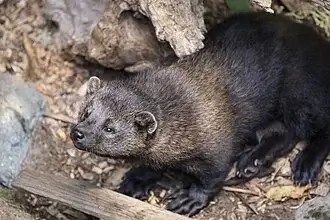
The fisher (Pekania pennanti) is a carnivorous mammal native to North America, a forest-dwelling creature whose range covers much of the boreal forest in Canada to the northern United States. It is a member of the mustelid family and is the only living member of the genus Pekania. It is sometimes referred to as a fisher cat, although it is not a cat. The fisher is similar to, but larger than, the American marten (Martes americana) and Pacific marten (Martes caurina). In some regions, the fisher is known as a pekan, derived from its name in the Abenaki language, or wejack, an Algonquian word (cf. Cree ocêk, Ojibwa ojiig) borrowed by fur traders. Other Native American names for the fisher are Chipewyan thacho and Carrier chunihcho, both meaning "big marten", and Wabanaki uskool. Fishers have few predators besides humans. They have been trapped since the 18th century for their fur. Their pelts were in such demand that they became locally extinct in several parts of the United States in the early part of the 20th century. Conservation and protection measures have allowed the species to rebound, but their current range is still reduced from its historical limits. In the 1920s, when pelt prices were high, some fur farmers attempted to raise fishers. However, their unusual delayed reproduction made breeding difficult. When pelt prices fell in the late 1940s, most fisher farming ended. While fishers usually avoid human contact, encroachments into forest habitats have resulted in some conflicts. Male and female fishers look similar, but can be differentiated by size, with males being up to twice as large as the females. The fur of the fisher varies seasonally, being denser and glossier in the winter. During the summer, the color becomes more mottled, as the fur goes through a moulting cycle. The fisher prefers to hunt in the full forest. Although an agile climber, it spends most of its time on the forest floor, where it prefers to forage around fallen trees. An omnivore, it
Habitat & Range
Although fishers are competent tree climbers, they spend most of their time on the forest floor and prefer continuous forest to other habitats. They have been found in extensive conifer forests typical of the boreal forest, but are also common in mixed-hardwood and conifer forests. Fishers prefer areas with continuous overhead cover with greater than 80% coverage and avoid areas with less than 50% coverage. Fishers are more likely to be found in old-growth forests. Since female fishers require moderately large trees for denning, forests that have been heavily logged and have extensive second growth appear to be unsuitable for their needs. Fishers also select for forest floors with large amounts of coarse woody debris. In western forests, where fire regularly removes understory debris, fishers show a preference for riparian woodland habitat. Fishers tend to avoid areas with deep snow. Habitat is also affected by snow compaction and moisture content.
Life History
The female fisher begins to breed at about one year of age and her reproductive cycle is an almost year-long event. Mating takes place in late March to early April. Blastocyst implantation is then delayed for ten months until mid-February of the following year when active pregnancy begins. After gestating for about 50 days, the female gives birth to one to four kits. The female then enters estrus 7–10 days later and the breeding cycle begins again. Females den in hollow trees. Kits are born blind, helpless, and are partially covered with fine hair. Kits begin to crawl after about three weeks. After about seven weeks, they open their eyes. They start to climb after eight weeks. Kits are completely dependent on their mother's milk for the first eight to ten weeks, after which they begin to switch to a solid diet. After four months, kits become intolerant of their litter mates, and at five months, the mother pushes them out on their own. After one year, juveniles will have established their own range.
Hunting Season
Trapping: Dec 19 - Jan 10 (WMUs 1B, 2C-2G, 3A-3D, 4A-4E).
License & Regulations
A valid Pennsylvania hunting license is required for all resident and non-resident hunters age 16 and older. Hunters under 16 may hunt while accompanied by a licensed adult or with a mentored youth permit. Licenses can be purchased online through the Pennsylvania Game Commission website (HuntFishPA) or at authorized issuing agents. Additional stamps may be required: furtaker license for trapping, federal Migratory Bird Hunting and Conservation Stamp (Duck Stamp) for waterfowl, HIP registration for migratory birds, and special permits for elk, bobcat, fisher, and river otter. All hunters born after June 1, 1965 must successfully complete a hunter-trapper education course before purchasing a license.
Frequently Asked Questions
Regulations for hunting Fisher in Pennsylvania
Fisher trapping in Pennsylvania is a limited-permit season. One fisher per year with a valid permit. Available in select WMUs across north-central and eastern Pennsylvania. Fishers were reintroduced to Pennsylvania in the 1990s and their population has expanded significantly.
When is Fisher hunting season in Pennsylvania?
The Fisher hunting season in Pennsylvania: Trapping: Dec 19 - Jan 10 (WMUs 1B, 2C-2G, 3A-3D, 4A-4E).
What is the bag limit for Fisher in Pennsylvania?
The bag limit for Fisher in Pennsylvania is: 1 per year (permit required).
What's another name for Fisher?
Fisher is also known as Fisher cat, Pennant's marten in Pennsylvania.
How did fisher get reintroduced to Pennsylvania?
Fishers were reintroduced to Pennsylvania in the 1990s through a successful translocation program. The population has expanded significantly and now supports a limited trapping season in select WMUs.
How to identify Fisher?
The fisher (Pekania pennanti) is a carnivorous mammal native to North America, a forest-dwelling creature whose range covers much of the boreal forest in Canada to the northern United States. It is a member of the mustelid family and is the only living member of the genus Pekania. It is sometimes referred to as a fisher cat, although it is not a cat. The fisher is similar to, but larger than, the American marten (Martes americana) and Pacific marten (Martes caurina). In some regions, the fisher ...
References
| State | Category | Directory | Subcategory | Content | Source |
|---|---|---|---|---|---|
| Pennsylvania | Hunting | Regulations | Season Dates | Trapping: Dec 19 - Jan 10 (WMUs 1B, 2C-2G, 3A-3D, 4A-4E). | Link |
| Pennsylvania | Hunting | License | License & Fees | A valid Pennsylvania hunting license is required for all resident and non-resident hunters age 16 and older. Hunters und | Link |
| Pennsylvania | Hunting | Regulations | Regulations | Fisher trapping in Pennsylvania is a limited-permit season. One fisher per year with a valid permit. Available in select | Link |