Also known as: Partridge (colloquial)
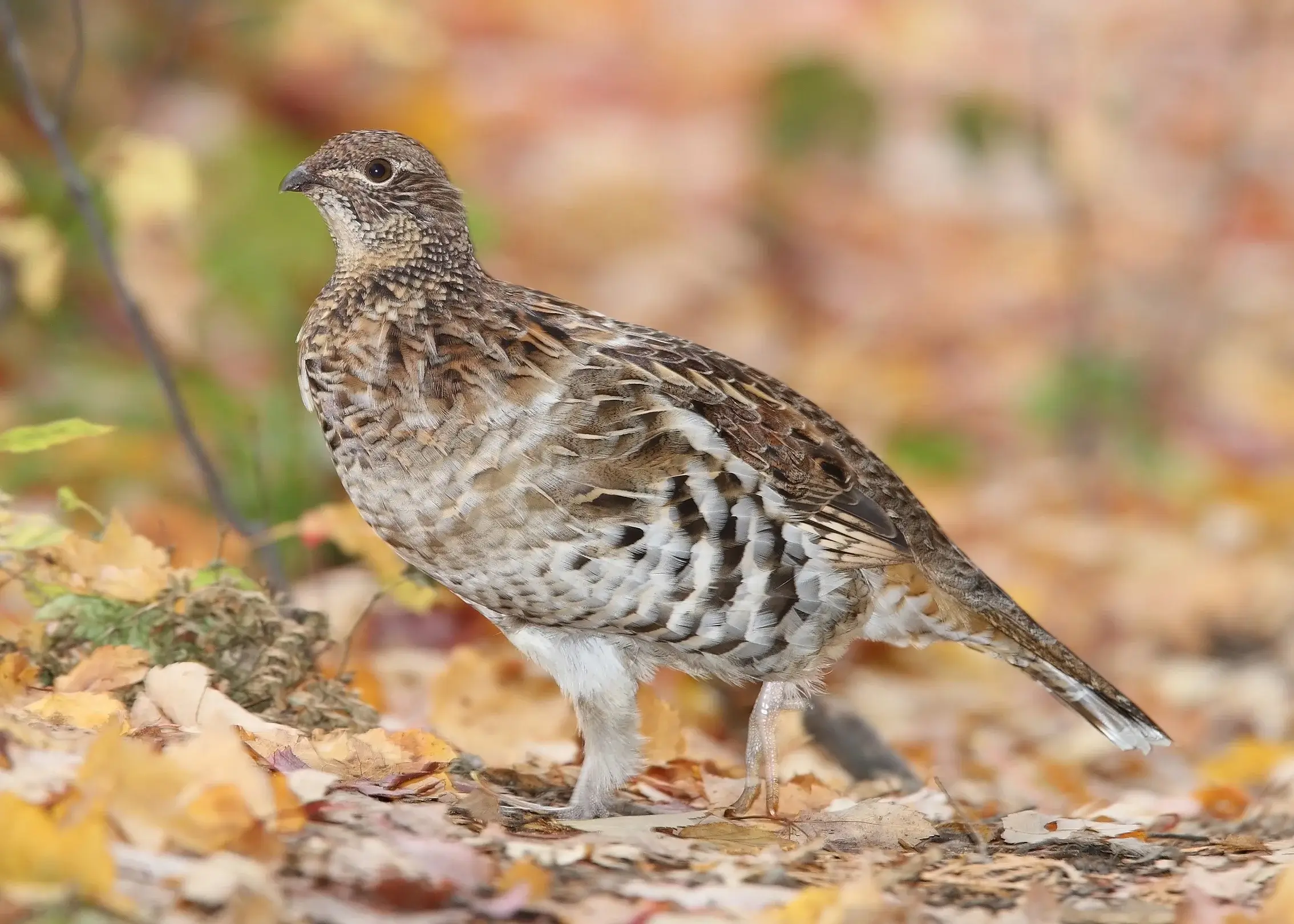
The ruffed grouse (Bonasa umbellus) is a medium-sized grouse occurring in forests from the Appalachian Mountains across Canada to Alaska. It is the most widely distributed game bird in North America. It is not migratory. It is the only species in the genus Bonasa. The ruffed grouse is sometimes incorrectly referred to as a "partridge", an unrelated phasianid, and occasionally confused with the grey partridge, a bird of open areas rather than woodlands. The ruffed grouse is the state game bird of Pennsylvania, United States.
Life History
Like most grouse, they spend most of their time on the ground; mixed woodland rich in aspen seems to be particularly well-liked. These birds forage on the ground or in trees. They are omnivores, eating buds, leaves, berries, seeds, and insects. According to nature writer Don L. Johnson: More than any other characteristic, it is the ruffed grouse's ability to thrive on a wide range of foods that has allowed it to adapt to such a wide and varied range of habitat on this continent. A complete menu of grouse fare might itself fill a book. One grouse crop yielded a live salamander in a salad of watercress. Another contained a small snake. The ruffed grouse differs from other grouse species in its courtship display. The ruffed grouse relies entirely on a nonvocal, acoustic display, known as drumming, unlike other grouse species. The drumming itself is a rapid, wing-beating display that creates a low-frequency sound, starting slow and speeding up (thump ... thump ... thump..thump-thump-thump-thump). Even in thick woods, this can be heard for a quarter-mile (400 m) or more. The ruffed grouse spends most of its time quietly on the ground, and when surprised, may explode into flight, beating its wings very loudly. It will burrow into the snow for warmth in the winter and may suddenly burst out of the snow when approached too closely. The male grouse proclaims his territory by engaging in a "drumming" display. This sound is made by beating his wings against the air to create a vacuum. It usually stands on a log, stone, or mound of soil when drumming. It does not strike the log to make the noise, it only uses the "drumming log" as a sort of stage. The ruffed grouse population has a cycle, and follows the cycle no matter how much or how little hunting occurs. The cycle has puzzled scientists for years, and is simply referred to as the "grouse cycle". In spite of this historical cycle, populations have been declining in Pennsylvania and management plans adopted. Habitat loss has been a concern for the species, but the introduction of the West Nile virus has been seen to be further increasing mortality.
Hunting Season
Oct 17 - Dec 24.
License & Regulations
A valid Pennsylvania hunting license is required for all resident and non-resident hunters age 16 and older. Hunters under 16 may hunt while accompanied by a licensed adult or with a mentored youth permit. Licenses can be purchased online through the Pennsylvania Game Commission website (HuntFishPA) or at authorized issuing agents. Additional stamps may be required: furtaker license for trapping, federal Migratory Bird Hunting and Conservation Stamp (Duck Stamp) for waterfowl, HIP registration for migratory birds, and special permits for elk, bobcat, fisher, and river otter. All hunters born after June 1, 1965 must successfully complete a hunter-trapper education course before purchasing a license.
Frequently Asked Questions
Regulations for hunting Ruffed Grouse in Pennsylvania
Ruffed grouse season runs from mid-October through December 24. Daily bag limit is 2 birds, with a 6-bird possession limit. Grouse populations in Pennsylvania are cyclical and benefit from young forest habitat. Hunters should focus on regenerating timber cuts and dense understory cover.
When is Ruffed Grouse hunting season in Pennsylvania?
The Ruffed Grouse hunting season in Pennsylvania: Oct 17 - Dec 24.
What is the bag limit for Ruffed Grouse in Pennsylvania?
The bag limit for Ruffed Grouse in Pennsylvania is: 2 per day, 6 possession.
What's another name for Ruffed Grouse?
Ruffed Grouse is also known as Partridge (colloquial) in Pennsylvania.
What habitat do ruffed grouse prefer in Pennsylvania?
Ruffed grouse in Pennsylvania favor young, regenerating forests with dense understory cover. They are especially abundant in areas with aspen, birch, and mixed hardwood stands. Their populations follow a cyclical pattern.
How to identify Ruffed Grouse?
The ruffed grouse (Bonasa umbellus) is a medium-sized grouse occurring in forests from the Appalachian Mountains across Canada to Alaska. It is the most widely distributed game bird in North America. It is not migratory. It is the only species in the genus Bonasa. The ruffed grouse is sometimes incorrectly referred to as a "partridge", an unrelated phasianid, and occasionally confused with the grey partridge, a bird of open areas rather than woodlands. The ruffed grouse is the state game bird of...
References
| State | Category | Directory | Subcategory | Content | Source |
|---|---|---|---|---|---|
| Pennsylvania | Hunting | Regulations | Season Dates | Oct 17 - Dec 24. | Link |
| Pennsylvania | Hunting | License | License & Fees | A valid Pennsylvania hunting license is required for all resident and non-resident hunters age 16 and older. Hunters und | Link |
| Pennsylvania | Hunting | Regulations | Regulations | Ruffed grouse season runs from mid-October through December 24. Daily bag limit is 2 birds, with a 6-bird possession lim | Link |